
YiMatrix · Academy Journal
The Three Divination Methods of Takashima Donsho: Evolution from the Dayan Method to Simplified Techniques
Japanese I Ching master Takashima Donsho employed three divination methods throughout his life, evolving from the 18 step Dayan method to a three step abbreviated method, and final
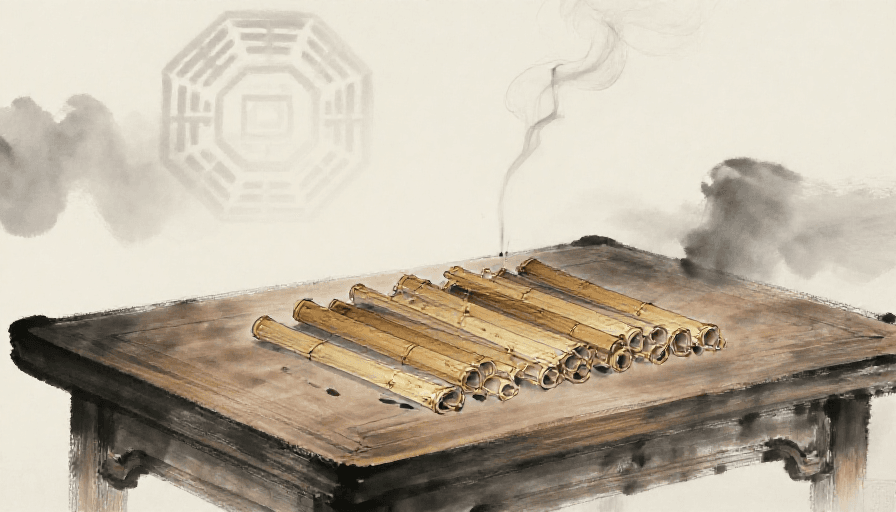
From 18 operations to three draws, the evolution of a master's divination methods throughout his life unveils the essence of spiritual practice.
Those who study the I Ching have likely heard of Takashima Donsho.
He was a prominent I Ching scholar of Japan's Meiji era, author of the influential work "Takashima's I Ching Divination," which has had a lasting impact on I Ching studies in both China and Japan. Shang Binghe, a renowned I Ching master of the late Qing and early Republican period, introduced his methods in "Ancient Divination Studies of the Zhouyi" with high praise.
But today, I won't discuss his divination skills; instead, I'll explore something more intriguing: He used three divination methods in his lifetime, ranging from the most complex to the simplest, with a vast span of variation.
This evolution itself is worth pondering.
The First Method: Dayan Divination—Most Orthodox, Most Laborious
In his early years, Takashima Donsho used the Dayan method, also known as yarrow stalk divination. "Takashima's I Ching Divination" even includes a rare old photo of him performing divination with yarrow stalks.
Since yarrow stalks were hard to find in Japan, he actually used bamboo sticks or wooden chopsticks, but the procedure strictly followed ancient traditions.
How does the Dayan method work? In short, it involves four steps: dividing into two, setting aside one, counting by fours, and gathering remainders.
First, prepare 50 short sticks. Why 50? Because the "Xici" (Appended Remarks) states, "The number of the great expansion is fifty, but only forty-nine are used." One stick is set aside to represent the Supreme Ultimate (Taiji), leaving 49 sticks for the actual operation.
Then begins the process of "three changes" to determine one line:
First Change—Randomly divide the 49 sticks into two piles (this is "dividing into two," symbolizing the two primal forces of heaven and earth); take one stick from one pile and set it aside separately (this is "setting aside one," symbolizing humanity and marking the change number); then count each pile in groups of four (this is "counting by fours," symbolizing the four seasons); finally, gather the remainders of 1 to 4 sticks from each pile together (this is "gathering remainders," symbolizing the intercalary month).
After the first change, the total remainders from both piles are 4 or 8 sticks, plus the one set aside, making a total of 5 or 9 sticks removed.
Second Change—Take the remaining 44 or 40 sticks and repeat "dividing into two, setting aside one, counting by fours, gathering remainders." After the second change, 40, 36, or 32 sticks remain.
Third Change—Repeat the process with the remaining sticks. After the third change, 36, 32, 28, or 24 sticks remain, grouped in fours to correspond to the numbers 9, 8, 7, or 6.
This number determines the nature of the line: 7 is young yang, 9 is old yang, both drawn as a solid line "—"; 8 is young yin, 6 is old yin, both drawn as a broken line "- -". Old yang and old yin are changing lines, crucial in divination interpretation. After calculating one line, it is recorded as "Chu Jiu" (first nine) or "Chu Liu" (first six), etc. (the first character indicates the line position, the second indicates the yin-yang and age of the line).
The key point is that this only yields one line.
A hexagram has six lines, from bottom to top: the first, second, third, fourth, fifth, and top lines. Each line requires three changes, so completing a hexagram involves a total of 18 operations.
Each operation requires recombining the 49 sticks, redividing, and recounting.
Honestly, this process is very time-consuming. But ancient practitioners believed that such elaborate ritualistic procedures helped diviners enter a state of "utmost sincerity," focusing their minds to perceive heavenly insights without distraction.
The Second Method: Abbreviated Divination—Three Steps to Determine a Hexagram
In his middle period, Takashima Donsho began using a simplified method called "abbreviated divination."
The tools remained the same: 50 bamboo sticks, with one set aside for the Supreme Ultimate, using 49 sticks. But the procedure was greatly streamlined, reduced from 18 operations to three.
How does it work?
Step 1: Obtain the upper trigram. After the querent silently prays with a calm mind, randomly divide the 49 sticks into two piles. For men, take the number of sticks in the left pile, divide by 8, and use the remainder to correspond to a trigram based on the Early Heaven sequence (Qian 1, Dui 2, Li 3, Zhen 4, Xun 5, Kan 6, Gen 7, Kun 8). If less than 8, use that number directly. If divisible by 8, count it as 8, i.e., Kun trigram. This yields the upper trigram.
Step 2: Obtain the lower trigram. Recombine the 49 sticks and divide again. For men, take the number of sticks in the right pile, divide by 8, and the remainder gives the lower trigram. Similarly, if divisible by 8, count as 8.
Step 3: Obtain the moving line. Recombine the 49 sticks and divide once more. For men, take the number of sticks in the left pile, divide by 6, and the remainder indicates the position of the moving line (1 corresponds to the first line, 6 to the top line). If divisible by 6, count as 6.
With these three steps, the hexagram is determined.
There's a point here that can be confusing and deserves special mention.
The abbreviated method yields "the upper trigram first, then the lower trigram." The first number corresponds to the upper trigram, the second to the lower trigram.
The issue is that a Taiwanese I Ching scholar, when introducing this method, treated the first number as the lower trigram. His reasoning was that traditional hexagram construction proceeds from bottom to top, so the first number should be the lower trigram.
This confuses two different concepts. The line construction order indeed goes from bottom to top (first line, second line, third line...), but that's in the Dayan method, where lines are calculated one by one, so the first calculated is naturally the first line (at the bottom).
The abbreviated method is different; it directly yields a "trigram" (a basic three-line unit), not line by line. In this case, the first obtained is the upper trigram, the second the lower trigram. This aligns with the Early Heaven method of Plum Blossom I Ching divination.
Another detail: For men, the first number from the left hand gives the upper trigram, the second from the right hand gives the lower trigram; for women, the first from the right hand gives the upper trigram, the second from the left hand gives the lower trigram. For the moving line, men use the left hand, women the right hand. In short, regardless of gender, the first number yields the upper trigram, with only the hands swapped.
The Third Method: Simplified Method—The Path of Ultimate Simplicity in Later Years
In his later years, Takashima Donsho used an even more minimalist method in his "Shenyi Hall."
The tools changed. Instead of 49 bamboo sticks, he used two bamboo tubes with 14 sticks:
- Tube A: Contains 8 bamboo sticks, each engraved with one of the trigrams: Qian, Dui, Li, Zhen, Xun, Kan, Gen, Kun.
- Tube B: Contains 6 bamboo sticks, each engraved with a line position: first line, second line, third line, fourth line, fifth line, sixth line.
The operation is simpler:
- The querent silently prays with a calm mind.
- For men, draw one stick from the trigram tube with the left hand—upper trigram.
- Draw another stick from the trigram tube with the right hand—lower trigram.
- Draw one stick from the line tube with the left hand—moving line.
- For women, reverse the hands (right hand draws upper trigram, left hand draws lower trigram, right hand draws moving line).
Three draws determine the hexagram, clean and efficient. After the hexagram is set, interpret the auspiciousness or inauspiciousness based on the obtained line text.
From 49 sticks operated 18 times, to 49 sticks operated 3 times, to 14 engraved sticks drawn 3 times.
This simplification process is not laziness; it's evolution.
A Side Note: How Does Rice Divination Relate to These Methods?
Readers might ask: How does the rice divination method I usually use (grabbing rice to determine a hexagram) compare with Takashima's methods?
The rice divination operation involves: grabbing rice three times, placing it in three separate piles. Divide the number of grains in the first pile by 8 to get the lower trigram, the second by 8 to get the upper trigram, and the third by 6 to get the moving line.
Note: Rice divination uses the first number for the lower trigram, the second for the upper trigram.
Whereas Takashima's abbreviated and simplified methods use the first number for the upper trigram, the second for the lower trigram.
The order is exactly reversed.
Where does this difference come from?
Rice divination and number-based divination logic imitate the line construction order of the Dayan method—from bottom to top, so the first number is placed at the bottom.
Takashima's abbreviated method aligns with the Early Heaven method of Plum Blossom I Ching divination—directly obtaining trigrams, with the first placed on top.
Organizing this into a table makes it clear:
| Method | First Number | Second Number | Origin |
|---|---|---|---|
| Rice Divination/Number Divination | Lower Trigram | Upper Trigram | Imitates Dayan method line construction order |
| Plum Blossom I Ching Early Heaven Method | Upper Trigram | Lower Trigram | Early Heaven sequence |
| Takashima's Abbreviated/Simplified Method | Upper Trigram | Lower Trigram | Consistent with Plum Blossom I Ching |
Thus, these methods share a common mathematical principle for hexagram determination (all use remainders to set the hexagram), but the order of using upper and lower trigrams follows different traditions. When using them, simply adhere to their respective rules.
From Complexity to Simplicity: What Lies Behind It?
I find the evolution of Takashima Donsho's divination methods throughout his life deeply thought-provoking.
Using the Dayan method early on was about respecting tradition and building a foundation. Though the 18 operations were cumbersome, each step held symbolic meanings of heaven, earth, and humanity, and each division and recombination helped one enter a state of utmost sincerity. For beginners, this ritualistic aspect cultivates a heart of reverence.
Using the abbreviated method in his middle period was a reasonable simplification after understanding the principles. The core of "random division, remainder-based hexagram determination" was retained, while repetitive rituals were removed. Efficiency improved, but the essence remained.
Using the simplified method in his later years was about reaching a level of mastery where all methods return to simplicity. At that stage, tools are merely mediums; what matters is the sincerity of intention. With three draws, the hexagram is simply there.
As the ancients said: "The I Ching is without thought, without action, quiescent and unmoving; yet when stimulated, it penetrates all affairs under heaven." The progression from complexity to simplicity is essentially an enhancement of the ability to "perceive and connect."
Therefore, if you're just starting out, don't dismiss the Dayan method as troublesome; diligently learn from the complex beginning. Once you have mastered the principles, hexagram images, and line texts, you'll naturally find a simplified method that suits you.
From complexity to simplicity is not about skipping, but about traversing the path.
What method do you usually use for divination? Feel free to share in the comments.