
YiMatrix · Academy Journal
The Same Dragon: Soaring Dragon and Regretful Dragon — The I Ching Only Moved It Up One Position
The Same Dragon: Soaring Dragon and Regretful Dragon — The I Ching Only Moved It Up One Position What it cares about is never "Are you a dragon?" but "Which line are you on?" The Q
What it cares about is never "Are you a dragon?" but "Which line are you on?"
The Qian hexagram tells the story of a dragon from beginning to end.
The fifth line, "Flying dragon in the sky" — the dragon soars into the sky, its most glorious moment. One line above, the sixth line, is "Arrogant dragon will have cause to repent" — the same dragon, moved up just one position, becomes regretful.
This is the same dragon. The same upward momentum. The I Ching didn't change the protagonist; it only moved it up one notch, yet the evaluation flipped entirely: one is the peak, the other is regret.
You've probably memorized these two phrases, but rarely stopped to think: Why does the same dragon have opposite outcomes?
The answer lies in two words: one is "position" (位), the other is "timing" (时). Throughout the I Ching, right and wrong are defined by these two words.
Let me break this down for you, layer by layer.
1. First, "Position" — The Six Lines Are Six Positions, Not Six Numbers
A hexagram has six lines, counted from bottom to top, one to six.
Many first-time readers see these six lines as six numbers or six steps. Actually, they are six positions — stacked from the lowest layer to the highest.
Think of a familiar scenario: The bottom line is a newcomer; above that, a core member; the fifth line near the top is the decision-maker; the top sixth line is someone who has stepped back from leadership. The same line, placed at different heights, means something entirely different.
The key is this: The position defines what is appropriate at that level.
The same forward-charging action, placed at the bottom line, is rash — because that position isn't meant to charge; placed at the fifth line, it is proper — because that position is meant to move forward. The action hasn't changed; only its position has. When the position changes, the standard of "right" changes accordingly.
The six lines are not six numbers; they are six positions. The same action, in a different position, shifts from appropriate to rash — the position defines what is "right."
You have a ready example at hand. Recall: Have you ever done something that was neither right nor wrong in itself, but when done at a different time or place, the outcome was completely different? The same words, said at a dinner table, are lively; said in a meeting, are offensive. The same decision, made three months earlier, is foresight; three months later, is following the trend.
You don't need to judge it immediately. Just notice this: Often, what determines whether something is "right" is not the thing itself.
The I Ching, over two thousand years ago, embedded this into the positions of the lines.
2. Next, "Timing" — Another Coordinate of Right and Wrong
If "position" governs spatial height, then "timing" governs temporal sequence.
The six lines from bottom to top can also be read as six stages of an event: emerging, appearing, intensifying, deciding whether to advance further, reaching the peak, and going too far. Each line is a node on the timeline of the event.
There is a hexagram in the I Ching specifically about "stopping," called Gen. Gen is a mountain, which is still. Logically, this hexagram should say "stopping is right." But it doesn't. The Commentary on the Decision for Gen says:
"When it is time to stop, stop; when it is time to act, act. In motion or stillness, do not miss the right time, and the path will be bright."
In plain language: Stop when it's time to stop; go when it's time to go. Whether moving or still, don't miss the timing, and the path will be clear.
Notice the nuance. It doesn't say "stopping is right" or "going is right." It says: Whether stopping is right depends on whether it is "time to stop" — whether the moment for stopping has arrived. Whether going is right depends on whether it is "time to go." The same "stop" is appropriate at the right time but a missed opportunity at the wrong time.
Right and wrong are not in the action of "stopping" but in the "timing."
Now look back at the dragon, and it makes sense. The dragon soars because it is time to fly — this is "when it is time to act, act." The dragon soars too far and becomes arrogant because the time has reached its end, but it didn't stop. The Commentary on the Words for "Arrogant dragon will have cause to repent" says: "It reaches the extreme together with the time" — it follows the trend to its utmost limit.
It's not that the dragon suddenly turned bad. It's that the "timing" changed, and the dragon didn't change with it.
What's most intriguing about this arrogant dragon is that it is judged by both "position" and "timing" for the same thing. Spatially, it climbed too far, moving from the fifth line to the top line — it is out of position. Temporally, it went too far; the trend has reached its peak, but it didn't stop — it "reaches the extreme together with the time." Being out of position and out of time are two sides of the same coin for this dragon: reaching the top in position means reaching the end in time. Position and timing are never two separate rulers; they are two expressions of the same "excess."
3. When in Position vs. Out of Position — Why Evaluations Reverse
Now we can dissect the dragon to the finest detail.
The I Ching assigns parity to the six positions: the first, third, and fifth are yang positions; the second, fourth, and sixth are yin positions. Lines are also yin or yang — a yang line is solid, a yin line is broken. A yang line falling exactly on a yang position is called "in position" (当位), also "correct" (得正). If it falls on a yin position, it is "out of position" (失位), also "incorrect" (不正).
Now apply this to the dragon's two lines.
Fifth line "Flying dragon in the sky": a yang line at the fifth position, which is yang — in position. Moreover, the fifth position is the center of the upper trigram, so it is both in the correct position and in the center — this is called "central and correct" (中正), the most stable structure among the six lines. Hence, this line is the flying dragon.
Sixth line "Arrogant dragon will have cause to repent": still the same yang line, moved up one notch to the sixth position, which is yin — out of position. The Commentary on the Words for these two lines says: one is "occupying the position of heavenly virtue" (乃位乎天德), standing in the correct position of heavenly virtue; the other is "reaching the extreme together with the time" (与时偕极), following the trend to its end.
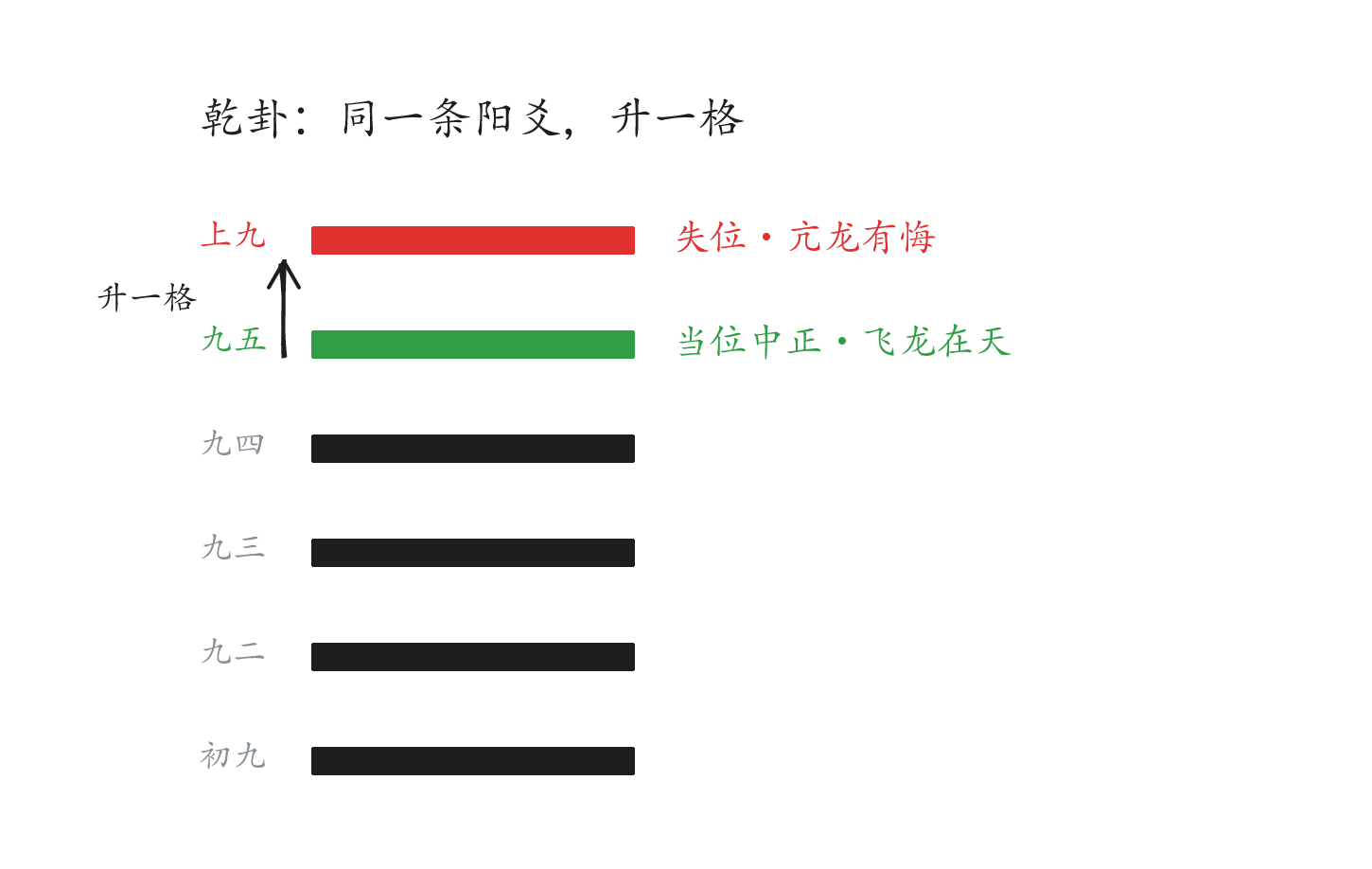
Do you see it? The same yang line, the same momentum, moved up just one notch — the position changed from "correct" to "incorrect," and the evaluation flipped from "flying" to "arrogant."
The flying dragon and the arrogant dragon are the same dragon with the same momentum; the only difference is a one-notch change in position — yet whether a line is "correct" or "excessive" is never determined by the line itself, but by the timing and position it occupies.
This is not about the dragon's fortune; it's about the structure of the system. The I Ching doesn't secretly tell you "which line is good or bad"; it tells you something more sobering: Right and wrong are conditional, and the conditions are two words — timing and position.
One dragon is a single-point proof, but the I Ching wasn't satisfied. At the very end of the book, it pushed "position" to its extreme, leaving a textbook pair of examples.
Among the sixty-four hexagrams, one hexagram has all six lines in position — every yin and yang line falls exactly where it should, with no misplacement anywhere. This is unique among the sixty-four. Its name is "Jiji" (既济), meaning "already completed" or "the river has been crossed."
The very next hexagram is the opposite — all six lines out of position, every line in the wrong place, with no correct placement. It is also unique among the sixty-four. Its name is "Weiji" (未济), meaning "not yet completed" or "the river has not been crossed."
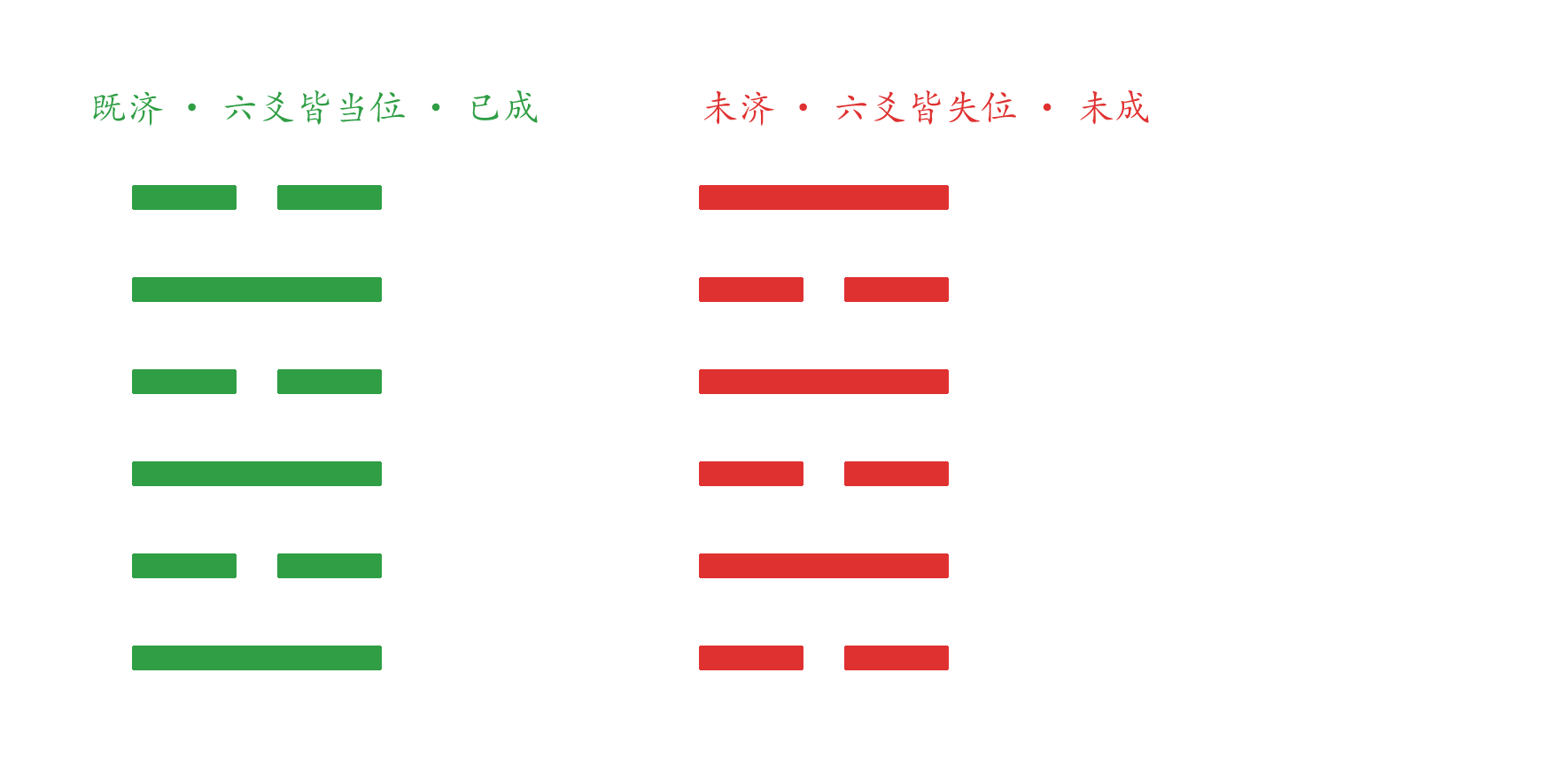
Consider this correspondence. One hexagram is called "already completed," and all its lines are in position; the other is called "not yet completed," and all its lines are out of position. Completion and non-completion correspond exactly to the correctness of positions — this is no coincidence. The I Ching designed the last two hexagrams as a textbook pair. It tells you in the final two pages: What we call success is everything in its proper place; what we call failure is things out of place.
Today, when we tackle a tricky problem, the first thing we do instinctively is the same: first look up to see the current situation and what cards we hold, then judge how to proceed correctly. Right and wrong depend on premises — this is a realization anyone who truly engages with a matter will eventually reach. The I Ching wrote this ahead of time in its sixty-four hexagrams.
Ancient people didn't have the phrase "absolutely correct."
But if you read this book, you'll find it saw through something earlier than anyone: There is no floating, universal absolute answer. The same dragon, the same words, the same action — change the timing and position, and right and wrong flip. It doesn't give you standard answers; it gives you two coordinates — timing and position.
This is not to say the ancients invented some modern wisdom, nor that "our ancestors were first, others come later." The truth is simpler: When a person seriously observes the world, they will inevitably encounter the same thing — right and wrong are never absolute; they depend on where you stand in time and space. The East wrote this into the positions of the lines.
The Commentary on the Words left a sentence for the arrogant dragon: "One who knows the timing of advance and retreat, survival and perishing, without losing correctness — is that not only the sage?" — Only a sage can see clearly the timing of advance and retreat, survival and perishing, and never deviate from the right path. The real difficulty of this sentence is not in "advance and retreat, survival and perishing" but in the word "timing": The hard part is never judging right from wrong; it's first seeing clearly what time it is and which line you stand on.
Ancient people didn't have the phrase "absolutely correct," but they saw through its non-existence earlier than anyone.
The real difficulty is never judging right from wrong; it's first seeing clearly which line you stand on — and no one can do that for you.