
YiMatrix · Academy Journal
The Heavenly Stems and Earthly Branches Are Not Zodiac Signs; They Are a Sexagesimal Time Encoding System
The Heavenly Stems and Earthly Branches Are Not Zodiac Signs; They Are a Sexagesimal Time Encoding System. Before you read on, answer me this:
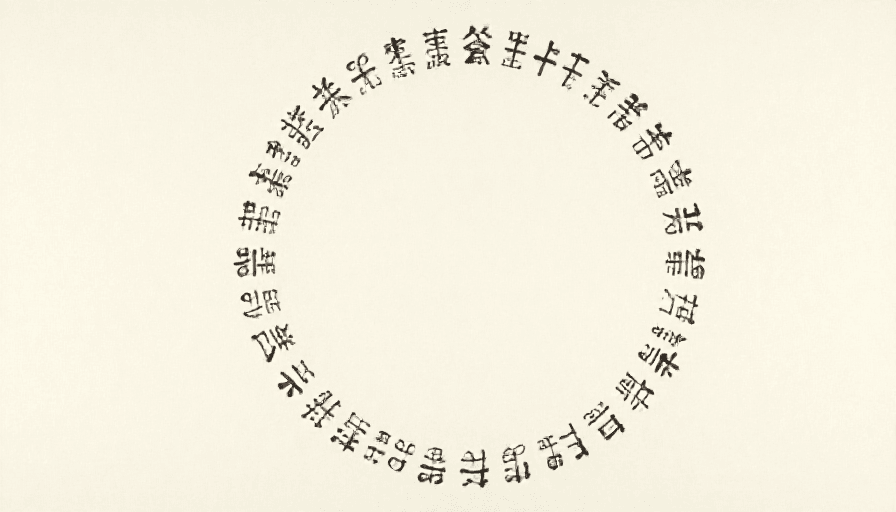
Before you read on, answer me this: What is your Chinese zodiac sign?
Rat, Ox, Tiger, Rabbit—you probably blurted out the answer in a second.
That answer, you thought, was the Heavenly Stems and Earthly Branches (Ganzhi).
Wrong. What you gave is just the outer layer of Ganzhi.
The zodiac is merely a garment worn by Ganzhi. Take off this garment, and inside lies a time coordinate system that has been running for thousands of years.
Rat, Ox, Tiger, Rabbit; Jia, Yi, Bing, Ding—most people stuff these characters into the drawer labeled "zodiac" or "almanac," shut it, and never think again. But its true form is entirely different from what you imagine.
It is not a set of auspicious symbols. It is a coordinate system for addressing time—and, moreover, a sexagesimal one.
Let me peel this apart layer by layer. By the end, you'll see that the twelve zodiac animals you've known since childhood are just the tip of the iceberg.
1. First, a Calculation: Why Sixty?
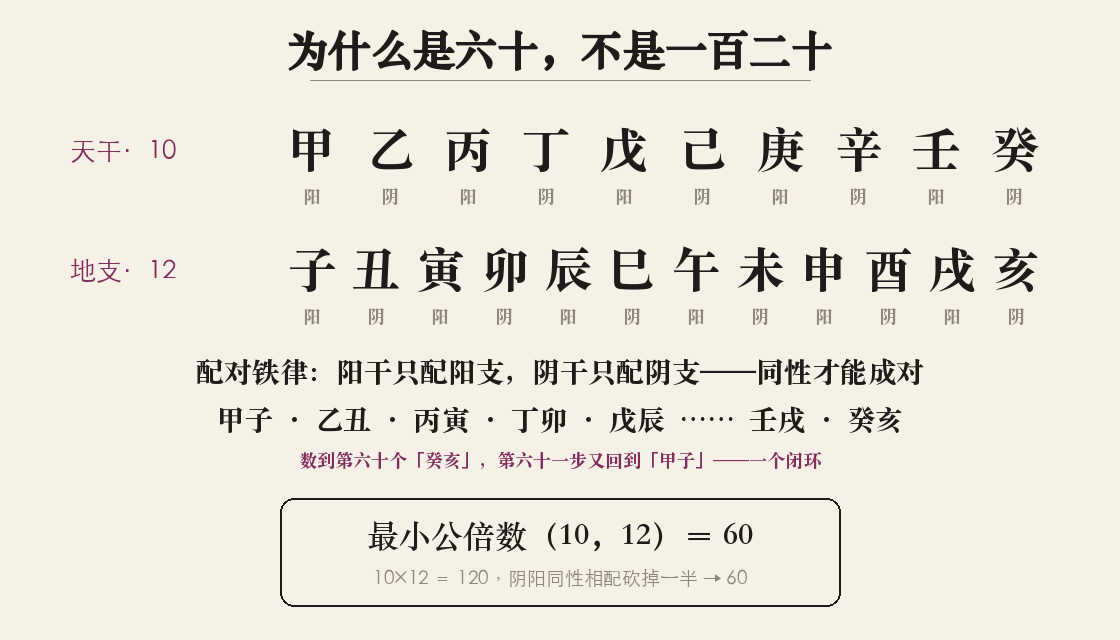
The Heavenly Stems are ten: Jia, Yi, Bing, Ding, Wu, Ji, Geng, Xin, Ren, Gui.
The Earthly Branches are twelve: Zi, Chou, Yin, Mao, Chen, Si, Wu, Wei, Shen, You, Xu, Hai.
The rule is simple: pair one Heavenly Stem with one Earthly Branch, going down the list: Jia-Zi, Yi-Chou, Bing-Yin, Ding-Mao... and so on.
So here's the question: At which pairing do we return to "Jia-Zi"?
You might blurt out: Ten and twelve, that's one hundred and twenty.
No. The answer is sixty.
Because the least common multiple of ten and twelve is sixty. The Heavenly Stems cycle six times and the Earthly Branches cycle five times, and they return to the starting point simultaneously, not a second off. That's the origin of the old saying "sixty years make a Jia-Zi cycle"—it's not a convention, but a calculated result.
But why sixty, not one hundred and twenty (ten times twelve)?
Here lies a rule many overlook: the pairing is not arbitrary; it follows "like pairs with like." The Heavenly Stems are divided into Yin and Yang—Jia, Bing, Wu, Geng, Ren are Yang; Yi, Ding, Ji, Xin, Gui are Yin. Similarly, the Earthly Branches have Yin and Yang—Zi, Yin, Chen, Wu, Shen, Xu are Yang; Chou, Mao, Si, Wei, You, Hai are Yin.
The rule is: Yang stems can only pair with Yang branches, and Yin stems only with Yin branches.
Thus, Jia (Yang) can only pair with the six Yang branches, and Yi (Yin) only with the six Yin branches. Each stem pairs with six branches, and ten stems times six equals sixty. The other half—Yang with Yin and Yin with Yang—is excluded from the start. Half of one hundred and twenty vanishes.
So the "sixty" of the sixty Jia-Zi cycle is not a lucky number pulled out of thin air. It is the precise result of the numbers ten and twelve, combined with a parity rule, converging to a unique outcome.
2. It Encodes Not Just Years, But Every Layer of Time
If Ganzhi were only used for year counting, it wouldn't qualify as a "system."
What's truly impressive is that it encodes not just years, but months, days, and hours—each layer of time has its own set of Ganzhi.
One set for a year: This year is Bing-Wu year.
One set for a month: Each of the twelve months has its own exclusive set.
One set for a day: Starting from a certain Jia-Zi day, count day by day.
One set for a two-hour period (shichen): A day is divided into twelve shichen, each with its own set.
So when ancient people recorded the moment of a person's birth, they didn't write "11 PM on a certain day in May 2026." They wrote four sets of Ganzhi—for the year, month, day, and hour.
Four sets, each with two characters, totaling eight characters.
This is the "Four Pillars," commonly known as the "Eight Characters" (Bazi), often mystified by the public.
Bazi is not a code of fate; it is a coordinate reading of a moment—ancient people addressed time.
Think of it like latitude and longitude. To pinpoint a location on Earth, you need four numbers: latitude, longitude, altitude, and optionally time. To pinpoint a moment, ancient people used four axes—Year Pillar, Month Pillar, Day Pillar, Hour Pillar—crossing to uniquely mark "this very moment" on the grid of time.
(One note to avoid nitpicking: The Month Pillar is not based on lunar phases but on solar terms, like Start of Spring and Awakening of Insects, which do not align with the lunar calendar's first and fifteenth days. That's another topic for another time.)
The Four Pillars and Eight Characters later acquired many additional uses, obscuring their original form. But at their core, they are a reading of time—ancient people, lacking clocks, assigned a serial number to every moment.
3. Placing It Today: A Cyclic Code
I first realized what Ganzhi was while coding.
Programmers are familiar with Unix timestamps. Starting from midnight on January 1, 1970, counting second by second, today it's around 1.7 billion. It's a straight line moving forward, never returning, ever increasing, with no end.
Almost all "time" in the modern world is fundamentally such a line.
But ancient Ganzhi is not a line at all.
It is a circle. Sixty years complete a cycle, returning to Jia-Zi; sixty days complete a cycle, returning to Jia-Zi day; sixty shichen—that is, five days—complete a cycle, returning to Jia-Zi shichen. Each layer cycles, resetting to zero after sixty.
Timestamps stretch time into a straight line; Ganzhi rolls time into a circle. One keeps counting to 1.7 billion and beyond; the other resets to zero at sixty.
Behind this lie two fundamentally different views of time.
A linear view says: time is a one-way arrow; what's past is gone; every second is new and unrepeatable.
A circular view says: time is a repeating spiral; this year's Jia-Zi and the Jia-Zi of sixty years ago share the same name—history doesn't repeat, but it rhymes.
Which is more "correct"? It's not a matter of right or wrong, but of the scale you're looking from.
It's worth noting the timeline. The Gregorian calendar we use today was officially promulgated in 1582. But the Ganzhi method of encoding time is much older. Even conservatively, the continuous Ganzhi day-counting, verified by astronomical records, can be traced back to a solar eclipse recorded in the Spring and Autumn Annals in 720 BCE—over 2,700 years without interruption.
A code that started spinning over two millennia ago is still ticking away in any almanac you open today.
4. Why Sixty—And Not Just the Chinese Chose It
Now comes the crucial question: Why ten and twelve? Why not other numbers?
The ten Heavenly Stems likely come from fingers—people counted on their hands, five on one hand, ten on both; the decimal system is born from the body.
The twelve Earthly Branches come from the sky—the moon waxes and wanes about twelve times a year; the sun rises and sets, dividing day and night into six segments each, totaling twelve. The duodecimal system is cast by celestial phenomena.
One from the body, one from the sky. Two independent systems collide, their least common multiple is sixty. This sixty thus carries both the rhythm of the body and the rhythm of the heavens—it wasn't chosen arbitrarily; it's the intersection of two independent paths.
If the story ended with "how clever the ancients were," it wouldn't be that striking. What truly gave me pause is the following.
On the other side of the world, someone independently chose sixty as well.
Between 3000 and 2000 BCE, the Sumerians in Mesopotamia and later the Babylonians developed a sexagesimal system. Look at your watch today—60 minutes in an hour, 60 seconds in a minute; look at a map—360 degrees in a circle, 60 arcminutes in a degree—all directly inherited from the Babylonian sexagesimal system, used for millennia without change.
Two civilizations separated by half the globe, mainstream scholars believe, independently arrived at the same number: sixty. Neither had seen the other, nor read a single word from the other.
Why sixty for both? Because mathematically, sixty is incredibly useful—it is divisible by 1, 2, 3, 4, 5, 6, and also by 10, 12, 15, 20, 30, up to itself, totaling 12 factors. Among numbers of similar size, it is the most evenly divisible. Whether you want to divide time into halves, thirds, quarters, fifths, sixths, or twelve parts, sixty handles it all, leaving no remainder. The decimal system can't do that; ten can only be cleanly split into halves and fifths, beyond that you get fractions.
No one copied anyone. Whenever a civilization seriously began to count time, it would eventually be stopped by the number sixty—the East stopped the Shang people, the West stopped the Babylonians.
This is far more moving than "we were the first."
It's not about which civilization was smarter; it's that in a calculable world, truth knows no borders. It sits there, waiting for different people to walk toward it from different directions and collide with it.
The Shang people had no clocks, no second hands, not even the term "base system."
They used ten fingers and twelve lunar cycles to encode time. This code was carved on oracle bones, written into history books, and has been cycling to this day without a single day's pause.
Next time someone asks you your zodiac sign, you can still answer Rat, Ox, Tiger, or Rabbit. But deep down, you'll know—the zodiac is just the cover of this system.
Underneath the cover are sixty symbols, a circle that resets at sixty, and people from thousands of years ago who, before we were even born, had already carefully counted time for us.