
YiMatrix · Academy Journal
The Six Dragons of the Qian Hexagram: An Ancient Lifecycle Curve
Opening the first hexagram of the I Ching, Qian, reveals dragons from start to finish. Many think the ancients were describing a mystical creature—but these six dragons are actuall
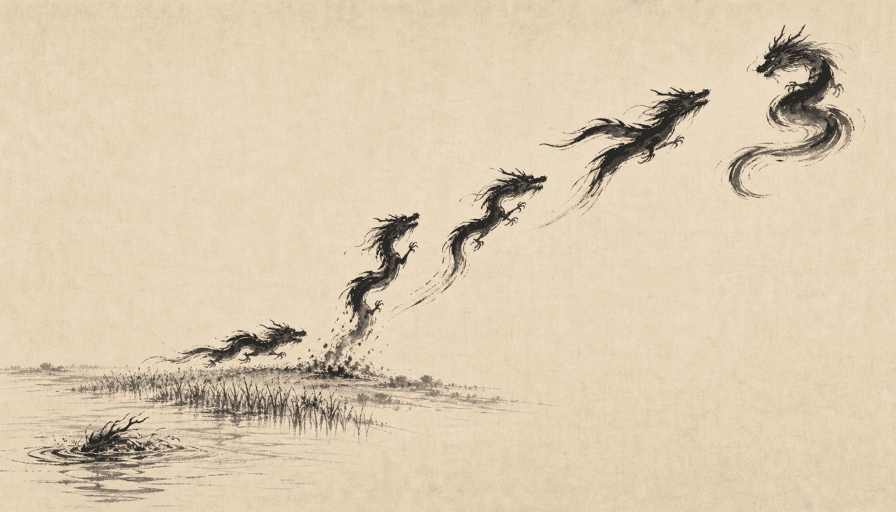
Opening the I Ching, the first hexagram, Qian, speaks of dragons from beginning to end.
Hidden dragon, appearing dragon, flying dragon, arrogant dragon. Many believe the ancients were describing a mystical animal.
No.
These six dragons are not dragons at all.
They are six states of a single dragon—any endeavor, from start to finish, must go through these six steps.
Below, I will unfold this curve for you, section by section. By the end, you might feel a bit dazed—realizing that you walk this curve every single day.
1. Six Dragons, Six States of One Dragon
First, look at the original text.
The six lines of the Qian hexagram, counting from bottom to top, each line has a line statement. Together, the six statements form a complete arc.
First Nine: Hidden dragon. Do not act. The dragon is submerged in water; the time has not yet come. Do not move. This is the beginning, hidden.
Second Nine: Dragon appearing in the field. The dragon emerges from the water, appears in the field, and is seen by others. The time has come; it shows its head.
Third Nine: The noble man is active and vigilant all day, and in the evening he is cautious as if in danger. This line does not explicitly mention the dragon but describes its state—exerting effort during the day, staying vigilant at night. The most arduous and tense period.
Fourth Nine: It may leap in the abyss. The dragon wants to leap but has not yet flown, suspended between leaping and not leaping. A turning point, but not yet stable.
Fifth Nine: Flying dragon in the sky. The dragon takes flight. This line is the most famous; "the supreme position" comes from here. The peak.
Top Nine: Arrogant dragon will have regret. The dragon flies too high and cannot pull back, beginning to regret. The zenith, then decline.
Hidden, appearing, vigilant, leaping, flying, arrogant.
From concealment to emergence, from striving to flight, from flight to regret. A line slowly climbs up, reaches the top, then turns back.
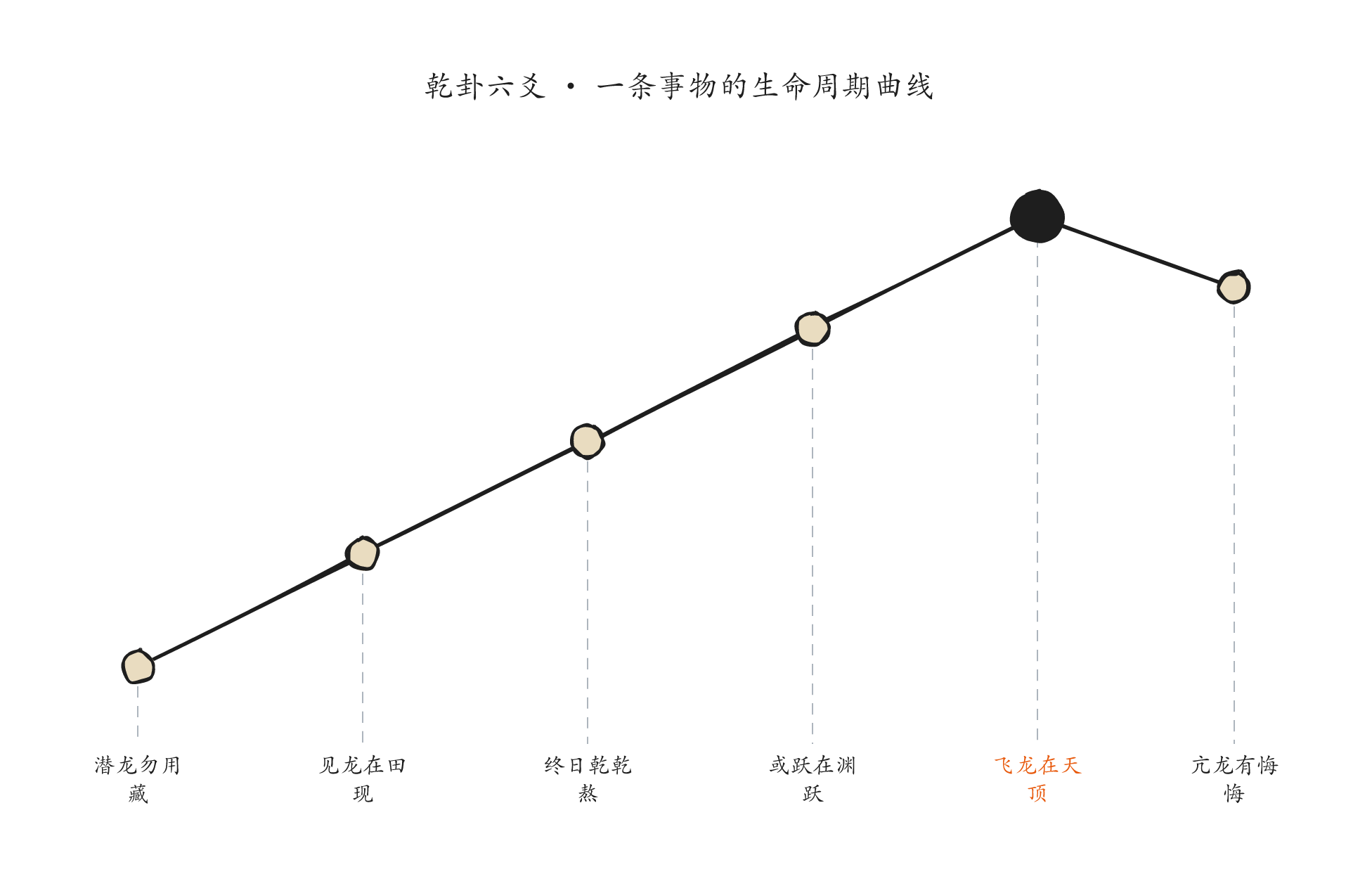
Do you see it? These are not six separate dragons; it is one dragon, from birth to peak to decline, cut into six frames.
2. Change the Product, Change the Person, Change the Dynasty—the Curve Remains
Looking at dragons alone is still abstract. Let's apply these six steps to two things you know well.
On the left, a product. On the right, a person—Liu Bang.
Hidden dragon, do not act—hidden, not yet formed. Product: You just have an idea, still turning in your mind, not yet announced. Liu Bang: Served as a village chief in Pei County, drinking, running up debts, causing trouble. No one knew he would become emperor.
Dragon appearing in the field—emerges, is seen. Product: The first version launches; the first batch of users gets to know you. Liu Bang: Responded to the uprising at the end of the Qin dynasty, led a group from Pei County to rebel against Qin, first seen by the world.
Active and vigilant all day—hard struggle, staying cautious. Product: Working overtime during the day, reviewing at night; the hardest, most exhausting period where you dare not relax. Liu Bang: The four-year Chu-Han Contention, chased by Xiang Yu, nearly died several times, cautious every day.
May leap in the abyss—turning point, not yet stable. Product: The growth curve starts to rise, but not yet stable; hesitant to leap or not. Liu Bang: Han Xin's decisive battle at the Jingxing Pass broke Zhao, giving Liu Bang the capital to contend with Xiang Yu—but Xiang Yu was still there, the outcome undecided.
Flying dragon in the sky—takes off, reaches the peak. Product: The product truly takes off, gaining momentum. Liu Bang: The Battle of Gaixia, Xiang Yu committed suicide, Liu Bang declared emperor. The flying dragon line.
Arrogant dragon will have regret—peak, then decline. Product: Overexpansion, resource depletion, hitting a wall, beginning to reflect. Liu Bang: Early Han dynasty purges of meritorious officials; Han Xin killed, Peng Yue executed, Ying Bu suppressed. One after another.
See? Change the product, change the person, change the dynasty—the line remains unchanged.
Three thousand years ago, six statements perfectly fit the cycle of a product and the life of a person.
| Stage | Product | Liu Bang |
|---|---|---|
| Hidden | Idea in mind | Village chief in Pei County |
| Appearing | First version launched | Uprising seen by world |
| Vigilant | Overtime and hard work | Four years of Chu-Han contention |
| Leaping | Growth rising, unstable | Breaking Zhao, gaining capital |
| Flying | Takes off, peaks | Gaixia, becomes emperor |
| Arrogant | Overextension, hitting wall | Early Han purges |
Change the product, change the person, change the dynasty—the curve remains.
Think about the thing you are working on right now. Stop and consider—where does it fall among these six frames? This is not to make you decide anything, but to help you see clearly which segment of the curve you stand on.
3. How Did the Ancients Write Down This Curve?
Here's the question.
Three thousand years ago, there were no coordinate axes, no graphs. How did the ancients draw and pass down this "lifecycle"?
The method they used is called taking images to analogize.
In today's terms—using a concrete thing to encapsulate a class of abstract principles.
For example, the dragon. The ancients had never seen a real dragon, but in their minds, there was such a virtual creature: able to hide, appear, leap, fly, and become arrogant. This single dragon covered all states of a thing from concealment to peak to decline.
So they did not say "things have six stages of development"—that is too dry, no one remembers it. They drew a dragon, letting you watch it hide, watch it fly, watch it regret. The principle was thus embedded in the image.
The "Xici Zhuan" (Chapter 12) once revealed this:
The sages established images to fully express their meanings. — Meaning is too vast and abstract to be clearly conveyed by words alone; so the sages established an "image," finding a concrete carrier to contain the meaning.
This is the use of "image."
It predates writing in helping people remember abstract things, and predates mathematics in compressing principles into a transmissible form.
It is older than writing, older than mathematics. This is the earliest modeling tool of the Chinese.
4. Once You Understand Images, the I Ching Is Full of Them
Once you recognize "image" as a method, flipping through the I Ching reveals that the entire book is composed of images.
Physical images: Dragon, horse, mountain, thunder, wind, water, fire. Using natural objects to contain the states of things.
Human relations images: The eight trigrams can also be read as elder brother, younger brother, father, mother, husband, wife. Using family relationships to contain positions in the human world.
Temperament images: Strong, yielding, active, penetrating, perilous, clinging, stopping, joyful. Using eight dispositions to contain the momentum of things.
The same set of eight symbols, from a different perspective, generates a new set of images.
One set for physics, one for human relations, one for temperament, layered upon each other. This is why just eight symbols, paired in twos, yielding sixty-four hexagrams, can fully describe the human world—because they never contained sixty-four stories, but sixty-four "images."
5. The Ancients Had No Excel, Yet They Grasped This First
When I read the phrase "establish images to fully express meanings," I often pause and think for a long time.
Three thousand years ago, people had no computers, no Excel, no modern statistics. They had no tools at all.
Yet they had already grasped something very modern—
Abstract principles, if only stored in the mind, will be lost; they must be placed in a concrete carrier to be remembered, passed down, and used by future generations.
This is the essence of "image." It is not decoration, not a symbolic game; it is a method of stuffing abstraction into concreteness—in today's terms, a metacognitive tool.
Today, we draw flowcharts, list lifecycles, build mental models—doing the same thing: giving invisible principles a visible shape.
The ancients had no Excel, no statistics, yet they knew: abstract principles must be placed in concrete carriers to survive three thousand years.
Compared to the answer "dragons are mysterious," this is far more substantial.
The ancients did not name it "modeling."
They simply looked carefully at the world, and then drew a dragon.
And the arc that dragon traced, three thousand years later, is still slowly climbing in the thing you hold in your hands.