
YiMatrix · Academy Journal
"What is above form is called the Way; what is within form is called the vessel"—A "layering" written over two thousand years ago in the Xici
"What is above form is called the Way; what is within form is called the vessel"—this line you memorized comes from the Xici commentary of the Book of Changes. The Xici does not an
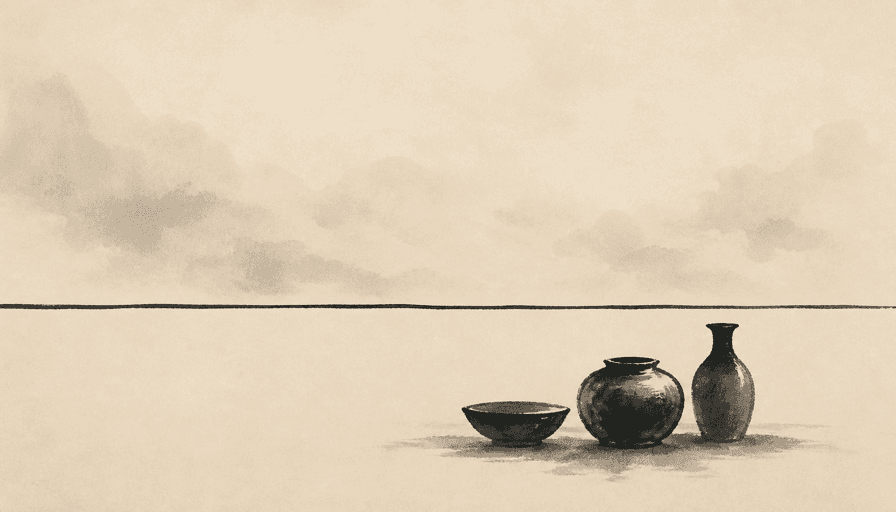
"What is above form is called the Way; what is within form is called the vessel."
You have probably memorized this line. It sits in your high school political textbook. Your teacher told you to remember that "the Way is abstract, the vessel is concrete." You remembered it, took the exam, and then forgot where it came from.
It comes from the Book of Changes (Yijing), from a piece called the Xici.
And most people, including me back then, never seriously considered one question: Why did someone over two thousand years ago specifically write this line, clearly cutting the entire world into two layers?
You memorized this line but never took the Xici seriously. Yet it is not some metaphysical outline—it is the manual for this system.
Let me peel this apart layer by layer. By the end, you will realize that the line you memorized for ten years means something entirely different from what you thought.
1. What exactly is the Xici—the only "general treatise" in the Yijing
First, let's break down the Yijing.
It is actually two layers stacked together.
The bottom layer consists of the hexagram statements and line statements of the sixty-four hexagrams—this is the core, the symbolic system itself. What the Qian hexagram says, what the Kun hexagram says, the words under each hexagram and line—all belong to this layer.
The top layer consists of commentaries written by later people, ten pieces collectively called the "Ten Wings." Wings are like wings that enable this ancient and difficult symbolic system to be understood.
The key point is this: among the Ten Wings, most are line-by-line or hexagram-by-hexagram annotations. For example, the Tuanzhuan explains the hexagram statement of each hexagram one by one; the Xiangzhuan even writes a comment under each line. They are notes attached to specific hexagrams or lines, scattered among the sixty-four hexagrams.
Only one piece is an exception.
That is the Xici. It does not annotate any hexagram. It does not talk about the Qian hexagram or the Kun hexagram. It stands outside the entire system and explains: how this whole system is designed, what the underlying rules are, how to read it, and what it can be used for.
Scholars define it directly: the Xici is "a systematic and detailed general treatise on the overall purpose of the Book of Changes" (Wikipedia entry for "Ten Wings").
General treatise. Note these two words. It is not a footnote for a particular hexagram; it is the overall manual for the entire book.
Pause here and try this with something at hand, and you will immediately understand the difference. Your phone has dozens of apps, each with its own function description—these are like the Tuanzhuan and Xiangzhuan attached to each hexagram. But have you ever read something else: a general manual that does not talk about a specific app but explains "how the entire machine is designed and how it runs at the bottom"? The Xici is that manual for the Yijing.
The Tuanzhuan and Xiangzhuan are notes written beside each hexagram; the Xici is a separate piece written at the very beginning—it does not discuss any hexagram; it discusses how this entire system was created.
A rare "system manual" lies quietly in the Yijing, skimmed over by generations as a metaphysical outline.
2. What does this general treatise write—a framework meant to cover all things, explaining itself
Since it is a manual, what does it say first?
The standard opening of a manual always covers two things: first, what scope this system is meant to cover; second, what its underlying rules are.
The Xici does exactly these two things at the start.
First, the scope. Chapter 4 of the Xici Part A opens with:
"The Yi matches Heaven and Earth, therefore it can encompass the Way of Heaven and Earth."
In plain language: The precision of this model is benchmarked against Heaven and Earth themselves; thus it can fully contain the patterns of Heaven and Earth. The word "encompass" (milun) is heavy: mi means pervasive, reaching everywhere; lun means gathering silk threads into a complete set—together it means comprehensive coverage, leaving nothing out.
Think about what this sentence does. It is not modestly saying "I can explain some small principles"; it is fixing the scope of application from the start: what I cover is the Way of Heaven and Earth, all things, the operation of the entire world—not just the local aspects of a single hexagram or line.
This is a modeling framework writing its own coverage scope.
Next, the underlying rules. Chapter 5 of the Xici Part A opens with:
"One yin and one yang are called the Way."
This line is famous, so famous that it is often misinterpreted. Here I only say one thing: it states the most fundamental generative rule of the entire system. Everything grows from the alternation of yin and yang states—this is the root rule that drives the system. It is not giving you a conceptual lesson on "what yin and yang are"; it is writing in the manual: the bottom layer of this system is driven by this rule.
See, scope declaration first, underlying rules second.
A framework meant to cover all things, opening by clarifying its scope and underlying rules—this is not metaphysical talk; it is what a manual should look like.
At this point, "the Xici is a manual" is no longer a metaphor; it is what this piece itself shows.
3. The hardest line—"What is above form is called the Way; what is within form is called the vessel"
Now back to the opening line.
Chapter 12 of the Xici Part A writes this line:
"What is above form is called the Way; what is within form is called the vessel."
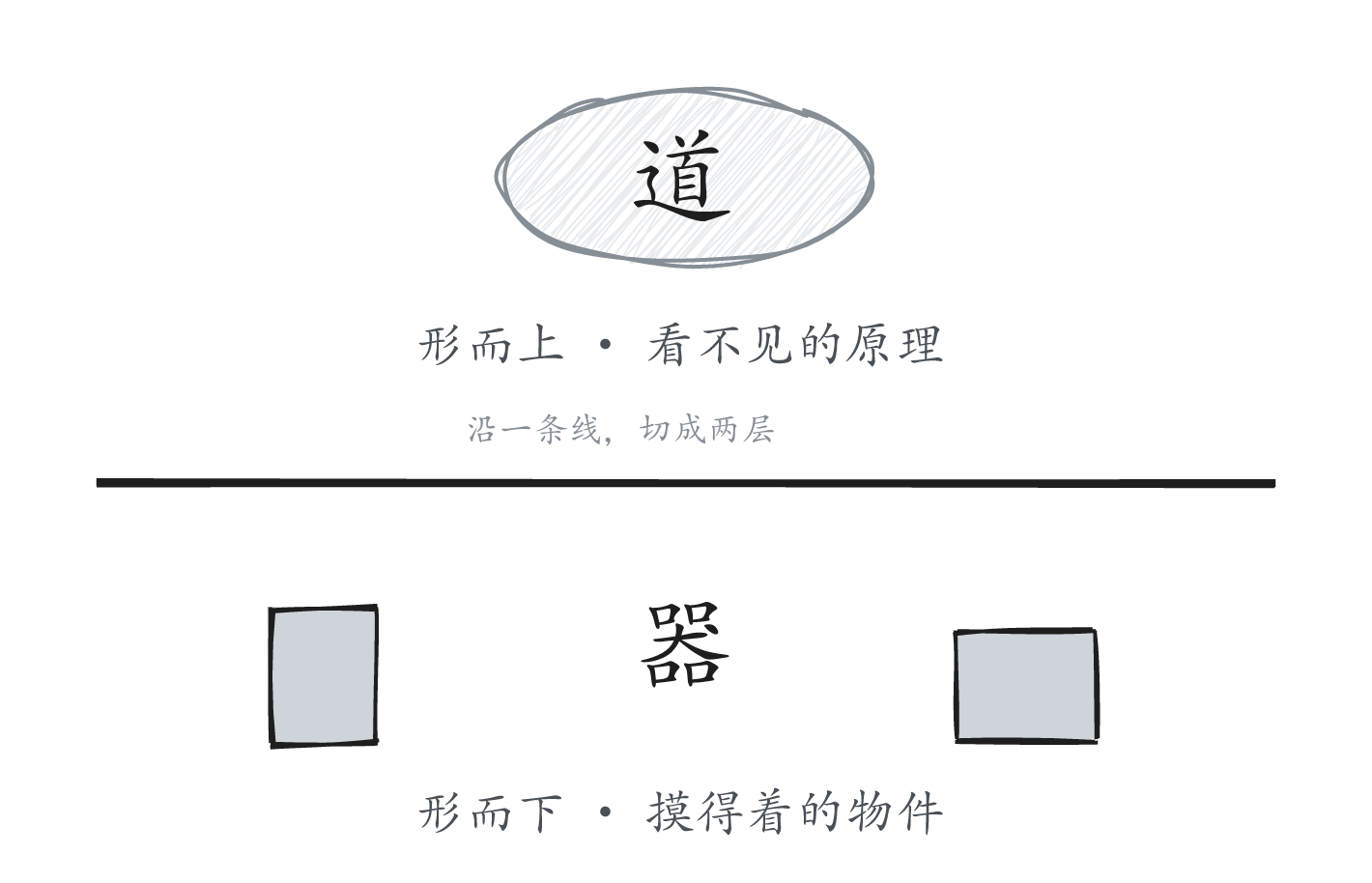
In plain language: The principles and laws that transcend form, invisible and intangible, are called the Way; the concrete objects that fall within form, visible and usable, are called vessels.
The true weight of this line is not in the words "abstract and concrete"; it is in its clear declaration of layering.
It cuts the entire world into two layers along a line. The upper layer is abstract principles, invisible rules—the Way. The lower layer is concrete objects, tangible implementations—vessels. Principles belong to principles, objects belong to objects; they are not mixed together.
You might frown: calling an ancient line from over two thousand years ago "layering"—is that a stretch?
It is not my stretch. This mapping was done by philosophers themselves.
Feng Youlan stated clearly in New Rational Philosophy (1939): "What we call above form and within form correspond to what Western philosophy calls abstract and concrete." The connection between "Way and vessel" and "abstract and concrete" was made not by some netizen's imagination, but by someone who wrote the entire history of Chinese philosophy.
And these two layers—abstract and concrete—are exactly the first cut we instinctively make today when dealing with any complex system: first separate principles from implementation, first think clearly about "what is the principle," then deal with "what thing to make."
"What is above form is called the Way; what is within form is called the vessel"—this line from over two thousand years ago cuts the world into two layers: principles and objects. Today we call this layering; the ancients called it Way and vessel.
Having said this, I must quickly add a clarification to avoid misunderstanding.
This does not mean the ancients invented some modern knowledge in advance, nor does it mean "our ancestors were the earliest, others come later." The truth is much simpler and more thought-provoking: When different civilizations earnestly try to layer the world, they will touch the same structure from different directions. The East touched Way and vessel; the West touched abstract and concrete—neither copied the other; two paths led to the same place.
This is more moving than "we were first." It does not say who is smarter; it says: dividing the world into two layers—principles and objects—may be the cut that anyone who looks at the world clearly will eventually make.
The Xici does not discuss any hexagram.
It discusses how this entire system is designed, what scope it covers, what underlying rules drive it, and along which line the world is cut. It is a manual written over two thousand years ago for a complete world model.
And the line "What is above form is called the Way; what is within form is called the vessel" is the sharpest cut in that manual.
The ancients did not have the word "system," but they earnestly wrote down the design ideas of a complete world model and left them for us, who were not yet born.
When you memorize this line again, it is no longer just an exam point. It is someone over two thousand years ago who layered the world for you in advance.