
YiMatrix · Academy Journal
Is Bazi a "Study" and Zi Wei Dou Shu Merely a "Technique"? This Distinction Matters Far More Than "Which Is More Accurate"
Both Bazi and Zi Wei Dou Shu use birth times to deduce fate, but they are fundamentally two completely different paths. One has a theoretical model that can deduce "why," while the
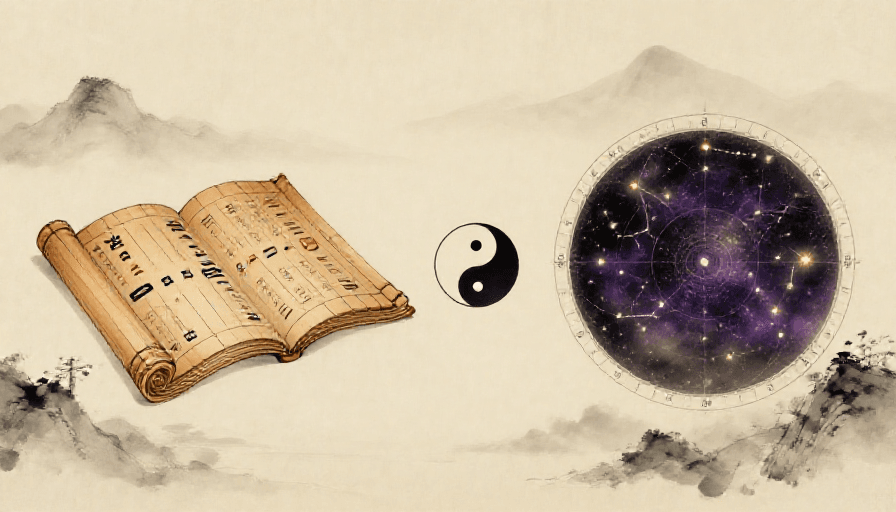
It's not about which is more accurate, but about clarifying the inherent structural differences between the two systems.
I'm often asked: For analyzing life's script, should I use Bazi or Zi Wei Dou Shu?
I've been asked this dozens of times and have seen countless evasive answers like "each has its merits." Today, I want to approach it from a different angle. On the surface, both systems use birth times to deduce fate, but at their core, they are completely different paths—one is a "technique," the other a "study."
This distinction matters far more than "which is more accurate."
Two Different Paths
To understand the difference between the two systems, we must first look at their origins. Different origins lead to different frameworks.
Bazi fortune-telling is a purely indigenous Chinese system.
Its foundation lies in the pre-Qin theories of Yin-Yang and the Five Elements. During the Tang Dynasty, a man named Li Xuzhong, who served as a palace censor, was the first to combine Yin-Yang and the Five Elements with birth year, month, and day for fortune-telling. Han Yu wrote his epitaph, claiming his predictions were "accurate in 99 out of 100 cases"—though exaggerated, it shows his influence at the time.
By the Northern Song Dynasty, Xu Ziping added the "hour" to Li Xuzhong's method, forming the complete system of four pillars and eight characters (year, month, day, hour). More crucially, he "focused on the Five Elements, not on Nayin," shifting the core of fortune-telling from empirical formulas to theoretical deductions based on the interactions of the Five Elements.
From then on, Bazi fortune-telling had its own theoretical framework.
Zi Wei Dou Shu took a different path.
During the Zhenyuan era of the Tang Dynasty, a Western Regions diviner named Li Biqian brought a book called the "Yusi Jing" to Central China. Tracing its origins, this book was based on astrological works from 1st-century Alexandria, translated by Persians and infused with Indian astrology, then transmitted to China along the Silk Road.
Influenced by these foreign astrological elements, China first developed a fortune-telling method called "Eighteen Flying Stars"—eighteen stars placed in twelve palaces, each with a main star and several secondary stars, offering very direct and rigid interpretations. Later, through modifications by Chen Tuan (according to legend), it evolved into today's Zi Wei Dou Shu.
Here's something many don't know: The stars in Zi Wei Dou Shu are all "virtual stars."
Although named "Zi Wei," "Tai Yang," "Tai Yin," etc., their positions in the chart are not determined by actual celestial phenomena but are calculated from the birth hour using fixed formulas. They are symbols, not real stars.
So, you see, Bazi grew from the indigenous tree of Yin-Yang and the Five Elements; Zi Wei Dou Shu grafted foreign astrological elements onto the root of Chinese divination, resulting in a hybrid tree.
Both roughly took shape during the Song Dynasty, but they followed completely different paths.
One Is a "Technique," the Other a "Study"
Different origins ultimately led to a key difference: structure.
The late Zi Wei Dou Shu master Wang Tingzhi (1935–2024), a successor of the Zhongzhou School, dedicated his life to researching and promoting Zi Wei Dou Shu. Last October, this ninety-year-old gentleman passed away in Toronto. One of his greatest contributions was breaking the Zhongzhou School's rule of "passing knowledge to only one person per generation" and making his learning public.
He once said something significant:
"Zi Wei Dou Shu is merely a divination technique."
Note, this wasn't said by an outsider but by one of the most influential figures in the Zi Wei Dou Shu community. Moreover, his intention wasn't to belittle Zi Wei Dou Shu; on the contrary—he opposed deifying divination into an all-powerful "study" or belief system. In his view, Zi Wei Dou Shu is a useful fortune-telling tool, and using it as such allows for better application.
So, what exactly is the difference between "technique" and "study"?
A "technique" is a technical tool or empirical rule—knowing how, but not necessarily why.
A "study" involves theoretical exploration and a systematic framework—knowing both how and why, with the ability to deduce.
The deduction process in Zi Wei Dou Shu is as follows:
Input (birth hour) -> Encoding (Star Placement Method, placing 108 stars into twelve palaces) -> Rule System (if Star A is in Palace B, interpret as C) -> Output (conclusion)
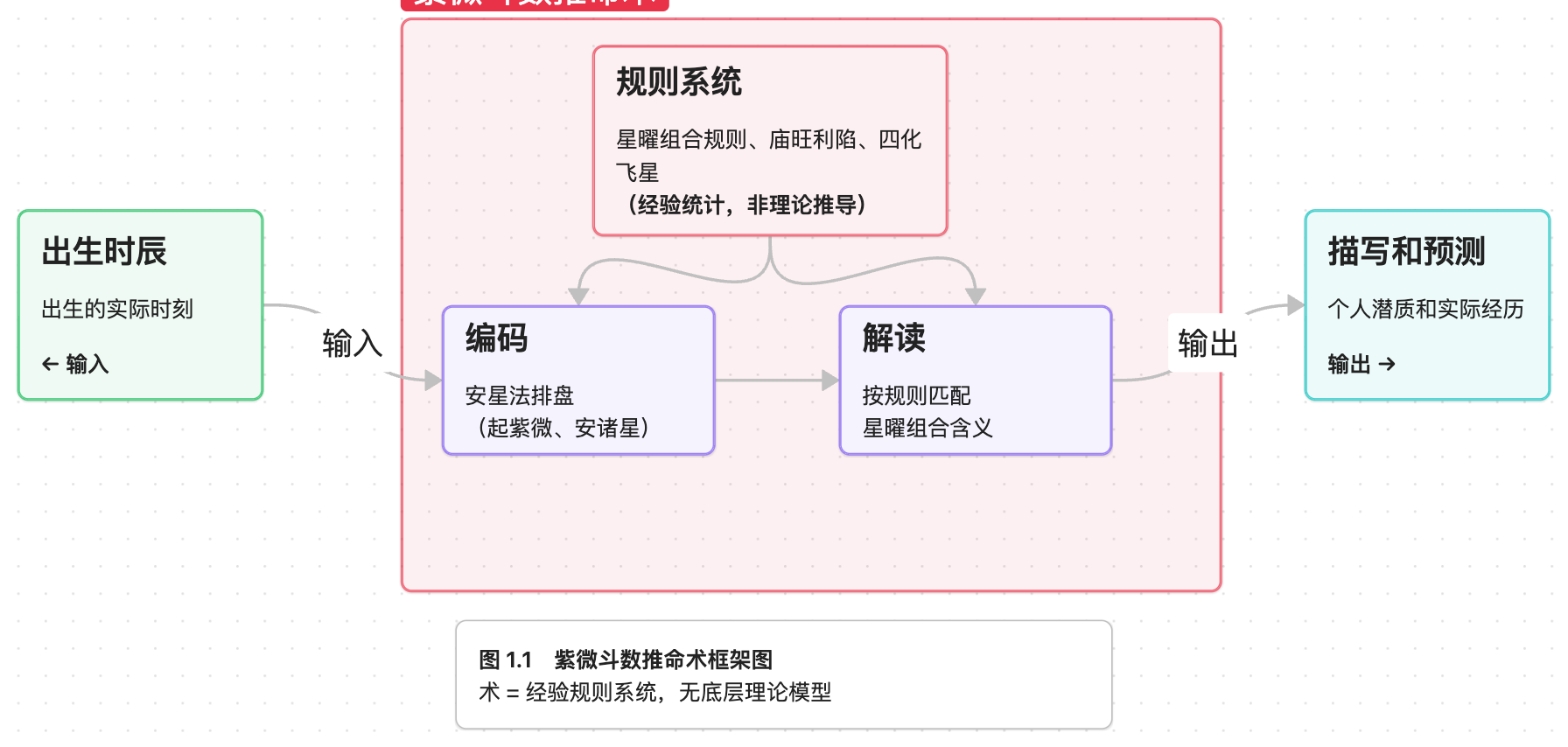
In this process, the "rule system" is the core. Specific stars in specific palaces, or in conjunction or opposition with other stars, correspond to particular interpretations. These interpretations come from millennia of accumulated experience and are often very accurate. Zi Wei Dou Shu also has internal explanations—stars have Five Element attributes and systems of auspicious and inauspicious positions—but these explanations are more empirical summaries than deductions from a unified theory.
The deduction process in Bazi fortune-telling adds an extra layer:
Input (birth hour) -> Encoding (arranging the four pillars and eight characters) -> Theoretical Model (interactions of Yin-Yang and the Five Elements) -> Reasoning System (analysis of Ten Gods, patterns, and useful elements) -> Output (conclusion)
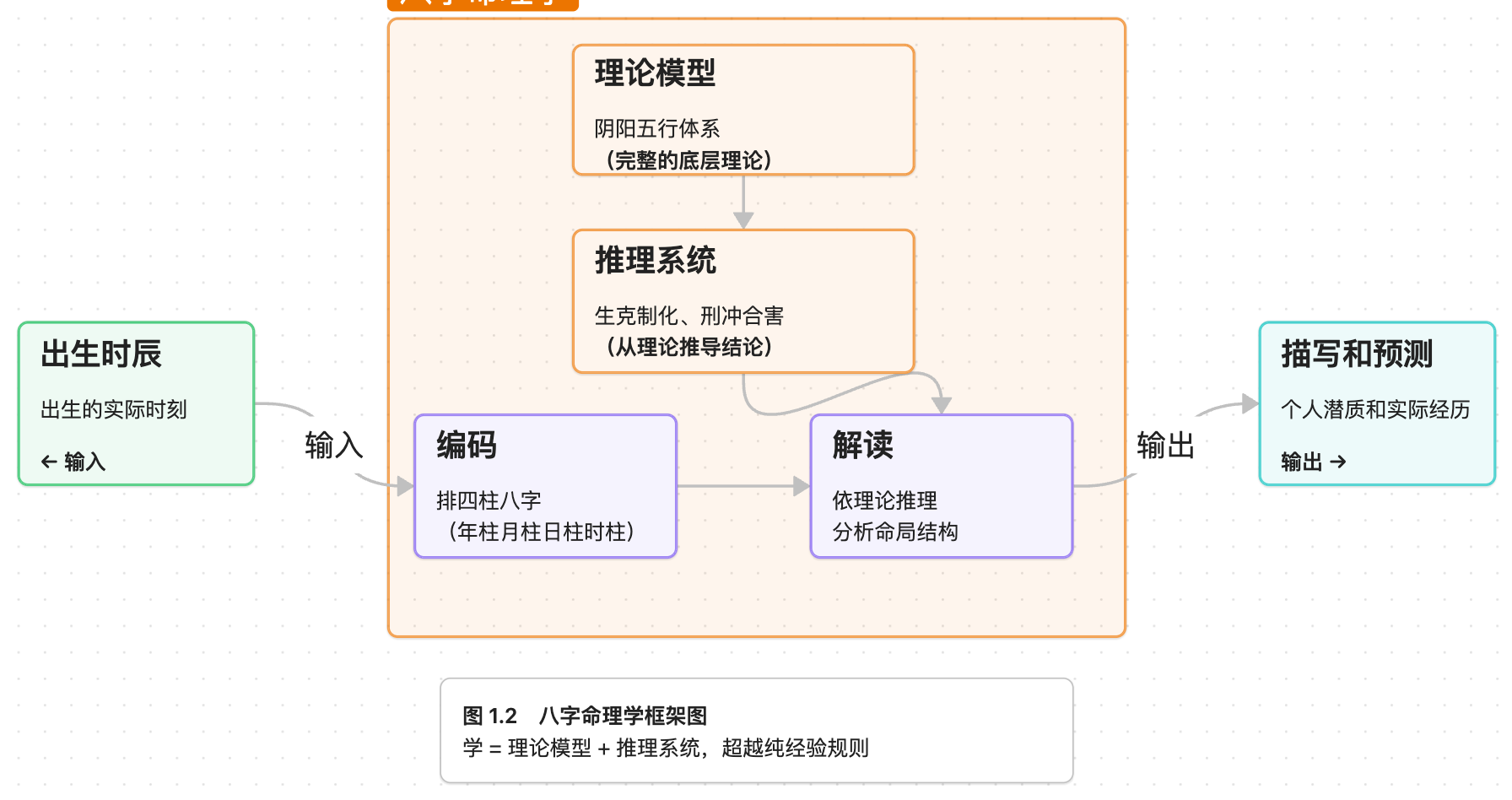
The key lies in that theoretical model. With the theory of Yin-Yang and the Five Elements interactions, Bazi doesn't just tell you "what the outcome is" but can also explain "why this outcome occurs." Moreover, because it has theory, you can deduce the unknown from the known, not relying entirely on ready-made interpretations.
Fortune-telling scholar Lu Zhiji put it aptly: "Traditional fortune-telling can transcend the confines of divination and enter the realm of scholarship because it has constructed a 'theoretical model' for description and prediction."
To use an analogy. Zi Wei Dou Shu is like empirical formulas in traditional Chinese medicine—"this formula works for this illness," it can cure, but the principle isn't necessarily clear. Bazi fortune-telling is like pattern differentiation and treatment in Chinese medicine—"based on the theory of disease causes and mechanisms, this symptom belongs to a certain pattern, so use this formula," with a complete chain of deduction.
Can empirical formulas cure illnesses? Of course, and sometimes they are faster and more direct than pattern differentiation. But pattern differentiation can handle new, complex situations because it has theory to deduce from.
The value of a "technique" lies in practicality; the value of a "study" lies in deducibility. This isn't about superiority, but structural difference.
A Table to Clarify the Differences
After all this text, let's summarize with a table. The core differences between the two systems are clear here:
| Dimension | Bazi Fortune-Telling | Zi Wei Dou Shu |
|---|---|---|
| Historical Origin | Indigenous growth (Yin-Yang, Five Elements) | Influenced by Indian astrology |
| Core Method | Arranging four pillars + Five Elements interaction reasoning | Star placement method + star combination rules |
| Theoretical Level | "Study": has theoretical model + reasoning system | "Technique": empirical rule system |
| Nature of Stars | Does not involve celestial bodies (pure stems and branches, Five Elements) | Virtual stars (symbols, not real celestial bodies) |
| Information Density | Four pillars and eight characters, relatively concise | Twelve palaces + 108 stars, high information density |
| Learning Curve | Easy to start, hard to master (deep theory) | Complex charting, slow to pick up (many rules) |
| Practical Characteristics | More direct for analyzing major and annual cycles | More detailed with palace-based analysis |
An additional detail: Bazi uses the solar term calendar (solar-based), with the beginning of spring marking the year and solar terms defining months, avoiding leap month issues. Zi Wei Dou Shu uses the lunar calendar, requiring special handling for leap months.
Moreover, Zi Wei Dou Shu is very sensitive to birth hour—if the hour is wrong, the life palace and body palace change entirely, affecting the whole chart. With Bazi, if the hour is missing, you can still deduce with six characters; though incomplete, about 70–80% of the information remains.
Fortune-Telling Is a Black Box, Not a Crystal Ball
At this point, some might ask: After all this, which is more "accurate"?
The question itself is problematic.
Mr. Lu Zhiji has a statement I particularly agree with: "There is no 'deterministic' correspondence between birth time and life trajectory; it is only a probabilistic correlation."
Whether Bazi or Zi Wei Dou Shu, they are essentially "black boxes."
A black box is a concept from cybernetics, meaning: We don't know how a system works internally, only inferring patterns by observing the relationship between input and output. You watch TV daily, pressing the remote for a picture, but you don't need to know the circuit principles inside. To you, the TV is a black box.
Fortune-telling systems are similar. We don't know the real causal mechanism between birth time and fate—perhaps we never will. But through millennia of accumulated experience, ancient people established functional models that can simulate the "input-output" relationship to some extent.
If fortune-telling is compared to a black box, then Zi Wei Dou Shu is a pure black box—only input-output rules, with an opaque interior. Bazi fortune-telling is more like a "gray box"—with the Yin-Yang and Five Elements theoretical model providing partial explanation of its internal structure, offering stronger interpretability.
Interestingly, ancient people were clear about the limitations of fortune-telling. When evaluating Wan Minying's "San Ming Tong Hui" in the "Siku Quanshu Zongmu Tiyao," it says: "Also often inaccurate." Then it advises: "Those who study fate should grasp the general idea and adapt flexibly."
In plain terms: Don't take fortune-telling too seriously; grasp the general direction and apply it flexibly.
What we see is not fate itself, but fate's projection through our calculation framework. The projection has reference value, but it is not the whole picture.
So, Should You Use Bazi or Zi Wei Dou Shu?
Returning to the question at the beginning of the article.
My advice is simple: This isn't about choosing the "more accurate" one, but about what you want.
If you want to quickly understand the major patterns of life—the general direction of career, marriage, wealth—Bazi is more direct. Its theoretical model helps you understand "why it is this way," knowing both how and why.
If you want to see details in specific areas—such as the property palace, travel palace, or social palace—Zi Wei Dou Shu's twelve-palace system offers finer divisions and higher information density.
The two are not mutually exclusive. Many fortune-tellers use both systems, cross-referencing them.
But regardless of which you use, understanding its underlying structure—whether it's a "technique" or a "study"—helps you use it better. Knowing Zi Wei Dou Shu is an empirical rule system, you won't obsess over "why this star in this palace means this"; knowing Bazi has a theoretical model, you can try to deduce from theory instead of memorizing interpretations.
They are both black box models, offering probabilities, not certainties. Fortune-telling is a probabilistic lens, not a crystal ball.
Are you a Bazi supporter or a Zi Wei Dou Shu supporter? Or do you use both? Share your thoughts in the comments.