
YiMatrix · Academy Journal
Were the Eight Trigrams Originally Unrelated to Yin and Yang? Numbers on a Bronze Vessel Hold a 3,000-Year-Old Secret
We often say 'yin yang and the eight trigrams' together as if they were inherently paired. But archaeological evidence tells us: the eight trigrams originated from the Shang Zhou n
We often say 'yin-yang and the eight trigrams' together as if they were inherently paired. But archaeological evidence tells us: the reality is far more complex than imagined.
Today, we utter the four characters 'yin-yang and the eight trigrams' as if they were naturally conjoined.
But what if I told you that the eight trigrams were originally unrelated to yin-yang—they were two completely independent systems that each evolved for over a thousand years before converging at a historical juncture—would you believe it?
This isn't my speculation; it's what archaeological evidence says.
The story begins with a bronze vessel. In the first year of the Chonghe era of the Northern Song Dynasty, 1118 CE, a batch of bronze vessels was unearthed in Xiaogan, Hubei. Among them was one called the 'Zhongfang Ding,' cast during the reign of King Zhao of the Western Zhou Dynasty, about 3,000 years ago. The vessel bears inscriptions, most of which scholars can decipher, except for two strange symbols at the end—
'7 8 6 6 6 6, 8 7 6 6 6 6'
Six numbers in each group, placed side by side. What do they mean?
No one knew. This puzzle remained unsolved for 800 years.
The 800-Year-Old Puzzle on the Bronze Vessel
The Zhongfang Ding is one of the 'Six Vessels of Anzhou,' the most notable among the unearthed bronzes. The inscription records a military campaign during the Western Zhou period, and its content isn't particularly difficult to interpret. But those two sets of numbers at the end stumped everyone.
Song Dynasty scholars called them 'strange characters.' Some guessed they meant 'he he' (majestic), others suggested 'eighteen grandees' or 'eight grandees.' All explanations seemed forced.
In 1932, Guo Moruo offered a new interpretation: these were the clan emblem of the vessel's owner—similar to a clan's symbolic mark. This sounded plausible, but there was a problem: similar numerical combinations later appeared at Yinxu in Anyang, Shaanxi, and several other archaeological sites. Could people from different places and eras all belong to the same clan? It didn't make sense.
In 1950, a Shang Dynasty oracle bone was unearthed at the Sipanmo site in Yinxu, Anyang, Henan. Archaeologist Guo Baojun discovered three sets of numerical symbols on a bovine scapula—'7 8 7 6 7 6,' '7 5 7 6 6 6,' and '8 6 6 5 8 7.' Each set of six numbers had the same structure as those on the Zhongfang Ding.
This meant that this recording method dated back at least to the Shang Dynasty, even earlier than the Zhongfang Ding.
In 1956, a Western Zhou oracle bone was unearthed in Zhangjiapo, Chang'an, Shaanxi, bearing similar numerical combinations. Young scholar Li Xueqin noticed this phenomenon and wrote a restrained yet insightful remark:
'These numerical inscriptions are clearly different from Shang Dynasty oracle bone inscriptions and remind us of the 'nine' and 'six' in the 'Book of Changes.'
He had vaguely touched the edge of the truth—these numbers were related to the 'Book of Changes.' But he didn't take the next step.
In 1957, paleographer Tang Lan proposed another explanation: this was the script of a non-Shang-Zhou ethnic group. Although his direction was wrong, he correctly identified the specific numbers—1, 5, 6, 7, 8. This foundational deciphering work later proved crucial.
A symbol, silent for 800 years, awaited someone to unveil its true nature.
Zhang Zhenglang's Astonishing Discovery: Trigrams Were Originally Written with Numbers
That person was Zhang Zhenglang.
In December 1978, the inaugural academic symposium of the Chinese Paleography Research Association was held in Changchun, Jilin. Just the year before, a batch of important oracle bones had been unearthed at the Fengchu Palace site in Zhouyuan, Fufeng, Shaanxi, and the academic community was abuzz with excitement.
Zhang Zhenglang wasn't giving a formal presentation—he merely stood up spontaneously to make a speech titled 'Ancient Divination Methods and King Wen's Development of the Book of Changes.' But those few minutes of remarks reshaped the direction of 'Book of Changes' studies for the next forty years.
His core idea was just one sentence, yet it was enough to rewrite the foundational understanding of 'Book of Changes' research:
These numerical combinations on Shang-Zhou bronze vessels and oracle bones are trigrams. Odd numbers represent yang lines, even numbers represent yin lines.
In other words, the '7 8 6 6 6 6' at the end of the Zhongfang Ding inscription wasn't a clan emblem or foreign script, but a genuine trigram—written with numbers.
According to Zhang Zhenglang's interpretation, 7 is odd (yang), 8 and 6 are even (yin). Reading '7 8 6 6 6 6' from bottom to top corresponds precisely to the Bo (Peeling) trigram among the 64 hexagrams of the 'Book of Changes.' The other group '8 7 6 6 6 6' corresponds to the Bi (Closeness) trigram.
You might ask: today, we draw yang lines as a long horizontal '—' and yin lines as two short horizontals '--'. What's the connection to numbers?
The connection is profound. Zhang Zhenglang traced a complete evolutionary chain:
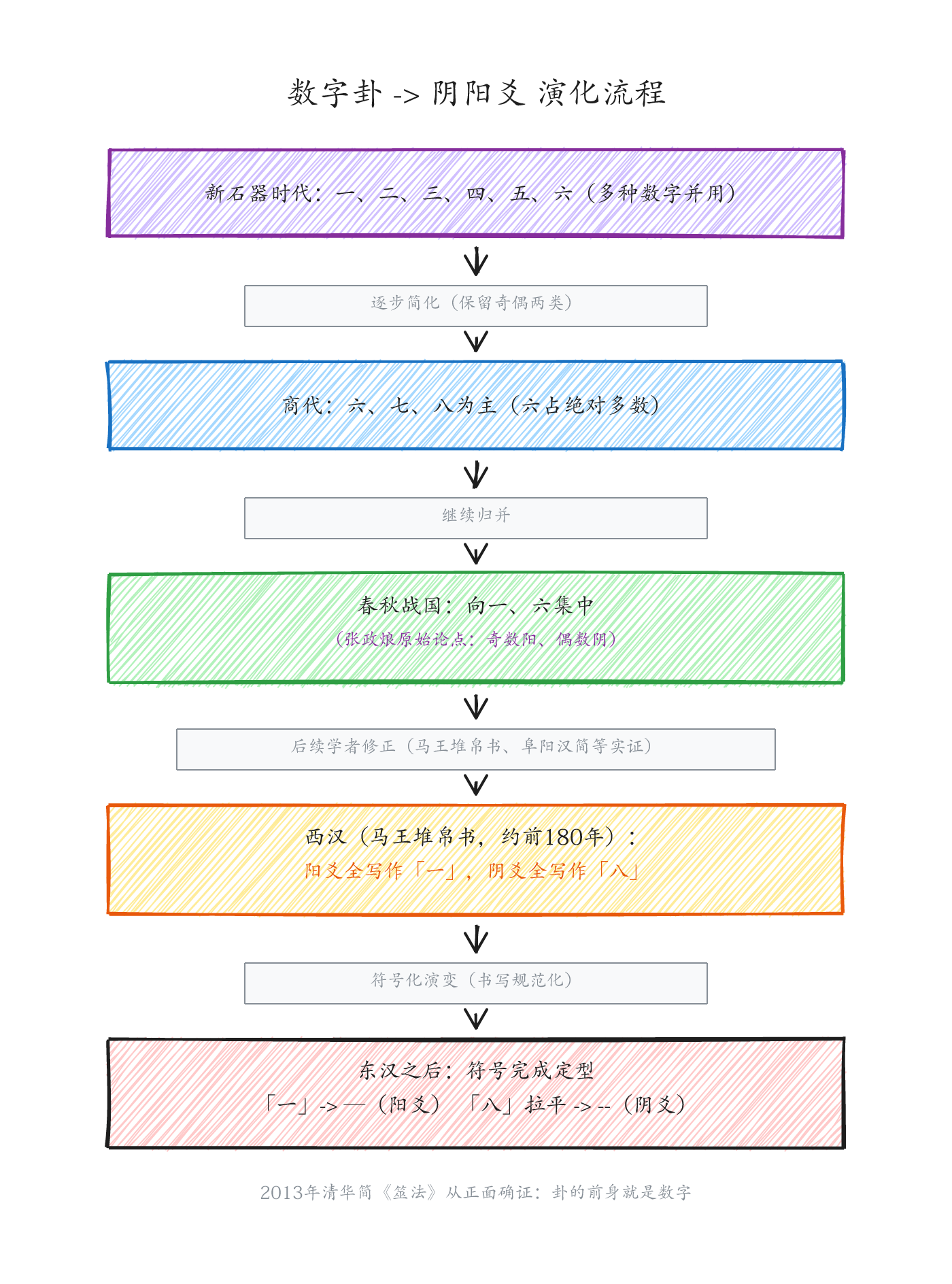
There's an interesting detail in academic history. Zhang Zhenglang initially concluded that numerical trigrams gradually simplified from multiple numbers, merging into '1' and '6' as binary symbols by the Warring States period—'1' representing yang, '6' representing yin. This was already a remarkable breakthrough.
But later archaeological discoveries refined this conclusion. The Western Han silk manuscript of the 'Book of Changes' unearthed at Mawangdui clearly shows—all yang lines are written as '1,' all yin lines as '8.' The same is true for the Han bamboo slips of the 'Book of Changes' from Shuanggudui, Fuyang. That is, the final merger wasn't '1' and '6,' but '1' and '8.'
In 2013, Tsinghua University released a batch of Warring States bamboo slips (Tsinghua Bamboo Slips), including the 'Divination Methods' section, which explicitly records trigram lines with numbers, confirming Zhang Zhenglang's core judgment from over thirty years earlier—the predecessor of trigrams was numbers.
See? The single horizontal and two short horizontals we draw today are essentially 'fossils' of two numbers used by ancient people for divination.
The yang line '—' is a direct continuation of the number '1.' What about the yin line '--'? Look closely at the character '八' (eight)—two strokes splayed apart; flatten it, and doesn't it resemble two short horizontals?
It wasn't until the Eastern Han Xiping Stone Classics that the familiar broken-line writing style appeared.
A spontaneous speech solved an 800-year-old puzzle. Zhang Zhenglang later published his research in a paper titled 'An Attempt to Interpret the 'Book of Changes' Trigrams in Early Zhou Bronze Inscriptions' in the 1980 issue of 'Archaeological Journal.' This paper is hailed as the 'groundbreaking work in the field of numerical trigram research.'
The Origin of Yin-Yang: From Hillside Sunlight to Cosmic Qi
Alright, the story of numerical trigrams is complete. The origin of the eight trigrams is clear—they originated from the Shang-Zhou divination recording system, unrelated to philosophy, purely a set of divination tools.
What about 'yin-yang'? Where did yin-yang come from?
The answer lies in the characters themselves.
The right component of '阳' (yang) is '昜,' depicted in oracle bone script as the sun emitting rays. The right component of '阴' (yin) is '侌,' depicting clouds obscuring the sun. Both characters have the left radical '阜,' representing a hill.
Put together, the meaning is straightforward: the side of the hill facing the sun is called yang, the side facing away is called yin.
It's that simple. Initially, 'yin-yang' referred to which side of a hillside had sunlight and which had shadow.
When did it become a core concept for Chinese understanding of the universe?
In 780 BCE, a major earthquake struck Qishan, Shaanxi. The Jing, Wei, and Luo rivers dried up, and Mount Qi collapsed. It was a disaster significant enough to be recorded in history.
At that time, a man stepped forward. His name was Boyang Fu, the Grand Historian of the Zhou royal court. Looking at the dried riverbeds and collapsed hillsides, he said:
'Yang is suppressed and cannot emerge, yin is constrained and cannot ascend, hence the earthquake.'
Note, he was no longer talking about the shady and sunny sides of a hill. He was talking about 'qi'—an invisible cosmic force. This is the earliest known record in literature combining 'yin-yang' with 'qi.'
Even more impressively, Boyang Fu made a prophecy: 'The state will fall within ten years.'
Eleven years later, King You of Zhou was killed, the Western Zhou Dynasty fell, and the Zhou court was forced to move east to Luoyi.
The prophecy came true.
Later, Laozi wrote the famous line in the 'Dao De Jing':
'The Dao gives birth to the One, the One gives birth to the Two, the Two give birth to the Three, and the Three give birth to all things. All things carry yin and embrace yang, blending qi to achieve harmony.'
The 'Two' in 'One gives birth to the Two' is widely interpreted by later generations as yin-yang. Thus, yin-yang evolved from everyday language describing natural phenomena into a philosophical concept explaining the generation of all things in the universe.
The characters yin-yang, starting from sunlight and shadow on hillsides, took centuries to become the ultimate code for Chinese understanding of the universe.
The Convergence of Two Rivers: The Marriage of Trigrams and Yin-Yang
Now, let's bring the two threads together.
One thread is the eight trigrams: originating from the Shang-Zhou numerical divination system, simplifying from multiple numbers to binary symbols, eventually evolving into yang and yin lines. This was a practical divination tool, largely unrelated to philosophy.
The other thread is yin-yang: starting from hillside light and shadow, elevated by Boyang Fu into a philosophical concept of 'qi,' then abstracted by Laozi into a cosmological ontology. This was a philosophical system, largely unrelated to divination.
The two threads evolved separately for hundreds, even thousands, of years.
When did they merge?
The answer is the 'Commentaries on the Book of Changes.'
The 'Commentaries on the Book of Changes,' also known as the 'Ten Wings,' is a systematic interpretation and elaboration of the 'Book of Changes.' Mainstream academia believes it was compiled between the Warring States period and the Western Han Dynasty, not written by a single person but the collective work of a group of thinkers.
The 'Commentaries on the Book of Changes' accomplished something remarkable: it implanted yin-yang philosophy into the trigram symbol system.
The yang line '—' corresponds to yang, the yin line '--' corresponds to yin. The trigrams were no longer just divination tools; they gained a philosophical soul.
The 'Commentaries on the Book of Changes: Appended Remarks, Part I' contains the line that influenced Chinese intellectual history for two millennia:
'In the Changes, there is the Supreme Ultimate, which generates the Two Modes. The Two Modes generate the Four Images, the Four Images generate the Eight Trigrams, and the Eight Trigrams determine auspiciousness and inauspiciousness, from which great endeavors arise.'
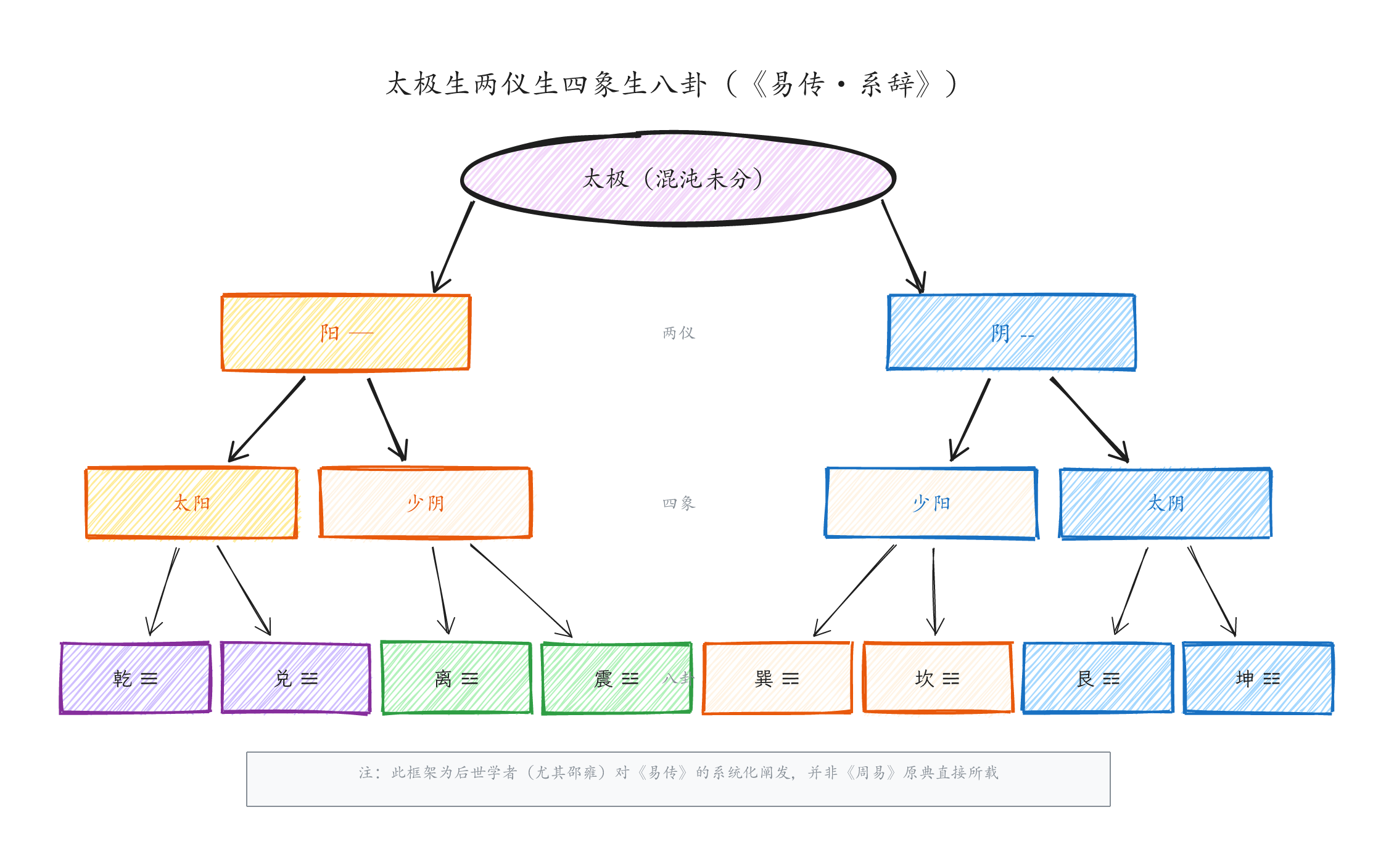
From chaos to yin-yang, from yin-yang to the Four Images, from the Four Images to the Eight Trigrams, from the Eight Trigrams to human affairs and fortune—a complete chain of cosmic generation.
The same 'Commentaries on the Book of Changes' also contains another equally weighty line:
'The alternation of yin and yang is called the Dao.'
The alternating changes of yin and yang are the essence of the 'Dao.'
The 'Zhuangzi: Under Heaven' chapter summarizes the core contribution of the 'Book of Changes' in five characters—'The Changes elucidate yin and yang.'
Thus, the two independent rivers finally converged. The trigram symbols evolved from numerical trigrams gained the philosophical soul of yin-yang.
Yin-yang philosophy found its precise symbolic载体 in the trigram system.
Yin-yang and the eight trigrams are not the natural growth of a single system, but the magnificent confluence of two rivers of civilization.
Final Thoughts
Today, when we say 'yin-yang and the eight trigrams,' few pause to think: how did these four characters come together?
Behind it lies numerical trigrams silent on oracle bones and bronze vessels for three millennia, awaiting a scholar to decipher them; the characters yin-yang starting from hillside light and shadow, taking centuries to enter the core of Chinese philosophy; and the authors of the 'Commentaries on the Book of Changes' accomplishing that great fusion, giving divination tools philosophical depth and abstract philosophy symbolic form.
Behind every concept we take for granted, there may lie a millennia-spanning evolutionary history.
How long have you studied the 'Book of Changes'? Did you know before that yin-yang and the trigrams were originally independent systems? How do you think ancient people first came up with using numbers for divination?
Share your thoughts in the comments.