
YiMatrix · Academy Journal
A Gambler, a Samurai, an Engineer: Six Life Choices in the Gua Hexagram of the I Ching
Six individuals face the same dilemma—to decide or not? From reckless adventurers to intellectuals who know but cannot act, six real stories from Takashima Ekidan illuminate the li
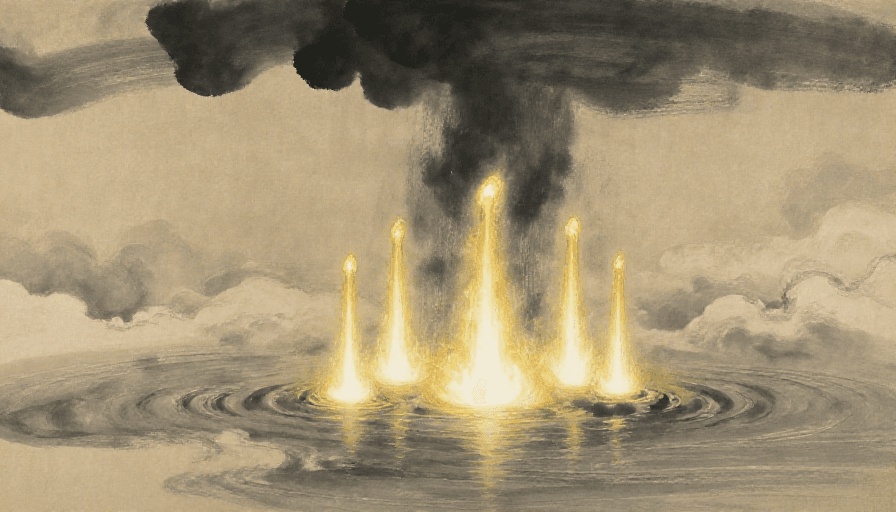
Six individuals face the same dilemma—to "decide" or not? They offer six entirely different answers.
One day during the Meiji era, two prominent Japanese politicians brought a young merchant into the divination room of Takashima Tonshō, Japan's "Sage of the I Ching."
This young man was Amemiya Keijirō, a foreign exchange trader from Yokohama. In his recent operations, he had earned 150,000 yen—an astronomical sum at the time. He came to ask Takashima: How should he invest this money?
Takashima cast the hexagram and obtained the fourth line of Gua. After examining the hexagram, he did not rush to interpret it but first offered an investment suggestion. Then he said four words:
"Hears advice but does not believe."
He said, "This is what worries me most—you probably won't listen to my words."
Fourteen days later, Amemiya reappeared. His face was ashen. On the way back, he had been persuaded by peers to "gamble one more time," losing most of his money in a single bet.
Takashima sighed.
This story comes from Takashima Ekidan. Takashima Tonshō was the most renowned I Ching scholar of Japan's Meiji era, later called the "Sage of the I Ching." He performed countless divinations in his lifetime, from personal matters to national policies, compiling over 800 real cases into a book. The chapter on the Gua hexagram includes six stories—six real people making choices at critical junctures in their lives.
Some chose correctly, some chose wrongly. Some heeded advice, some "heard advice but did not believe." Some hesitated when they most needed to decide, some knowingly walked down a dead-end path.
These six stories correspond precisely to the six lines of the Gua hexagram, from the first to the top line, like six lessons.
First, What Is the Gua Hexagram?
The Gua hexagram looks like this: five solid lines below, with a single broken line at the top.
In plain terms, it means five gentlemen deciding to remove one petty person. The character "Gua" means "decide"—to make a decision, to remove. Water accumulates in the sky and is bound to pour down—this is the imagery of "Gua."
Five against one seems easy. But the core spirit of the Gua hexagram is not "bullying the weak" but eight words:
"Strong yet joyful, decisive yet harmonious."
The lower trigram is Qian, representing strength; the upper trigram is Dui, representing joy. Making decisions with strength but without losing harmony—this is the highest principle given by the I Ching. It is not about using violence to counter violence or seeking revenge, but being decisive without losing kindness.
It sounds simple. But when it comes to the moment of choice, few among the six could achieve it.
First Line: Toyoshima's Ambition—Courage at the Tip of the Toes
The first story is the simplest.
A young man named Toyoshima eagerly came to Takashima, saying he was planning a major undertaking and asked for a divination. He obtained the first line of Gua.
Takashima spoke bluntly: "The first line is at the lowest position, with the weakest power. What you aim to do is of high status, not easily attainable. Although many share your ideals, you insist on charging ahead alone—this is overestimating yourself. Not only will you fail, but you'll also invite trouble."
The line text says "strength in the front toes"—power only reaches the toes. No matter how strong the toes are, they cannot support the whole body.
Toyoshima did not listen. He indeed met with failure.
Having drive is good, but drive must match capability. Advancing recklessly when the timing isn't right is more dangerous than staying put.
Second Line: The Merchant Halting Fraud—The Highest Form of Decision
The second story involves a major merchant from Yokohama.
He was away on business and left his shop in the care of several friends. Upon returning, he discovered—they had colluded in fraud, embezzling funds, falsifying prices, and forging accounts, stealing a large sum.
He came to Takashima, torn between two choices: expose them publicly and send them to authorities, or settle privately?
He obtained the second line of Gua. Takashima analyzed: "Falsifying accounts and fraud are deeds done in darkness. You must stay vigilant like a night watchman and gather evidence. But be careful—pushing too hard may make these people desperate. However, you are in the right, so do not fear."
The key is this next sentence: "In deciding, also do not lose a sense of kindness."
Being decisive without losing kindness, giving the other party a way out, can lead to a better resolution.
The merchant followed the advice, handling the matter firmly yet gently. It was resolved peacefully, and losses were recovered.
Honestly, the phrase "decisive yet harmonious" applies in today's workplace too—when you discover someone in your team engaging in underhanded dealings, do you expose them on the spot, or gather evidence and offer them a chance for a dignified exit? Those who choose the latter often truly solve the problem. Be firm, but do not go to extremes.
Third Line: The Inbanuma Project—Reformers Are Destined to Get Wet
The third story has a different tone.
In Meiji 22 (1889), someone came to divine about a large-scale water conservancy project—excavating Inbanuma. The fertile soil of the Kanto Plain was originally formed by sediment from the Tone River, but much of it was wasted flowing into the Pacific Ocean. If the sediment could be directed into Tokyo Bay, over time it would create vast tracts of fertile land.
He obtained the third line of Gua. Takashima said something that left a deep impression on me:
"Those who plan great deeds do not dwell on minor grievances; those who achieve great success do not fret over small harms."
The third line's text is "the gentleman decides decisively, walking alone encounters rain"—the initiator of a great undertaking walks at the forefront and is bound to face difficulties, like encountering rain while walking alone. During construction, nearby villages might be temporarily flooded, inevitably causing complaints. But once this canal is dug, it will benefit hundreds of thousands and leave a legacy for centuries.
Those who drive major change are always the first to get wet. Short-term pain is unavoidable; the key is whether what you do is worth it.
Fourth Line: Amemiya's Gambling—Between Knowing and Doing
Returning to Amemiya Keijirō from the beginning.
Two political figures—Councilor Nishimura Teiyō and former Kanagawa Prefecture Governor Ikegami Seiryō—brought him before Takashima. With 150,000 yen in hand, the young man was full of ambition.
After examining the hexagram, Takashima first gave a very specific suggestion: "You are from Yamanashi Prefecture, where the Fujikawa waterway is too shallow for cargo, and the land route is treacherous. Why not use this money to build a horse-drawn railway from Yamanashi through Hachiōji to Tokyo? It would benefit your hometown and yield a stable annual income of 7,500 yen."
Then he interpreted the hexagram—
"Buttocks without skin": You have an imminent disaster—unable to sit still, unable to enjoy stable fortune. Even with this money, you cannot hold onto it.
"Leading the sheep, regret vanishes": As long as you firmly grasp this money and invest it safely, regret will not come.
"Hears advice but does not believe": These four words are what I worry about most. You probably won't listen to my words.
Amemiya nodded repeatedly and left deferentially.
Who would have thought he would reappear fourteen days later? On the way back, he met peers who persuaded him to "gamble one more time while luck is good." One bet later, he lost most of it.
Takashima looked at him and said, "Alas, the hexagram has fully manifested. 'Buttocks without skin'—you indeed could not sit still. 'Hears advice but does not believe'—you indeed did not heed my words. Now, remember 'leading the sheep, regret vanishes'—hold tightly to the remaining money, and do not give in to greed again. Otherwise, even this 'sheep' will run away."
Finally, he said: "Life's gains and losses have their own destiny; the way of the I Ching foreknows but cannot be forced."
This story made me ponder for a long time. The problem was not that Amemiya did not know what to do—Takashima clearly said: build the railway, invest safely, stop gambling. He understood it all. The problem is that between "knowing what to do" and "actually doing it," there lies a vast chasm.
The name of this chasm is "hears advice but does not believe."
Fifth Line: The Aristocrat's Servant—A Weed-Pulling Protracted War
The protagonist of the fifth story is not the person involved but a loyal servant.
He came to Takashima, not for himself but for his old master—a hereditary noble. After the Meiji Restoration, he lost power, retired to a villa, gradually distanced himself from loyal old retainers, and instead mingled with petty people, indulging in pleasures, with family assets declining day by day.
He obtained the fifth line of Gua. Takashima judged: "Amaranth is soft and small but extremely tenacious—cut it, and it grows back; remove it, and it sprouts again. The petty people around your master are like amaranth; you must 'decide decisively'—repeatedly清除, ensuring roots are cut and species eradicated."
But the key is the phrase "walking the middle path"—advising the master to stay away from petty people must not be done forcefully; it must follow the righteous way. Force will only make the master rebellious, pushing the petty people closer.
This principle applies in families today too. Advising relatives to stay away from harmful friends or unreliable investments—being harsh and severe will backfire. Be gentle yet firm, persistent without giving up—"stay away from petty people, draw close to gentlemen," six words to say, but doing it is a weed-pulling protracted war.
Top Line: Zōzan's Death—Knowing the I Ching but Unable to Uphold It
The last story is the most震撼 page in the entire Gua chapter of Takashima Ekidan.
Sakuma Zōzan, one of the most outstanding intellectuals of late Edo Japan. Proficient in Western learning while deeply versed in the I Ching, he mastered both East and West. His students included Katsu Kaishū, Sakamoto Ryōma, and Yoshida Shōin—names that later reshaped Japanese history.
Shōin was arrested for secretly planning to go abroad, and Zōzan was implicated and placed under house arrest. After release, various feudal lords offered him high salaries, but he declined all. Only when Hitotsubashi, the most powerful figure in the Tokugawa shogunate, personally invited him with great礼 did he decide to take up the call.
His old friend Kitazawa urged him to divine before leaving.
Zōzan said proudly: "Now with foreign forces invading, the nation in crisis, a scholar receiving the shogun's summons is the greatest honor—no need for divination."
Kitazawa再三 requested. Zōzan reluctantly cast the hexagram—
Obtained Gua changing to Qian. The top line moving. "No call, ultimately there is misfortune."
He fell silent for a moment. Then said: "This is indeed an ominous sign. But since I have already accepted the mission, I will not hesitate. I will just be加倍 careful."
Before departure, he bought an expensive steed at a high price, naming it "Miyakoji"—the road to Kyoto. Passing through Ōgaki, he stayed at the home of his old friend Obara. Obara also understood the I Ching and asked about the hexagram for this journey. Zōzan replied: "Gua changing to Qian."
Obara fell silent for a long time, his expression clearly showing劝阻.
Zōzan said no more. The next day, he bid farewell and set off.
Arriving in Kyoto, court nobles came to congratulate him. Prince Nakagawa hosted a banquet. In the midst of drinking, Zōzan spoke extensively on European military affairs and, carried away, mounted his horse to demonstrate Western equestrian skills publicly. Prince Nakagawa personally赐酒, and Zōzan, moved to tears, immediately renamed his steed "Ōte"—the royal court.
—"Proclaiming in the royal court" is precisely the first phrase of the Gua hexagram's judgment.
After谢恩 and exiting, Zōzan rode his horse to Kiyamachi Street.
Anti-foreign samurai attacked from both sides.
He was assassinated on the spot, on horseback.
After hearing Kitazawa's account, Takashima Tonshō commented with one sentence. This sentence is also the one that left the deepest impression on me from the entire Takashima Ekidan:
"Although Mr. Zōzan could know the I Ching, it is a pity he could not uphold the I Ching, ultimately misled by his eagerness to serve the world."
Knowing but not following. Mastering the principles of the I Ching but unable to uphold them. Driven by a sense of honor and mission, ignoring the danger signals he saw with his own eyes.
This is the greatest tragedy—not being unable to see clearly, but seeing clearly yet being unable to act accordingly.
In Conclusion
Six stories, six individuals, six choices.
From the first to the top line, like six lessons, each heavier than the last:
The first line teaches acting within one's means—do not rush when strength is insufficient. The second line teaches decisive yet harmonious—the highest realm of decision is not losing kindness. The third line teaches daring to walk alone—reformers are destined to get wet first. The fourth line warns of hearing advice but not believing—between knowing and doing lies an abyss. The fifth line reminds deciding decisively again and again—removing evil is a protracted war; do not expect to finish it in one battle. The top line tells the cruelest truth—knowing the I Ching but unable to uphold it, knowing does not equal doing.
Honestly, after reading these six stories, what struck me most was not any specific lesson but a贯穿始终 question:
Faced with a choice, how do you "decide"?
Everyone encounters moments requiring decision. Resign or endure, expose or remain silent, take risks or be conservative, step forward or retreat. The answer of the Gua hexagram is not a一刀切的 "just be decisive"—it says that decision must match your strength (first line), maintain kindness (second line), withstand孤独 (third line), truly heed忠言 (fourth line), have patience for a protracted war (fifth line), and ultimately, unite "knowing" and "doing" (top line).
One more thing worth mentioning. In the arrangement of the sixty-four hexagrams, Gua is immediately followed by Gou. What does this mean? Gua is five solid lines removing the last broken line, achieving great success; but when Gou is turned over, a broken line悄悄 emerges again from the very bottom. That is, what you think is "completely resolved" is merely the beginning of the next cycle.
The end of Gua is the beginning of Gou. Decision is always in progress.
Have you had similar experiences—at a critical juncture in life,明明 knowing which choice to make, yet偏偏 choosing another? Or, moments of "decisive yet harmonious"—firm but not extreme, ultimately succeeding?
Share your stories in the comments.