
YiMatrix · Academy Journal
Understanding These Eight Words from the 'Book of Changes' Will Make You Rethink What a 'Good Family' Is
'Words have substance, actions have constancy' from the Family Hexagram is the simplest yet most profound wisdom for managing a family from three thousand years ago.
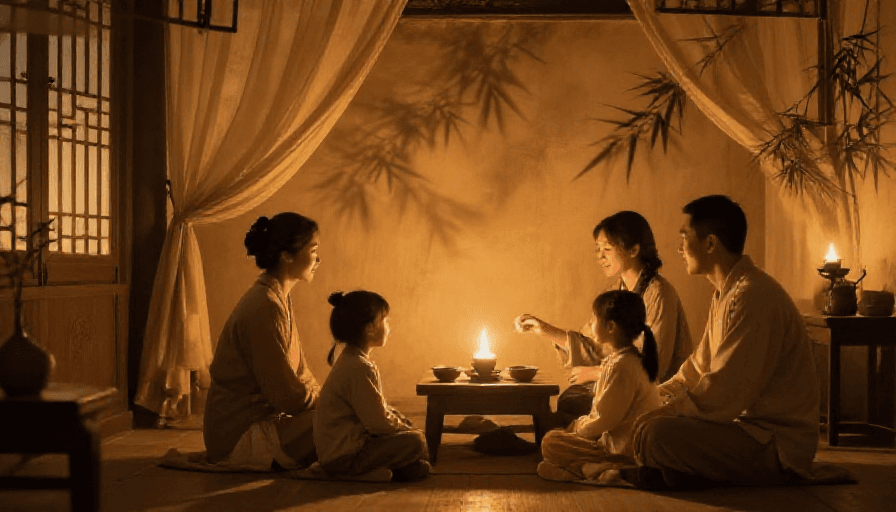
"Words have substance, actions have constancy" from the Family Hexagram is the simplest yet most profound wisdom for managing a family from three thousand years ago.
In 2024, 6.1 million new couples got married in China, while 3.51 million couples divorced. The divorce-to-marriage ratio is 57.5%—for every 100 couples registering for marriage, 57.5 couples registered for divorce during the same period.
What's even more disheartening are the reasons. Recent data consistently shows that over 70% of divorce cases are not due to infidelity or domestic violence, but because of "trivial family matters" and "personality incompatibility."
In plain terms: promises that aren't kept, rules that are set only to be broken, and disappointments that accumulate over time.
Three thousand years ago, the 37th hexagram of the 'Book of Changes,' the Family Hexagram, explained this perfectly in eight words.
Wind Arises from Fire: Why the Ancients Said Managing a Family Is Like Tending a Fire
The hexagram image of the Family Hexagram consists of Li (Fire) below and Xun (Wind) above. When fire burns, wind arises from it—wind arises from fire, family.
Seeing this image, the ancients summarized it in one sentence:
The superior person ensures that words have substance and actions have constancy.
Speech should have content and basis, not be idle talk; actions should have principles and perseverance, not be inconsistent.
Just these eight words.
They sound unremarkable? But think carefully: fire burning internally represents "inner clarity"—family members have principles and bottom lines in their hearts; wind blowing outward represents "outer harmony"—the harmony and upbringing displayed externally. Inner fire comes first, then outer wind.
A good family is not one without conflicts, but one with a constant set of rules for handling conflicts.
These eight words are divided into two halves. The first half, "words have substance," refers to what is spoken; the second half, "actions have constancy," refers to what is done. Let's look at them one by one.
Words Have Substance: Speech Should Carry Weight
"Words have substance" doesn't mean you need eloquence or the ability to flatter. It means: What you say should carry weight and be fulfillable.
The third line (Nine in the third place) of the Family Hexagram gives a vivid contrast:
The family is strict and stern; there is regret and danger, but good fortune. If the wife and children are frivolous and playful, there will be regret in the end.
"Strict and stern" refers to the sound of severe reprimands. In a family, if the head is strict in discipline, causing some resentment among family members and even self-doubt—"regret and danger"—the result? Good fortune. The family's way does not collapse.
Conversely, "frivolous and playful"—family members are carefree, without rules, doing as they please, seemingly joyful. The result? "Regret in the end." Problems will arise sooner or later.
Takashima Tanshō recorded a case: an official came to divine his fortune and got this line. Takashima interpreted: This person has a strong, unyielding nature, governing affairs meticulously, so subordinates inevitably complain. But precisely because of his strictness, affairs are orderly and won't fall into chaos. "Strict and stern," though bitter, is a hundred times better than "frivolous and playful."
Applying this to today's families makes the truth even more poignant.
The '2024 Blue Book on Family Education' surveyed nearly a million families and found a concerning statistic: among adolescents with high levels of parental emotional neglect, about 40% have varying degrees of depression risk. Researchers found that an important risk factor is "expressing high expectations in inefficient ways"—saying a lot but not following through; setting many rules but breaking them first.
Isn't this a typical portrayal of "words without substance"? Words spoken carry no weight, children don't trust you, spouses don't trust you, rules can't be established, and trust is gradually eroded.
Strictness is love, laxity is harm—the origin of this proverb is far older than you think.
Why Did Takashima Tanshō's Partnership Venture Get "Great Good Fortune"?
Just keeping promises isn't enough. "Actions have constancy" means persistently doing the right things, not being inconsistent.
Takashima Tanshō himself used this hexagram.
He and a friend planned to start a business together. Before beginning, they divined and got the fourth line (Six in the fourth place) of the Family Hexagram—"enriching the family, great good fortune." Takashima analyzed: The inner trigram Li represents me, the outer trigram Xun represents my friend; their compatibility indicates shared aspirations. The second and fourth lines are the ruling lines of the inner and outer trigrams, each taking a role and cooperating to succeed. The Xun trigram itself has the saying "near profit, thrice the market," fitting for business.
The result? The partnership indeed yielded substantial profits.
See, this "great good fortune" didn't fall from the sky. What's the premise? Each taking a role, clear division of labor, long-term persistence. The underlying logic of good partnerships and good family relationships is the same—each in their proper place, fulfilling their duties, and then persevering.
The final line (Nine at the top) of the Family Hexagram pushes this principle to the extreme:
Sincerity and awe-inspiring dignity bring good fortune in the end.
Honesty and trustworthiness, self-established dignity, ultimately bring good fortune. The commentary offers an even more subtle explanation: "The good fortune of awe-inspiring dignity refers to turning back to oneself." What does this mean? Dignity doesn't come from anger or power, but from "turning back to oneself"—reflecting and demanding of oneself.
True authority doesn't rely on volume, but on constancy. What you persistently do is more convincing than what you say.
Rectify the Family, and the World Will Be Settled
The commentary on the Family Hexagram has a passage that reads like solving an addition problem:
Let the father be a father, the son a son, the elder brother an elder brother, the younger brother a younger brother, the husband a husband, the wife a wife—then the family's way is rectified. Rectify the family, and the world will be settled.
The father fulfills the father's duties, the son fulfills the son's duties, brothers, husband and wife—each person fulfills their role properly, and the family's way is rectified. With the family's way rectified, extending outward, the world is settled.
Note, this isn't about hierarchical oppression. "Let the father be a father" doesn't mean the father can do as he pleases; on the contrary—it requires the father to first do "what a father should do." Each role has its own path to fulfill; no one can enjoy rights without fulfilling obligations.
But "rectifying the family's way" isn't achieved overnight. It precisely requires "actions have constancy"—the way to rectify a family has never relied on impulsive family meetings, but on day-after-day practice.
Two thousand years later, Zeng Guofan wrote in his family letters an almost identical sentiment:
"A person without constancy will achieve nothing in a lifetime."
He also reflected: "In my life, I have suffered greatly from the fault of lacking constancy." One of the most powerful figures in the late Qing dynasty, reflecting on his own "lack of constancy"—isn't this what the top line of the Family Hexagram calls "turning back to oneself"?
See, from the 'Book of Changes' to Zeng Guofan, spanning over two thousand years, they repeatedly say the same thing: Managing a family well doesn't rely on talent or luck, but on the daily practice of these four words: 'keeping one's word.'
Takashima Tanshō, summarizing the entire Family Hexagram, said something I think is the best conclusion:
"Words trustworthy within a family can be trusted in the world; actions visible within a family can be seen in the world."
If you keep your word and act with constancy at home, these skills work anywhere. Conversely, someone who doesn't keep their word at home will hardly be convincing outside.
The world's stability begins with the rectification of the family, and the family's rectification begins with your own cultivation. This has been said for three thousand years; it's not just ancient sentiment, but a questionnaire placed before every family.
So those eight words aren't some profound secret.
"Words have substance"—keep your word. "Actions have constancy"—persevere.
It sounds simple, but hard to do. But if done, the family is rectified.
Is there an "unwritten rule" in your family that everyone tacitly follows? Share in the comments.
References:
- 'Book of Changes: Family Hexagram'—hexagram statement, commentary, image statement, line statements, and line commentaries
- Takashima Tanshō, 'Takashima's Divinations'—Family Hexagram case
- Zeng Guofan, 'Zeng Guofan's Family Letters: Cultivation Chapter: To Ninth Brother'
- Ministry of Civil Affairs 2024 marriage registration data
- '2024 Blue Book on Family Education: Report on China's Family Parenting Environment'
Author: Nanhuang Shuo