
YiMatrix · Academy Journal
Fleeing with a 40-Degree Fever Overnight, the Inn Burned Down That Night: Nine True Stories from the Yi Hexagram 'Benefit' in the Book of Changes
Nine people at different crossroads in life asked the same question—how to gain benefit? Yet the answer pointed in the same direction: true gain never comes from taking inward, but
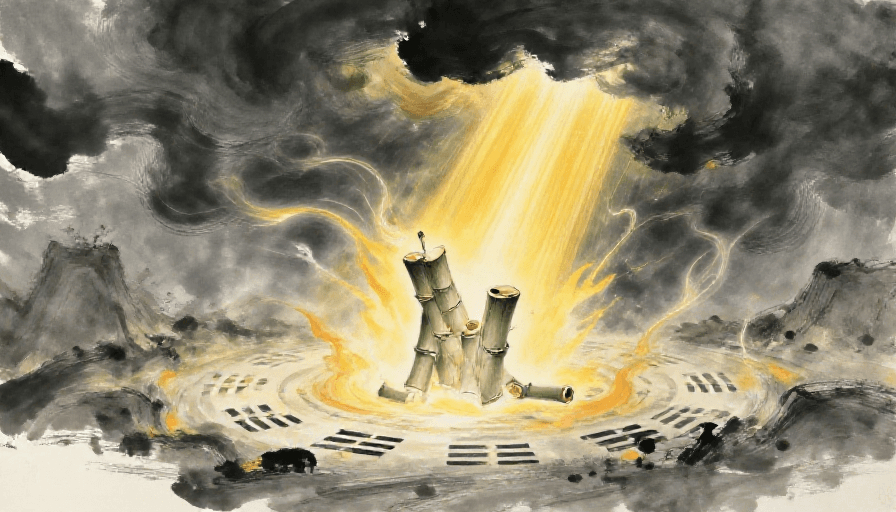
Nine people at different crossroads in life asked the same question—how to "gain benefit"? Yet the answer pointed in the same direction: true gain never comes from taking inward, but from giving outward.
April, Meiji 25, Sapporo, Hokkaido.
Takashima Tanshō—Japan's "Sage of the Changes"—had just taken office as president of the Hokkaido Coal Mine Railway Company a few days earlier. While inspecting the railway mines, he suddenly fell ill with stomach chills, his fever soaring over 40 degrees. A German doctor diagnosed him and insisted he be hospitalized the next day.
Takashima didn't rush to agree. He did something that seemed unthinkable to ordinary people—lying in bed, he cast a hexagram.
The divination yielded the third line of the Yi hexagram (Benefit).
Staring at the hexagram, he murmured: "'Benefit used in times of misfortune'—my illness may worsen. But 'no blame,' it won't be fatal." Then he noticed that the fourth line after the third said "favorable to rely on for moving the capital"—indicating a "move." Tomorrow will reach the fourth line, so it seems I should leave this place.
The German doctor tried to stop him: "With a 40-degree fever, how can you move!"
Takashima didn't listen. That night, he boarded a ship from Otaru despite his illness, arriving in Hakodate the next morning.
On the very night he left, a fire broke out in Sapporo. The inn where he had stayed was burned to ashes.
When the news spread, Sapporo newspapers exclaimed: Could this man have foreseen the fire?
Takashima later admitted: "I only asked about my illness, focusing on the illness itself, knowing there was misfortune but fortunately no blame, so I forced myself to move. I didn't anticipate a fire. Upon reflection afterward, the changing hexagram was the Jia Ren hexagram (Family), which contains Li—Li represents fire. The mystery of the Changes lies hidden in the images; I didn't see it at the time."
This story comes from the Yi hexagram chapter in Takashima's Divinations. Takashima Tanshō cast nearly a thousand divinations in his lifetime, and this chapter on the Yi hexagram is particularly rich—nine real people, at different crossroads in life, each asked a hexagram. Some asked about harvests, some about family fortunes, some about national destiny, some about investments. Yet the answers pointed in the same direction.

First, What Is the Yi Hexagram?
The Yi hexagram looks like this: below is the Zhen hexagram (Thunder), above is the Xun hexagram (Wind). Wind and thunder interact, their force intensifying—the louder the thunder, the fiercer the wind; the fiercer the wind, the stronger the thunder. Mutual enhancement—this is "benefit."
But the core spirit of the Yi hexagram is not "how to make oneself gain more," but eight words:
Reduce above to benefit below, and the people will be endlessly joyful.
Those in higher positions actively give their resources and power downward—the people rejoice, their joy boundless.
Does it sound like political philosophy? Indeed, it is. But on a personal level, this statement also holds true: What truly benefits you is not accumulating inward, but giving outward.
The Great Image commentary puts it more directly:
When you see goodness, move toward it; when you have faults, correct them.
Move toward goodness as swiftly as the wind, correct faults as fiercely as thunder.
These ten words are the Yi hexagram's guide for self-cultivation for everyone.
First Nine·Divining the Autumn Harvest: Those Who Follow Heaven's Ways Are Not Shortchanged by Heaven
Meiji 24 (1891), a local official asked Takashima to divine that year's autumn harvest.
The divination yielded the first line of the Yi hexagram.
Takashima spoke confidently: "The first line says 'favorable for great undertakings, supreme good fortune, no blame'—three positive terms combined: favorable, supreme good fortune, no blame, all good. 'Great undertakings' refers to 'eastern undertakings,' the spring planting. The hexagram name itself is 'Benefit,' and the Tuan commentary adds 'Heaven bestows and Earth gives birth, its benefit is boundless'—Heaven's way bestows, Earth's way gives life, the benefit is vast and limitless."
"This year's autumn harvest will surely be abundant. Thousands of granaries and ten thousand boxes, the people will benefit."
That autumn, it indeed turned out to be a bountiful year.
This story is the simplest, but its principle is the most fundamental: those who follow seasonal patterns and work diligently often gain more real benefit than any opportunistic shortcut.
Second Six·A Wealthy Family's Affairs: Why Some Families Prosper More and More
A friend came to Takashima on behalf of a wealthy magnate: How is this family's internal management? How long will their prosperity last?
The divination yielded the second line of the Yi hexagram.
Takashima analyzed: "The second line is in the center of the inner hexagram, yielding and in its proper place—this itself indicates the family's internal affairs are well-managed. Look at the line text: 'ten pairs of tortoise shells'—in ancient times, tortoise shells were the most valuable currency, 'ten' signifies fullness. 'Or benefit comes,' says the benefit flows from somewhere unknown—the Xiang commentary says 'from outside,' external sources of wealth and fortune actively gather toward him."
"But the key is three words: 'eternal perseverance brings good fortune.' Long-lasting adherence to correctness brings good fortune. This family's prosperity isn't temporary luck but the result of upright family values, honesty, and trustworthiness. The changing hexagram is Zhong Fu (Inner Truth)—symbolizing inner sincerity, further confirming: the foundation is 'trust.'"
Honestly, this hexagram applies equally in today's business world. Look at those century-old enterprises that have weathered cycles—none started with speculation and lasted a hundred years. Those that remain are the ones that engraved 'trust' into their bones.
'Eternal perseverance brings good fortune'—three words summarize the secret of all enduring endeavors.
Third Six·Immigration Enterprise: Benefiting in the Hardest Places Is True Benefit
A friend of Takashima's did something significant: purchased land on the U.S. West Coast, founded an immigration company, specifically helping impoverished and helpless people from their homeland emigrate overseas to engage in land reclamation and livestock farming.
He asked Takashima: What is my fortune?
The divination yielded the third line of the Yi hexagram.
Takashima said: "The third line discusses 'benefit used in times of misfortune, no blame'—bringing benefit in times of danger and misfortune, no disaster. This exactly describes what you're doing: opening paths for the impoverished and helpless, the most difficult and urgent act of benefiting the people."
"'Sincerity in the center'—the poor trust you, following in migration. 'Report to the duke with a jade tablet'—the government commends your achievements. Look at the later lines: the fourth line 'favorable to rely on for moving the capital,' the text is clearer; the fifth line 'sincerity and a benevolent heart,' virtue more evident—this is when your fortune will flourish."
"But one thing to note: the third line position is yin occupying a yang place, indicating an excessive desire for gain. As long as your aim is to aid the unfortunate and save the people, without personal bias, there will be no blame; once the heart inclines askew, blame will follow."
This story left a deep impression on me. Today we talk about "social enterprises" and "public welfare entrepreneurship," which sound modern, but over a hundred years ago, someone was already doing this. And the Yi hexagram's judgment is clear: Benefit isn't limited to favorable circumstances—extending aid where others see no profit is the highest manifestation of the Yi hexagram.
Fifth Nine·Adopting a Son: The Return of a Benevolent Heart
A friend without biological sons came to Takashima, wanting to adopt the son of a friend as a foster son, asking about the prospects.
The divination yielded the fifth line of the Yi hexagram.
Takashima immediately said: "This line text seems tailor-made for you—'sincerity and a benevolent heart, do not ask, supreme good fortune.' With sincere heart benefiting the foster son, whether it's auspicious need not be asked, supreme good fortune is already clear."
"The Yi hexagram takes 'reduce above to benefit below' as benefit. Applied to adoption, it means: You (above) reduce yourself to benefit this child (below). Treat him with sincerity, and he will naturally recognize you as father with true heart."
"'Sincerity benefits my virtue'—the child, benefiting from parental care in the future, will surely repay with virtue. Continuing the enterprise, perpetuating family traditions, prospering the clan. The changing hexagram is Yi (Nourishment)—symbolizing nourishment, father and son nourishing each other, proper order between elder and younger."
This is the warmest story in the Yi hexagram.
The fifth line is the core line of the Yi hexagram, and its message is singular: 'Sincerity and a benevolent heart'—giving with true heart, giving without seeking return. This act itself is 'supreme good fortune,' no need to ask further.
Applied today: If you treat someone well with true heart, without calculation or immediate return—this "benevolent heart" will eventually return in some form. Not necessarily in the form you expect, but it will return.
Top Nine·Robbed by a Friend: The Warning of Benefit Turning to Loss at Its Peak
The last two stories take a sudden turn.
A friend came to ask about fortune, and the divination yielded the top line of the Yi hexagram.
Takashima looked grave: "The Yi hexagram is originally a greatly auspicious hexagram. But you've drawn the top line—the top line resides at the peak of benefit, things at their extreme change. Not only no benefit, but likely harm."
"'No one benefits him'—no one will benefit you further. 'Or someone attacks him'—someone may harm you. 'Setting the heart without constancy'—people around are unpredictable, turning clouds and rain. The final word: misfortune."
The friend left anxiously.
A few days later, this person urgently needed money and borrowed 500 yen from a certain household. It wasn't enough, so he took the 500 yen to borrow more from another friend. Unexpectedly, this "friend" had recently fallen into ruin...
On his way back, he was ambushed by this "friend." Beaten and robbed of all the money.
Later, the thief was caught. The hexagram text "or someone attacks him, from outside"—the attack came from an unexpected direction, a former friend. "Setting the heart without constancy"—he borrowed everywhere, his heart unsettled, ultimately inviting disaster.
Top Nine·Amemiya Reappears: The Old Gambler Asks About Silver Prices
If you read my previous article on the Guai hexagram, you'll remember Amemiya Keijirō—the young gambler who earned 150,000 yen but was judged by Takashima as "hearing words but not believing," and indeed lost most of it fourteen days later.
Meiji 26 (1893), Amemiya visited again. This time, he didn't ask about personal fortune but a bigger question: The trend of international silver prices.
The divination yielded the top line of the Yi hexagram. Again, the top line.
Takashima started from the hexagram structure: "The lower hexagram Zhen represents dark yellow (gold color), the upper hexagram Xun represents white (silver color). Xun above Zhen below, silver's momentum high and gold's low—indicating silver production far exceeds gold, oversupply."
"'No one benefits him'—silver prices won't rise further, already peaked. 'Or someone attacks him'—prices will fall. 'Setting the heart without constancy'—the market will lack stability, fluctuating endlessly. Ending with 'misfortune'—a clear warning to those long on silver."
"The top line changes to the Tun hexagram (Difficulty), Tun means difficulty—silver prices falling, market difficulties abound."
Takashima added finally: "If relying only on paper currency to cope, I'm afraid it won't last long."
This analysis, viewed today, is like a textbook market analysis report: oversupply → peak signal → downtrend → market chaos → paper currency devaluation risk. Using not candlestick charts but hexagram images.
In Conclusion
Nine stories, nine lives.
From the first line to the top line, the Yi hexagram describes a complete arc:
The first line teaches following Heaven's ways—working diligently, Heaven doesn't shortchange. The second line tells eternal perseverance brings good fortune—the secret of lasting prosperity is adhering to correctness. The third line says benefit used in times of misfortune—benefiting in the hardest places is true benefit. The fourth line discusses center action reporting to the duke—promoting great deeds requires correct path plus authorization. The fifth line gives the hexagram's spirit—sincerity and a benevolent heart, do not ask, supreme good fortune—giving with true heart is itself the greatest good fortune. The top line warns no one benefits him, or someone attacks him—benefit at its peak inevitably turns to loss.
Honestly, what moves me most about the Yi hexagram is its "counter-intuitive" nature compared to common sense:
We always think "benefit" means adding to our own bowl. But the Yi hexagram says true gain is adding to others' bowls.
"Reduce above to benefit below, and the people will be endlessly joyful"—you reduce yourself to give to others, others' joy is boundless, and this joy ultimately returns to you. The fifth line "sincerity and a benevolent heart" is evidence: with sincere heart bestowing benefit, no need to divine, supreme good fortune is clear.
And those who only want to add to their own bowl? The top line already says it clearly: "No one benefits him, or someone attacks him. Setting the heart without constancy, misfortune."
One more thing worth noting. The Yi hexagram (42nd) precedes the Sun hexagram (Loss, 41st), and they are inverse hexagrams of each other—flip one and you get the other. Loss at its extreme turns to benefit ("loss without end must benefit"), benefit at its extreme also turns to loss. Loss and benefit cycle, never ceasing.
This is precisely the deepest wisdom of the Book of Changes: there is no eternal gain, no eternal loss. The key isn't whether you're in loss or benefit at the moment, but what heart you face it with—is it "sincerity and a benevolent heart," or "setting the heart without constancy"?
Have you had similar experiences—when giving to others, you unexpectedly gained more? Or conversely, the more you try to grasp something, the more it slips away?
Share your stories in the comments.