
YiMatrix · Academy Journal
Yin and Yang Are Not Opposites—The First Lesson You Learn in the I Ching, 90% of People Get Wrong
Yin and yang are not opposites. Let me repeat: yin and yang are not opposites. Open any book on the I Ching, and the first chapter almost always says: 'Yin and yang are opposites—b
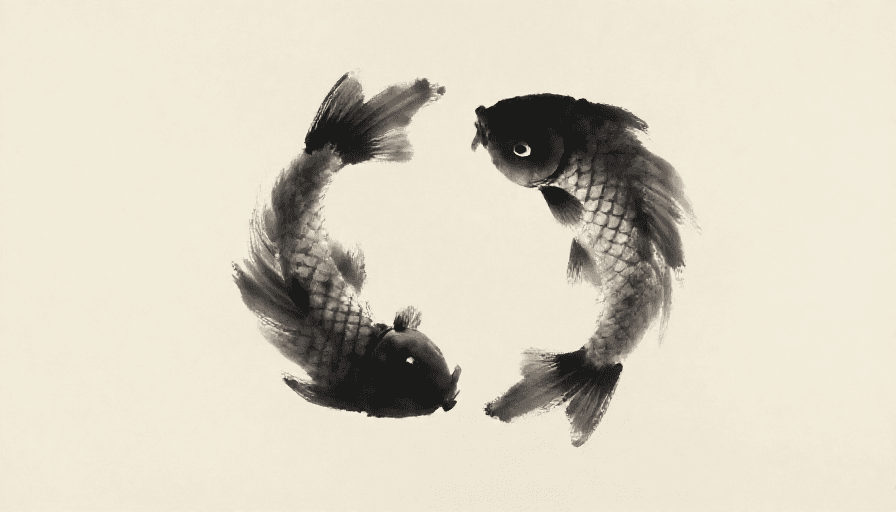
Yin and yang are not opposites.
Let me repeat—
Yin and yang are not opposites.
Open any book on the I Ching, and the first chapter almost always says:
"Yin and yang are opposites—black and white, male and female, good and bad."
This is a flaw passed down from the Republican era, later reinforced by the "unity of opposites" framework in high school politics classes, ingrained in generations of students.
It directly leads to one result: The harder you try to learn the I Ching, the less you get it.
It's not that you're not smart enough or diligent enough—it's that you were led astray from the very first step.
Without exaggeration, 90% of people who open the I Ching start off on the wrong foot.
And the nature of this study is that if the foundation is off by an inch, everything above is off by a mile.
The First Sentence of the Xici, Misread for Centuries
To discuss yin and yang, you can't avoid the Zhouyi·Xici.
Chapter 5 of the Xici Shang opens with:
Yi yin yi yang zhi wei dao, ji zhi zhe shan ye, cheng zhi zhe xing ye.
This sentence has been quoted countless times over millennia, but 90% of people have misread its emphasis.
Most read it as "yi yin / yi yang / zhi wei dao"—as if it says "yin and yang together constitute the Dao."
But look closely at the structure—"yi" yin "yi" yang—the emphasis is not on "yin and yang" but on the two "yi" (one/alternating).
"Yi yin yi yang" means "alternating yin and yang"—a shift, a flow. At one moment it contracts, the next it expands.
Zhu Xi's commentary on this line is straightforward:
"The alternating movement of yin and yang is qi. Its principle is what is called the Dao."
—"Alternating movement" means rotating operation. Yin and yang are a relay race, not a tug-of-war.
And the following phrase, "ji zhi zhe shan ye" (to continue it is goodness), further clarifies.
"Ji" means to continue, to inherit—yang passes the baton, yin takes it; yin passes it, yang takes it again.
It's not two people staring at each other—it's two people running a relay.
So the Xici itself makes it clear—
The Dao is not in one side or the other, but in the change itself.
Yin and Yang: The World's "Switch"
Once you delete "opposites," what are yin and yang?
Four words: a switching mechanism.
Here are four everyday correspondences:
| Yang (front stage, manifest state) | Yin (back stage, latent state) |
|---|---|
| Front stage | Back stage |
| Release | Accumulation |
| Execution | Preparation |
| Expansion | Contraction |
None of these pairs are "opposites."
The back stage is not the enemy of the front stage—it runs data for it.
Accumulation is not the opposite of release—it stockpiles ammunition for it.
Preparation is not the adversary of execution—it paves the way for it.
Contraction is not the mortal foe of expansion—it gathers momentum for the next round.
This is the true meaning of the two fish eyes in the Taiji diagram—
Within any pole, its opposite is already embedded.
They are not in conflict. They are handing over shifts.
So—
Yin is not idle; it is preparing conditions for the next change.
If you remember only one sentence from this article, remember this one.
It uproots the entire rhetoric of "opposites," soil and all.
Switching Is Not Random—It Has Its Own Rhythm
Knowing that yin and yang switch is not enough.
The more critical step is: this switching has a rhythm.
Three thousand years ago, this rhythm was already mapped out, called the Twelve Sovereign Hexagrams.
Without going into detail, let's look at the four key nodes on the main line:
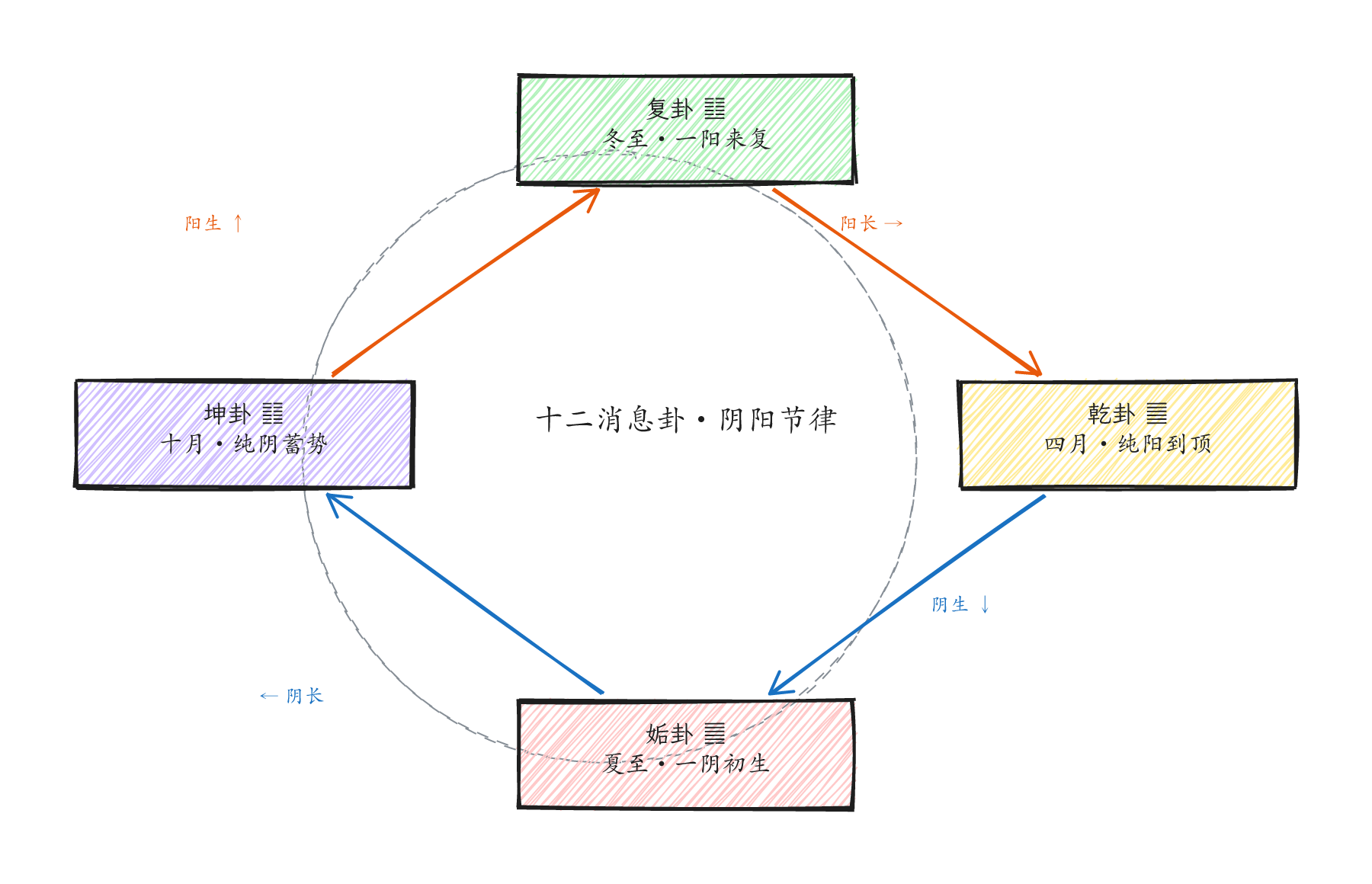
- Winter Solstice: the first yang energy stirs underground—the Fu hexagram, called "one yang returns"
- Around April-May: yang energy peaks—the Qian hexagram, pure yang six lines
- Summer Solstice: at yang's peak, the first yin energy quietly rises underground—the Gou hexagram, called "one yin begins"
- Around November: yin energy peaks—the Kun hexagram, pure yin six lines
- Then the next Winter Solstice, the Fu hexagram again, the cycle restarts
Yang grows for 6 months. Yin grows for 6 months. Symmetrical, stable, rhythmic.
Neither side is "primary" or "secondary."
Yin and yang are never at the peak forever, nor at the bottom forever.
This rhythm applies not only to the heavens but to everything around you:
Daytime yang reaches noon and begins to decline; at midnight, yin reaches its extreme, and at zi hour, one yang returns.
Inhalation is yang, exhalation is yin; exhalation is not the opposite of inhalation but its second half.
The four seasons: spring birth, summer growth, autumn harvest, winter storage. Autumn is not summer's opposite but its successor.
This article has thoroughly explained that "yin and yang are switching."
How to read the rhythm, how to use it, how to apply it to specific matters—the next article will focus on how to ground the Twelve Sovereign Hexagrams.
Why Did Emperor Xuanzong's Golden Age Collapse in Seven Years?
Yin and yang are never at the peak forever, nor at the bottom forever.
What happens if someone refuses to believe in this rhythm?
Let me show you a real, bloody case.
Emperor Xuanzong of Tang, Li Longji, ascended the throne in 712 and changed the era name to Kaiyuan in 713, ushering in the most glorious "Kaiyuan Golden Age" in Chinese history.
Du Fu later recalled those days in two lines:
"Remembering the Kaiyuan heyday, even small towns had ten thousand households."
The most ordinary small county had tens of thousands of families living in peace. This was the fullest yang moment—corresponding to the Qian hexagram's "nine in the fifth place: flying dragon in the sky."
But the Qian hexagram has one more line above that.
That is top nine: the arrogant dragon will regret.
Confucius, in the Wenyan Zhuan, defined "arrogance":
"'Arrogance' means knowing only how to advance but not how to retreat, knowing only how to exist but not how to perish, knowing only how to gain but not how to lose."
—"Arrogance" is knowing only how to charge forward, not how to turn back; knowing only how to hold on, not how to let go.
Emperor Xuanzong was exactly such an "arrogant dragon."
In 736 (Kaiyuan 24), he appointed Li Linfu as chancellor, beginning to exclude worthy talents; later, he doted on Yang Guifei and grew increasingly extravagant—in the words of the Wenyan Zhuan, the entire court began to "know only how to advance but not how to retreat."
The Zhouyi·Feng Hexagram·Tuan Zhuan had already warned:
"The sun reaches noon then declines; the moon becomes full then wanes. Heaven and earth wax and wane with time—how much more so for humans?"
The sun at noon must decline; the moon full must wane. Even heaven and earth ebb and flow with time—how much more so for humans?
But Emperor Xuanzong did not brake.
In the 11th month of 755 (Tianbao 14)—42 years after the start of the Kaiyuan era—An Lushan raised an army in Fanyang.
When the news reached Chang'an, the emperor initially dismissed it as infighting among officials.
Only on the seventh day, when urgent dispatches poured in like snowflakes, did he realize An Lushan had truly rebelled.
In panic, he executed two famous generals, Feng Changqing and Gao Xianzhi, on the spot—cutting down half the golden age's accumulated strength with his own hands.
Seven years and two months later (February 763), the An Lushan Rebellion was finally quelled.
In the same poem "Recalling the Past," Du Fu, right after the peaceful scenes, wrote the other side of war:
"Who would have heard that a bolt of silk costs ten thousand coins? The fields once planted with grain now flow with blood." "The palaces of Luoyang are burned to ashes; the ancestral temple is newly cleared of fox and rabbit dens."
A 42-year golden age collapsed in seven years.
Not because Emperor Xuanzong was incompetent—precisely because he was too capable, too full, too unwilling to turn back.
He didn't make a political mistake; he made an I Ching mistake—
He treated "yang" as eternal, refusing to leave room for "yin."
So—
When yang reaches its extreme, it must turn back.
This is not a moral lesson; it is a physical law.
Delete the Word "Opposites," and the Door to the I Ching Truly Opens
Back to the opening sentence—
Yin and yang are not opposites.
Yin and yang are switching.
They are a relay. A rhythm. Within any pole, its opposite is already embedded.
Delete the word "opposites" from your mind, and when you return to the Zhouyi—
"The interaction of the firm and the yielding gives rise to change"—you will no longer be stuck.
"Waxing and waning, fullness and emptiness"—you will no longer be confused.
"One yin, one yang is called the Dao"—you will reread those two "one" characters.
Reading this today, you have already passed the first hurdle of I Ching study.
The door behind is open.
Next Article Preview
This article has only clarified that "yin and yang are switching, not opposites."
Two more articles are coming—
Second article: How yin and yang move according to rhythm, how to use the Twelve Sovereign Hexagrams Third article: Three practical steps—judge the stage, see the imbalance, yin-yang before the five elements—to ground this foundational understanding into actionable methods for reading people, events, and situations
Don't get lost—click "Wow" so you can find the next post as soon as it's out.
Also, feel free to share this with that friend who always says "yin and yang are opposites"—once they catch up on this lesson, everything else they learn will go much smoother.