
YiMatrix · Academy Journal
Are You in the Fu Hexagram or the Guai Hexagram? The Ancients Used 12 Hexagrams to Define Life's Rhythms — A 3-Minute Self-Check
Are you in the Fu hexagram or the Guai hexagram? The ancients used 12 hexagrams to define life's rhythms—a 3 minute self check on yin and yang. You won't stay at the peak forever,
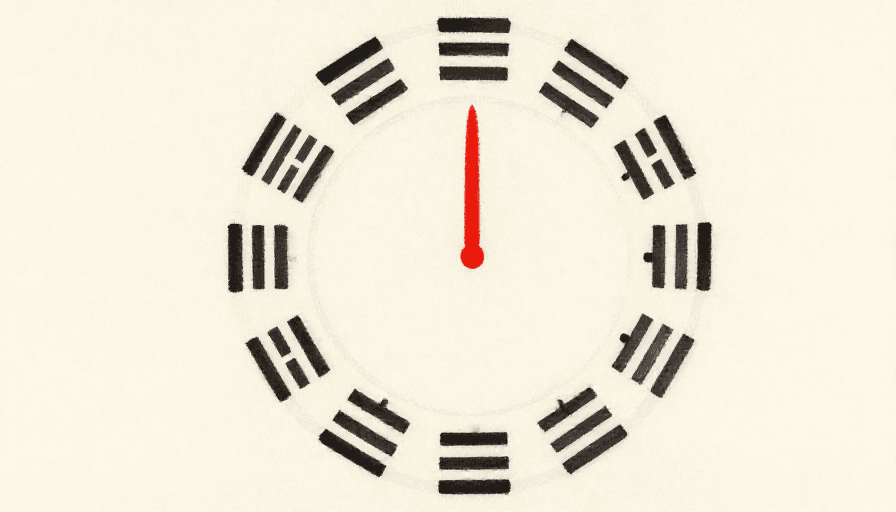
Yin and yang never stay at the peak forever, nor at the bottom forever.
The key to understanding yin and yang is rhythm.
This article is 2,500 words, a 3-minute read, but it will save you the effort of consulting 10 I Ching books later.
Last time, we discussed that yin and yang are not opposites but switches. Today, we talk about the second thing—this switch has a pattern.
The ancients spent thousands of years observing heaven and earth and carved this pattern into 12 hexagrams—called the 12 Disappearing and Appearing Hexagrams.
Understanding them allows you to answer three questions:
Where am I now?
Where will I go next?
At this moment, should I push forward or hold back?
Why Did the Ancients Say "Rhythm" Instead of "Cycle"?
You go to work during the day, sleep at night, and go to work again the next day—that's a cycle.
But you don't really think that "today's me" and "yesterday's me" are identical copies. There are changes, accumulations, and losses in between.
That's the difference between a cycle and a rhythm.
A cycle is mechanical repetition, like a clock. A rhythm is not. Rhythm is movement with direction, stages, and boundaries.
When the ancients spoke of rhythm, they meant something very specific:
First, it has direction. It moves toward a place, not spinning in place.
Second, it has stages. When you reach a certain stage, you do what that stage requires; when you move to the next stage, things change.
Third, it has boundaries. It doesn't rush forward indefinitely; it turns back when it reaches the limit.
Your breathing works this way: when you inhale to the top, you must exhale; when you exhale to the bottom, you must inhale.
The four seasons work this way: no matter how hot summer gets, it will pass; no matter how cold winter gets, it will end.
Your work, relationships, health, and fortune—all follow this pattern.
Understanding the word "rhythm" is more useful than memorizing the names of all 64 hexagrams.
A Yang Line Hides Underground at the Winter Solstice — How the Ancients Carved Rhythm into 12 Hexagrams
The ancients did something remarkable.
They matched each of the 12 months of the year with a hexagram, creating a complete "yin-yang movement chart"—the 12 Disappearing and Appearing Hexagrams.
| Lunar Month | Solar Term | Hexagram Name | Hexagram Image | Yang Lines | One-Sentence Characteristic |
|---|---|---|---|---|---|
| November | Winter Solstice | Fu (Return) | Earth over Thunder | 1 Yang | One yang returns, all things begin to sprout |
| December | Great Cold | Lin (Approach) | Earth over Lake | 2 Yang | Yang energy rises, vitality gradually appears |
| January | Rain Water | Tai (Peace) | Earth over Heaven | 3 Yang | Three yangs bring peace, heaven and earth interact |
| February | Spring Equinox | Da Zhuang (Great Strength) | Thunder over Heaven | 4 Yang | Thunder shakes the sky, all things grow strong |
| March | Grain Rain | Guai (Resolution) | Lake over Heaven | 5 Yang | Yin energy nearly exhausted, yang alone prevails |
| April | Grain Buds | Qian (Heaven) | Heaven over Heaven | 6 Yang | Pure yang peak, prosperity turns to decline |
| May | Summer Solstice | Gou (Encounter) | Heaven over Wind | 5 Yang | One yin begins to arise, extremes reverse |
| June | Great Heat | Dun (Retreat) | Heaven over Mountain | 4 Yang | Yang energy retreats, yin energy grows |
| July | End of Heat | Pi (Stagnation) | Heaven over Earth | 3 Yang | Heaven and earth do not interact, blockage |
| August | Autumn Equinox | Guan (Contemplation) | Wind over Earth | 2 Yang | Yin prevails over yang, killing atmosphere |
| September | Frost Descent | Bo (Falling) | Mountain over Earth | 1 Yang | Yin erodes yang, only one yang remains |
| October | Light Snow | Kun (Earth) | Earth over Earth | 0 Yang | Pure yin at bottom, rest and wait for return |
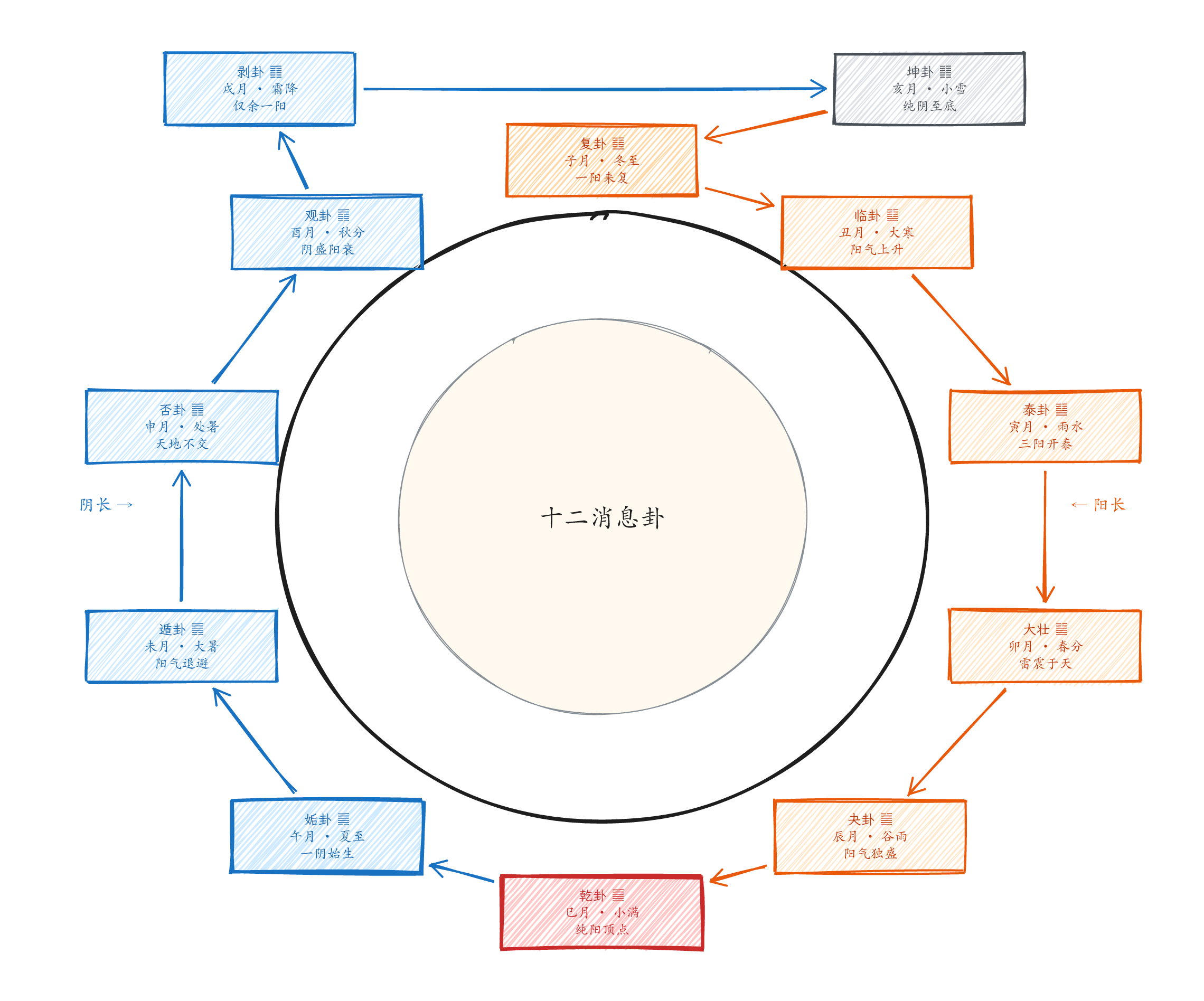
You only need to focus on two points in the entire chart.
One is the Winter Solstice—on the surface, it's the coldest day of the year, with the lowest sun and shortest daylight, seemingly full of yin. But the ancients said, at this very moment, deep underground, that yang line has quietly risen—this is the Fu hexagram, "one yang returns."
The Tuan Zhuan (Commentary on the Judgment) of the Fu hexagram has only one sentence, but it carries immense weight:
"Fu, it reveals the heart of heaven and earth." — Zhou Yi, Fu Hexagram, Tuan Zhuan
Meaning: Look at the Fu hexagram—this yang line emerging from the very bottom—this is the true heart of heaven and earth. The deepest secret of the entire universe lies in the fact that "something is returning in an invisible place."
The other is the Summer Solstice. On the surface, it's the day with the most yang energy, the highest sun and longest daylight. But the same principle applies—at this moment, that yin line underground has also quietly risen. This is the Gou hexagram, "one yin begins to arise."
Yang goes for 6 months to its peak, then yin takes over. Yin goes for 6 months to its bottom, then yang takes over. Symmetrical, stable, never stopping.
So—
The Fu hexagram's one yang arises—even where you can't see, light has already begun to return.
Open Your Phone Calendar: Which of the 12 Hexagrams Are You In Right Now?
Knowing these 12 hexagrams is useless; using them is what matters.
Next are three questions that represent the real application of this rhythm. Read and match yourself as you go—
First question: Which of the 12 hexagrams are you in right now?
There are two ways to check.
First, check by lunar month. Look up the lunar date on your phone calendar and match it to the table above—the lunar month corresponds to a hexagram. For example, the 11th lunar month is Fu, the 4th is Qian, the 10th is Kun. This is the "default coordinate" given by the rhythm of heaven and earth.
Second, match by your current life situation. This usage is more valuable because life's rhythm doesn't always follow the natural solar terms. Have you been overwhelmed lately, pushing hard without results? You're likely in the Bo hexagram—only one yang line left, barely holding on. Have things been going so smoothly that even you feel a bit unsteady? You're likely in the Qian hexagram—pure yang peak, with a reversal already on the way. Have you been holding back for a long time and suddenly had a new idea or opportunity, small but tempting? That's the Fu hexagram—that yang line underground has just emerged.
You can use both methods together. The lunar month gives you the rhythm of heaven, and your life situation gives you your own rhythm. If they align, go with the flow most effortlessly. If they don't, prioritize your own rhythm.
Second question: What is the "right thing to do" at this stage?
Each hexagram has its appropriate actions. Doing the wrong thing goes against the rhythm—
- In the Bo stage, you should conserve. It's not retreat; it's protecting that last yang line. Pushing too hard at this stage is most damaging.
- In the Fu stage, you should test the waters. A small move, a small investment, a small attempt—don't go all in right away; that yang line is still tender.
- In the Tai stage, you should expand. Three yangs bring peace, heaven and earth interact—this is the window to act. Being conservative at this stage is a waste.
- In the Qian stage, you should brake. It sounds counterintuitive—why brake when you're strongest? Because the next hexagram is Gou, and the reversal is already knocking. The Yao text of Qian's top line warned long ago: "A dragon flying too high will regret." — Zhou Yi, Qian Hexagram, Wenyan Zhuan
By now, you probably understand—rhythm is not mysticism; it's a law.
Share this with a friend who always doubts themselves in the low points—they're likely stuck in their life's Bo stage. What they need isn't a "keep going" but this chart. Tell them: the Fu hexagram is coming soon.
Now comes the part that's truly useful—and the hardest step in the entire rhythm system.
Third question: How far away is your next turning point?
This is the hardest and most valuable part of the entire rhythm system. The ancients gave it a special name: "Zhi Ji" (Knowing the Subtle).
In Xici II, Chapter 5, there is a sentence:
"Ji is the subtle movement of things, the first sign of good fortune." — Xici II, Chapter 5
In plain language—"Ji" refers to the slightest hint of something just beginning to move, not yet formed. It's the omen that can be seen before good or bad fortune manifests. To put it even more directly: when a thought like 'something feels off' arises in your mind, that thought itself is Ji.
On the Summer Solstice, the surface is still scorching, but that yin line underground has already risen—that's the Ji of heaven and earth.
Where is your Ji? Here are three specific practice scenarios. The next time it appears, don't ignore it—
Ji in work. When you're in a meeting and suddenly feel, "The atmosphere in today's meeting is a bit off," the boss's smile seems different, or a colleague's words carry an unusual caution—that moment of "something feels off" is your Ji at work. Ordinary people tell themselves, "I'm overthinking it," and continue the meeting. Those who use rhythm immediately mark it mentally, review the meeting afterward, and prepare a response three days in advance.
Ji in relationships. When you have dinner with a long-time friend, they're still laughing and chatting about usual things, but you suddenly feel, "Their laugh seems fake," or they say a polite phrase you've never heard before—that moment of "feeling fake" is your Ji in relationships. Ordinary people pretend not to notice and maintain a superficial good relationship. Those who use rhythm proactively arrange a one-on-one chat to address that hint. Whether the relationship can be repaired or should be let go, it's much easier than waiting until it collapses.
Ji in health. When you wake up with a dry throat, a slight tension in your temples, or you usually climb six flights of stairs without issue but today feel like stopping at the third—that moment of "something's not right" is your Ji in your body. Ordinary people drink some water and go out. Those who use rhythm immediately cancel tonight's social engagements, scrap late-night plans, and give their body a three-day window to self-repair.
Do you see the common thread? Ji is never a big event; it's the tiny signal so small it's almost ignored before the big event happens.
So—
Zhi Ji is not prophecy; it's moving the decision window forward by three days.
Ordinary people react only when things hit them. Those who use rhythm move at the first sign. Acting three days earlier reduces the cost by an order of magnitude; acting three days later could mean irreversible imbalance.
Zhi Ji means knowing the subtle—seeing that slight hint before things happen.
Leave a comment telling me which hexagram you're in today and where your most recent "Ji" appeared. I'll pick the five most striking ones and reply with your next steps.
So what the ancients valued most was not "predicting what will happen tomorrow" but this sentence—
After the peak comes a beginning, not an end.
After the bottom also comes a beginning, not an end. Every stage connects to the next, and the entire chart keeps turning.
Next Time: How to Tell from the Outside That Someone's Rhythm Has Gone Out of Balance
For this article, just remember four words:
Rhythm / Stage / Reversal / Zhi Ji.
It took me until my tenth year of studying the I Ching to truly understand "rhythm." Before that, I thought I was smarter than fate—until I experienced a complete "Bo to Fu" cycle myself and realized why the ancients carved these 12 hexagrams into the shape of a year. It's not a divination tool; it's a map to keep you from being proud at the peak or despairing at the bottom.
If you have a friend in the "Bo stage"—work not going well, relationships stuck, health poor—share this article with them. Tell them: The Fu hexagram is on its way; light has already returned from the deepest place.
I suggest you bookmark this 12-hexagram table and check it at the beginning of each month to compare with yourself.
Next time, we'll discuss the second step in practice: How to tell from the outside that a person or situation's rhythm has gone out of balance. Using Steve Jobs' story of being ousted from Apple by the board in 1985 and returning in 1997, we'll explain what "Bo to Fu" means—what signals can outsiders see when a person is at the bottom of the Bo hexagram? And what does the emerging yang line of the Fu hexagram look like?
I've broken this "Yin-Yang System Course" into five parts. Follow me, and I'll post one part each week.
Don't get lost.