
YiMatrix · Academy Journal
The Fu, Guai, Gou, and Kun Hexagrams—Which Step Are You Stuck On? The Ancients Could Tell in 3 Steps
Three step Yin Yang diagnosis: judge the phase, check for imbalance, and prioritize Yin Yang over the Five Elements. These three steps, left by the ancients, let you see things thr
In the previous two articles, we covered two things:
Yin and Yang are about switching, not opposition (#1), and this switching has a rhythm hidden in 12 hexagrams (#2).
But after reading them, many people ask me the same question:
"I understand the theory, but how do I actually use it?"
Today, in 5 minutes, I'll give you the answer.
Once you understand the rhythm, the next step is to see: Which step are you stuck on right now?
The diagnostic method left by the ancients has only three steps:
Judge the phase, check for imbalance, and prioritize Yin-Yang over the Five Elements.
Once these three steps are firmly in your mind, you'll never be confused when looking at any hexagram, any birth chart, or any situation.
First, Let's Be Clear: This Is a Tool, Not Mysticism
Let me say this upfront:
Yin and Yang are not for pondering; they are for using.
It has nothing to do with "meditation or sudden enlightenment." It's more like pulse diagnosis in Chinese medicine or auscultation in Western medicine—a repeatable diagnostic process: find symptoms, judge the phase, and give a solution.
In the second article, I gave you the map of the 12 message hexagrams. The map itself won't take you home—you need to know how to read it.
This article is the instruction manual for reading the map.
The three steps are fixed:
Step One—Are you currently in a phase of Yang growth or Yin growth?
Step Two—In this phase, is your structure imbalanced?
Step Three—After determining Yin and Yang, then look at the Five Elements. Never do it in reverse.
Let's break it down step by step.
Step One: Judge the Phase First, Then Judge Good or Bad
In the "Xici Xia Zhuan·Chapter 1," there is a sentence that serves as the general principle for this step:
Biantong zhe, qushi zhe ye.
—So-called flexibility means following the trend of the times.
What is the "trend of the times"? Applied to specific people and events, it means which segment of the Yin-Yang rhythm you are currently in.
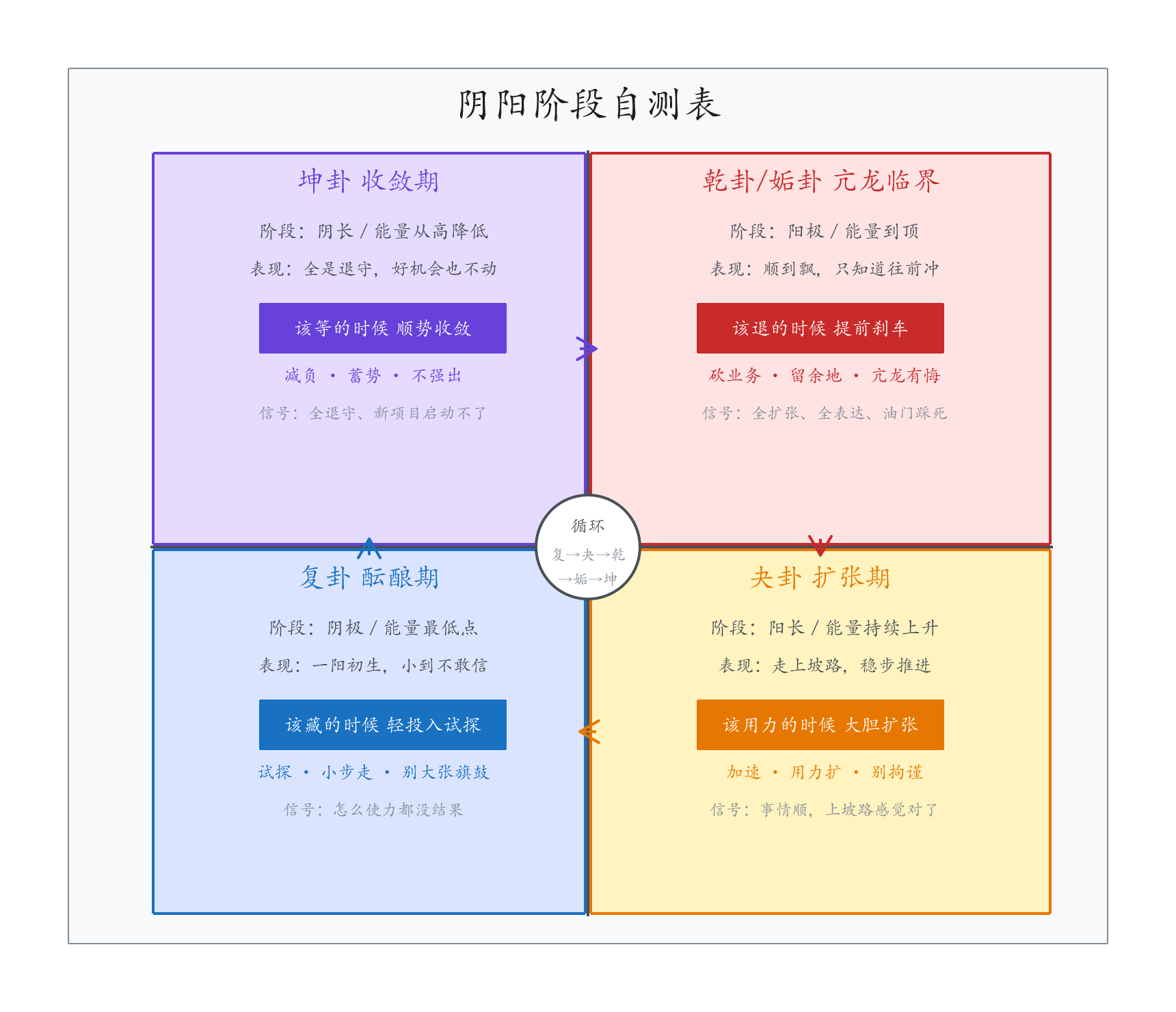
You don't need to memorize the entire chart of the 12 message hexagrams from the second article. Just keep these five key points in mind:
| Your Current State | Corresponding Hexagram | Rhythm Phase | What to Do |
|---|---|---|---|
| A new idea just emerges, so small you hardly believe it yourself | Fu | One Yang begins | Test, invest lightly |
| Things are progressing steadily, feeling like you're on an uphill path | Tai | Three Yangs bring prosperity | Expand vigorously, don't hold back |
| Things are going so smoothly you feel a bit dizzy | Guai | Five Yangs at the brink | Brake in advance |
| A slightly uncomfortable small signal just appears | Gou | One Yin begins | Be immediately alert |
| No matter how hard you try, you see no results, just want to hide | Kun | Pure Yin at the bottom | Withdraw, conserve, gather strength |
Stop here and check yourself:
Which box does the thing you've been investing the most energy in recently fall into?
If you can't answer, don't read further. If the first step isn't solid, the next two steps are empty.
Note one thing: Judging the phase is not the same as judging good or bad. Kun is not bad, and Fu is not good. Each box has its appropriate actions; do them right and it's auspicious, do them wrong and it's inauspicious.
Judge the phase, check for imbalance, and prioritize Yin-Yang over the Five Elements—this is the diagnostic method the ancients have used for three thousand years.
Step Two: Check if Your Current Structure Is Imbalanced
After judging the phase, the next step is to look at your "structure" within this phase:
Is the ratio of Yang to Yin correct?
In the "Qian Hexagram·Shangjiu" line statement, there are four words:
Kang long you hui.
—A dragon in the sky has regret.
The "Wenyan Zhuan" defines the word "kang": "Knowing only to advance but not to retreat, knowing only to exist but not to perish, knowing only to gain but not to lose." Only knowing to charge forward, not to turn back; only knowing to hold on, not to let go.
Imbalance has only two forms:
One is Yang extreme without retreat: Continuing to step on the gas when you should brake.
The other is Yin extreme without advance: Continuing to stay silent when you should act.
Imbalance is not a mistake; it's a failure to switch in time.
Back to yourself. The signals of imbalance are actually very specific. Check the following four items to see if any apply to you in the past week:
□ All movement, no stillness: Pushing three projects simultaneously, emails never stop, replying to work messages on weekends
□ All expansion, no contraction: Constantly adding new business, new relationships, new commitments, without reviewing or cutting
□ All expression, no internalization: High output on social media, near-zero reading, input far less than output
□ All retreat, no attack: Good opportunities come and you say "the timing isn't right," asked about a new project three times but haven't started
If you checked two or more—imbalance is already happening. The first two are Yang extreme, the last two are Yin extreme.
Step Three: Yin and Yang Always Come Before the Five Elements
This step is the most important of the entire article—and it's the step that 90% of people studying the I Ching haven't corrected even after years of study.
Yin and Yang come before the Five Elements— If you don't first see whether you are at Yang extreme or Yin extreme, talking about the Five Elements is useless.
In the "Xici Shang Zhuan·Chapter 11," there is a sentence quoted for thousands of years:
Yi you taiji, shi sheng liangyi, liangyi sheng sixiang, sixiang sheng bagua.
Note the order:
Taiji → Yin-Yang → Four Symbols → Eight Trigrams.
The Five Elements are not in this sequence. They are the mode of operation after Yin and Yang unfold, the second layer of diagnosis, not the first.
But many people start learning the I Ching from the Five Elements—what element is lacking, what to supplement. It seems systematic, but in fact, the root is twisted.
Let me give you an example, and you'll understand immediately:
Take the same birth chart with "Fire strong."
In a Yang growth phase, strong Fire helps the momentum—things rise with the trend, burning brighter.
In a Yin extreme phase, strong Fire is a drain—superficial excitement, empty inside, burning emptier.
The same Five Element, in different Yin-Yang phases, has completely opposite auspiciousness.
Forward this to that friend who always says, "I lack such-and-such element, so I need to supplement it." He hasn't been slacking; he learned the order backward.
If you skip Yin and Yang and go straight to the Five Elements, you'll end up with things like:
"I lack Water in my Five Elements, so I need to drink more water and be around water."
—This is mistaking the mode of operation for the fundamental law. It's like a Chinese doctor prescribing without taking a pulse—how often can that be right?
Finally, here's a self-test for you:
When you open a birth chart or look at a hexagram, do you first go straight to the Five Elements?
If so, next time try the reverse—first look at the Yin-Yang phase, then the Five Elements structure. Within a week, you'll find that many hexagrams you couldn't understand suddenly become readable.
The "Xici Xia Zhuan·Chapter 5" already gave the criterion:
Junzi jian ji er zuo, bu si zhong ri.
—A gentleman acts as soon as he sees the sign, without waiting until the end of the day (when the situation is fully clear).
This is the whole purpose of the three-step diagnostic method: to let you see things three days before they hit you.
A Solid Case: Why Emperor Xuanzong of Tang Didn't Brake
Now that the three steps are explained, let me give you a solid case—someone in history who completely reversed all three steps.
I've already told the story of Emperor Xuanzong of Tang in the first article, about how he didn't brake. Today, let's look from another angle—his "kang" is clearly recorded in three things in historical records:
First, neglect of governance—During the Tianbao era, he entrusted all military and state affairs to Li Linfu, a treacherous prime minister who dominated the court for nearly 19 years (736–752).
Second, favoritism toward powerful ministers—After Li Linfu came Yang Guozhong, and anyone who dared to speak out in court was purged.
Third, indulgence toward An Lushan—He allowed a non-Han military governor to simultaneously control the troops of Fanyang, Pinglu, and Hedong, trusting him without doubt.
None of these three things alone would have led to the fall of the empire. The problem was that they all occurred after the critical point of the Guai hexagram—Yang energy was already overflowing, yet he kept adding more.
He failed to judge the phase (already past Guai), failed to see the imbalance (all three were Yang extreme without retreat), and the Five Elements didn't even come into play—this is the result of reversing the entire diagnostic method.
In 755, An Lushan raised troops in Fanyang, and by 763, Shi Chaoyi hanged himself. The An Lushan Rebellion lasted over seven years. The 42-year Kaiyuan盛世 ended just like that.
The "Feng Hexagram·Tuan Zhuan" had already said it clearly:
Ri zhong ze ze, yue ying ze shi, tian di ying xu, yu shi xiaoxi.
—When the sun reaches noon, it begins to set; when the moon is full, it begins to wane. Heaven and earth wax and wane with time—how much more so for humans?
Emperor Xuanzong had court astronomers, the Imperial Observatory, and many Confucian officials well-versed in the I Ching. It wasn't that he couldn't see the hexagrams; it was that after seeing them, he didn't take the next step:
It is heaven that carves the rhythm into hexagrams; it is humans who use the three steps to understand the rhythm.
Three Steps in Summary | Yin-Yang Module Conclusion
Let me compress today's three steps into one sentence:
First judge the phase (are you in Yang growth or Yin growth), then check for imbalance (is the structure correct), and only then look at the Five Elements (how to specifically supplement).
This is the diagnostic method left by the ancients.
It took me ten years of studying the I Ching to truly use these three steps smoothly. Looking back, I realized that the ancients had already drawn the answer on the map; I was just standing in the wrong place. In the early years, I always thought, "If I memorize one more formula, I'll have an epiphany," but the more I memorized, the more confused I became. It wasn't until I corrected the order—"Yin and Yang before the Five Elements"—that those hexagrams I couldn't understand and those situations I couldn't judge gradually fell into place.
The Yin-Yang module concludes here. Read the three articles together:
#1 Yin and Yang are switching → #2 Switching has rhythm → #3 Rhythm can be diagnosed.
Forward this to that friend who has been studying the I Ching for years but is still stuck on the Five Elements—this article can save them years of detours.
Also, don't forget to click "Watching" so you can find me in time for the next post.
Next Article Preview
Next week, we officially enter Five Elements #1—
Many people think the Five Elements are five substances—metal, wood, water, fire, earth—so they agonize over "I lack metal, so I need to wear metal accessories."
Wrong.
The Five Elements are not five substances; they are five modes of operation.
In the next article, I'll explain this clearly—the Five Elements are about "how things move," not "what things are." Once you understand this, the Five Elements will truly be usable.
Updated every Tuesday, Thursday, and Sunday at 22:30.