
YiMatrix · Academy Journal
The Five Elements Are Not Metal, Wood, Water, Fire, and Earth—They Are 5 Modes of Operation
The Five Elements are not five substances but five modes of operation. The 22 characters in the 'Book of Documents·Hongfan' contain no nouns—only verbs. From Qin Shi Huang dyeing h
Have you ever felt this way when working—
Sometimes you want to rush outward, expand, and can't stop;
Other times you want to pull back, simplify, and set rules;
Sometimes you're exhausted but still force yourself to "hold on a little longer."
This isn't a split personality. It's you switching between 5 modes of operation.
These 5 modes have a name you hear every day, but 90% of people get it wrong—the Five Elements.
The Five Elements are not metal, wood, water, fire, and earth—they are 5 modes of operation.
This article takes 3 minutes to read, but afterward, you'll see everything from a different perspective.
In 221 BC, Qin Shi Huang used this logic to dye the entire empire black.
Qin Shi Huang Dyed His Empire Black: China's Earliest "Algorithm"
In 221 BC, Qin Shi Huang unified the six kingdoms.
The first thing he did was not appoint officials or grant titles—it was changing colors.
Flags were dyed black, official robes were dyed black, horses were dyed black. The start of the year was moved from the first month to the tenth month. The Yellow River was renamed "De Water." Even numbers were regulated—everything was based on the number six: official hats were six inches, carriages were six feet, and chariots were pulled by six horses.
Why?
The Records of the Grand Historian·Annals of Qin Shi Huang records clearly:
The First Emperor deduced the succession of the Five Virtues, believing that the Zhou dynasty had the virtue of fire, and Qin replaced Zhou's virtue by overcoming it. Now that the virtue of water had begun, he changed the start of the year, with court audiences all beginning on the first day of the tenth month. Clothing, banners, and flags all honored black.
In translation—Qin Shi Huang applied a theory called the "Cycle of the Five Virtues." His conclusion: The Zhou dynasty had the virtue of fire, and Qin, replacing Zhou, relied on the virtue that overcomes it. The era of water virtue had begun, so the year's start was moved to the tenth month, and all attire and flags were black.
Who proposed this "Cycle of the Five Virtues"? The Warring States yin-yang philosopher Zou Yan.
The Lüshi Chunqiu·Yingtong preserves a passage generally attributed to Zou Yan:
That which replaces fire must be water. When the qi of water prevails, its color is honored as black, and its affairs follow water.
In other words—what replaces the virtue of fire must be the virtue of water. Water overcomes fire—this is the logic ordained by heaven.
Qin Shi Huang changing colors was not superstition; it was China's earliest "algorithm for dynastic legitimacy."
The Zhou dynasty had the virtue of fire, Qin had the virtue of water, and water overcomes fire—this was the logic of regime change.
How long was this algorithm used? After Qin's water virtue, the Western Han switched to fire virtue, and the Tang dynasty switched to earth virtue. For over two thousand years, every time a dynasty changed, the new dynasty's first task was to recalculate its own "virtue" according to the Five Elements.
But here's a problem—metal, wood, water, fire, and earth are all substances. How can a substance "overcome" another substance?
Can a stone "overcome" a tree? Can a cup of water "overcome" a match? It sounds like children fighting.
So where's the problem? It lies in our misunderstanding of the "Five Elements."
The 22 Characters Defining the Five Elements in Ancient Texts Contain No Nouns
To answer this, we must go back to one of China's oldest sources—the Book of Documents·Hongfan.
It describes the Five Elements in just 22 characters:
Water: soaking and descending; Fire: blazing and ascending; Wood: bending and straightening; Metal: following and reforming; Earth: sowing and reaping.
Notice a detail: The first four use "X yue" (X is characterized by), while for earth it uses "tu yuan jia se" (earth then sowing and reaping). "Yuan" means "then," and the whole sentence translates to: Water's nature is to soak downward; Fire's nature is to burn upward; Wood's nature is to bend and straighten; Metal's nature is to cut and reform; Earth's nature is to sow and harvest.
Look closely at these 22 characters—not a single noun.
Soaking and descending, blazing and ascending, bending and straightening, following and reforming, sowing and reaping—all are verbs.
"Xing" (行) itself is a verb. It means to walk, to flow, to operate.
Metal is not metal, wood is not wood, water is not water droplets. They are 5 modes of how things operate.
This is the biggest difference between ancient Chinese and ancient Greek thought.
The ancient Greeks also spoke of four elements—earth, water, fire, and air. But they were talking about "what everything is made of"—a theory of substances. So when atomism emerged, the four-element theory was replaced.
Chinese Five Elements talk about "how everything operates"—a theory of patterns. So after 3,000 years, it still lives in traditional Chinese medicine, fortune-telling, solar terms, and diet—because operational patterns cannot be replaced by atomism.
5 Modes of Operation: Which One Are You In?
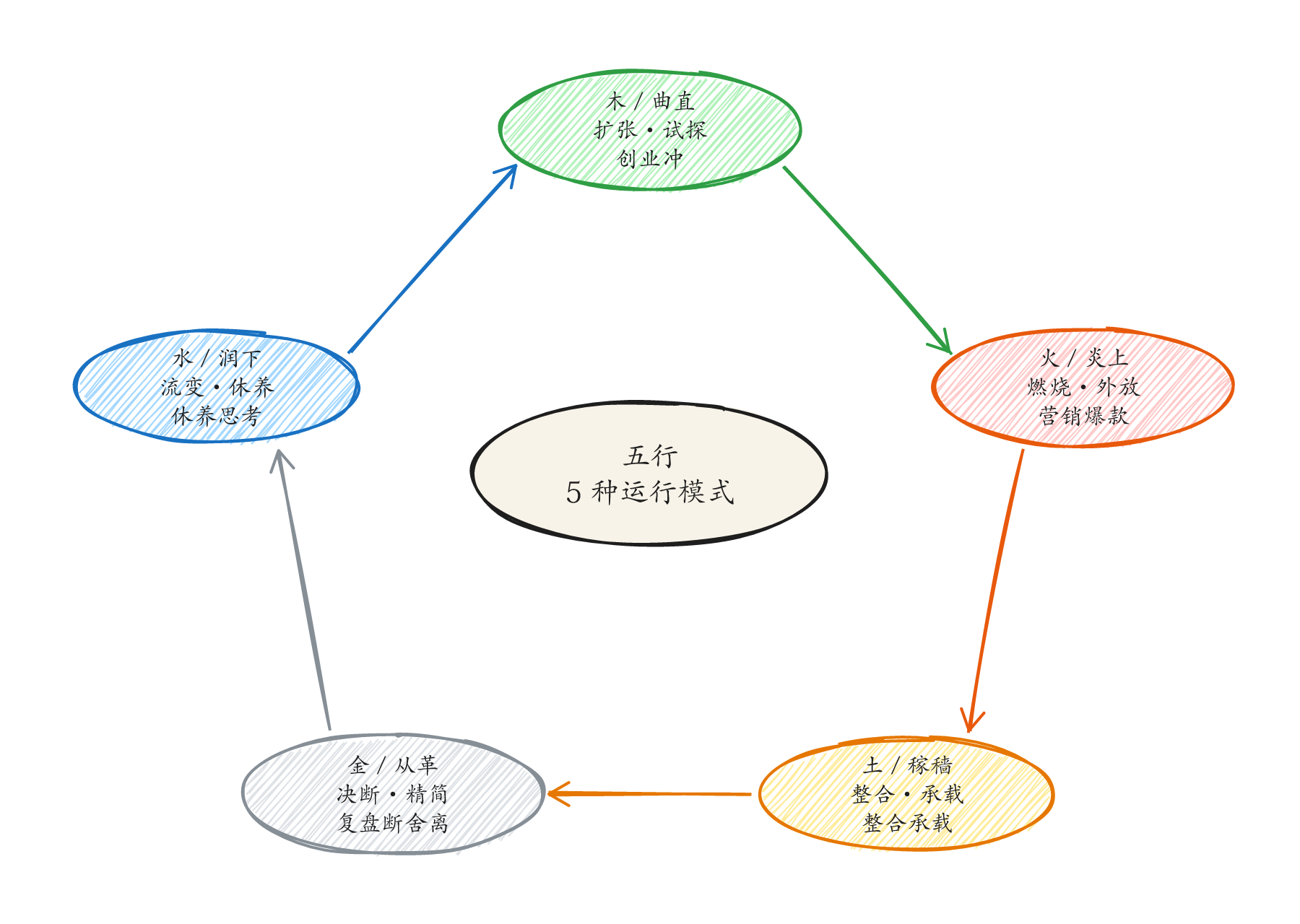
What do these 5 modes look like?
1. Wood—Germination and Upward Movement
Like spring grass, finding light even around stones.
Characteristics: Expansion, exploration, spreading out, unstoppable.
When you're in wood mode: Starting a business, building muscle, learning a new skill, laying the groundwork in a new relationship.
2. Fire—Blazing and Spreading
Like the summer sun, radiating in all directions.
Characteristics: Burning, outward expression, passion, peak productivity.
When you're in fire mode: Creating viral marketing, giving passionate speeches, leading a community to scale, in a high-exposure phase of your career.
3. Earth—Sowing and Reaping, Bearing
All seeds eventually return to the earth.
Characteristics: Integration, bearing, transformation, turning chaos into system.
When you're in earth mode: Building platforms, organizing and decluttering, managing and coordinating, maintaining long-term relationships, digesting and absorbing the results of the previous stage.
4. Metal—Following and Reforming, Convergence
Like the autumn sickle, cutting away everything unnecessary.
Characteristics: Decision-making, simplification, rule-setting, subtraction.
When you're in metal mode: Doing quarterly reviews, decluttering, cutting projects, declining unnecessary social engagements, tightening budgets.
5. Water—Soaking and Descending, Hiding
Like a deep winter well, the quietest but deepest.
Characteristics: Flow, rest, reflection, timing.
When you're in water mode: Settling, reading and recharging, deep thinking, waiting for opportunities, slowing down when unwell.
Send this to that friend who always says, "I'm deficient in water, so I drink more water"—what they're missing isn't water droplets, but the need to switch to water mode.
Three Questions: Find Your Match
After reading the 5 modes above, you've probably already matched yourself in your mind.
Now take it a step further and ask yourself three questions:
First—What mode have you been in for the past three months?
Second—What mode is that colleague or partner of yours stuck in?
Third—What mode do you want to switch to next month?
Here's a common sticking point: Many entrepreneurs get stuck in the "wood-to-fire transition."
At first, it's wood—expanding channels, growing teams, testing directions, full of energy. Then it's fire—creating hit products, scaling up, throwing all resources outward. This step is right.
But the next step should be earth—integrating systems, digesting the team, turning the traffic from fire into product barriers. Instead, they keep investing and burning because fire feels so good—data rises daily, media chases daily, teams expand daily.
By the time they realize they need to pull back, the money is gone, the team is scattered, and the product hasn't settled—because they didn't go through earth, and thus couldn't reach metal's review and water's preparation.
This is a classic case of "still in fire when you should be in earth."
The emotions corresponding to the 5 modes were already matched in the Yellow Emperor's Inner Classic·Suwen·Yinyang Yingxiang Dalun: wood corresponds to anger, fire to joy, earth to pensiveness, metal to grief, and water to fear. Whichever emotion is strongest recently often indicates which mode you're stuck in.
The 5 modes have no inherent good or bad—only whether the timing is right.
When you should be in wood but you're in water—you're procrastinating when you should be expanding.
When you should be in metal but you're in fire—you're still burning when you should be wrapping up.
It's not the mode that's wrong; it's that you haven't switched to the right one.
If you don't understand the Five Elements, you only see metal, wood, water, fire, and earth; if you do, you see how the universe operates.
Final Thoughts
It wasn't until my tenth year of studying the Book of Changes that I realized the Five Elements are not five nouns but five states I switch between every day.
When I first read those 22 characters in the Book of Documents, I saw no insight. But after repeatedly comparing them to the sticking points in my own life, I realized the ancients weren't writing about "5 things" but "5 states, 5 rhythms, 5 channels you must learn to switch."
Leave a comment telling me which mode you're stuck in—I'll read each one.
Next episode preview: Five Elements #2—How do the 5 modes generate and overcome each other? Why did the ancients choose exactly 5, not 4 or 6? Are mutual generation and overcoming really superstition?
Next Tuesday at 10:30 PM, we'll continue the conversation.
If you found this article useful, click "Wow"; share it with that friend who still says "the Five Elements are just metal, wood, water, fire, and earth"—let them know they might have only learned a periodic table of elements, not the world's operational pattern map that the Chinese drew 3,000 years ago.