
YiMatrix · Academy Journal
Are You Currently in the Hexagram of Meng? The Ancients Used One Hexagram to Thoroughly Explain the 6 Predicaments of "Not Knowing What You Don't Know"
In 1999, two psychologists from Cornell University, David Dunning and Justin Kruger, conducted a chilling experiment: in tests of humor, logical reasoning, and English grammar, tho
Have you ever had a moment like this—
A situation is right in front of you, and everyone can see you're stuck, but you alone think, "I'm fine; it's others who don't understand."
Years later, looking back, you realize how foolish you were back then.
Psychology has a name for this: the Dunning-Kruger effect. In 1999, two psychologists from Cornell University, David Dunning and Justin Kruger, conducted a chilling experiment: in tests of humor, logical reasoning, and English grammar, those who scored the lowest overestimated their ranking by 46 percentage points—those actually in the bottom 25% generally believed they were in the top 50%.
The less capable people are, the less they realize their incompetence.
But this was thoroughly explained three thousand years ago in the Zhouyi.
Hexagram 4, Meng.
A spring emerging from beneath a mountain, the water hasn't yet formed a river, and the direction is unclear—this is "Meng." The ancients not only named this state but also divided it into 6 predicaments, each with a way out.
The following 6 stories come from the real-life divination records of Japan's "Yi Sage" Takashima Kanko.
What is the Hexagram of Meng
The image of the Meng hexagram is mountain above water. Mountain is Gen, water is Kan. A spring gushes from the foot of the mountain but hasn't yet formed a river, and its flow direction is unclear—this is the picture of "Meng."
All things at their inception must pass through this stage.
The most famous line in the hexagram statement is these eight characters:
Fei wo qiu tong meng, tong meng qiu wo.
It is not I who seek the ignorant child; the ignorant child seeks me.
Then it adds:
Chu shi gao, zai san du, du ze bu gao.
The first sincere inquiry receives an answer; repeated inquiries are disrespectful, and then no answer is given.
Note that "du" here means disrespect or irreverence, not "reading." One sincere request for guidance is worth ten half-hearted interruptions.
The Great Image says: "The superior man, by resolute conduct, nurtures virtue." Cultivate virtue with decisive and resolute actions.
The initiative for enlightenment never lies with the teacher, but with whether the student is willing to seek.
This is the general principle of the Meng hexagram. The following 6 stories illustrate 6 different ways of seeking or not seeking.
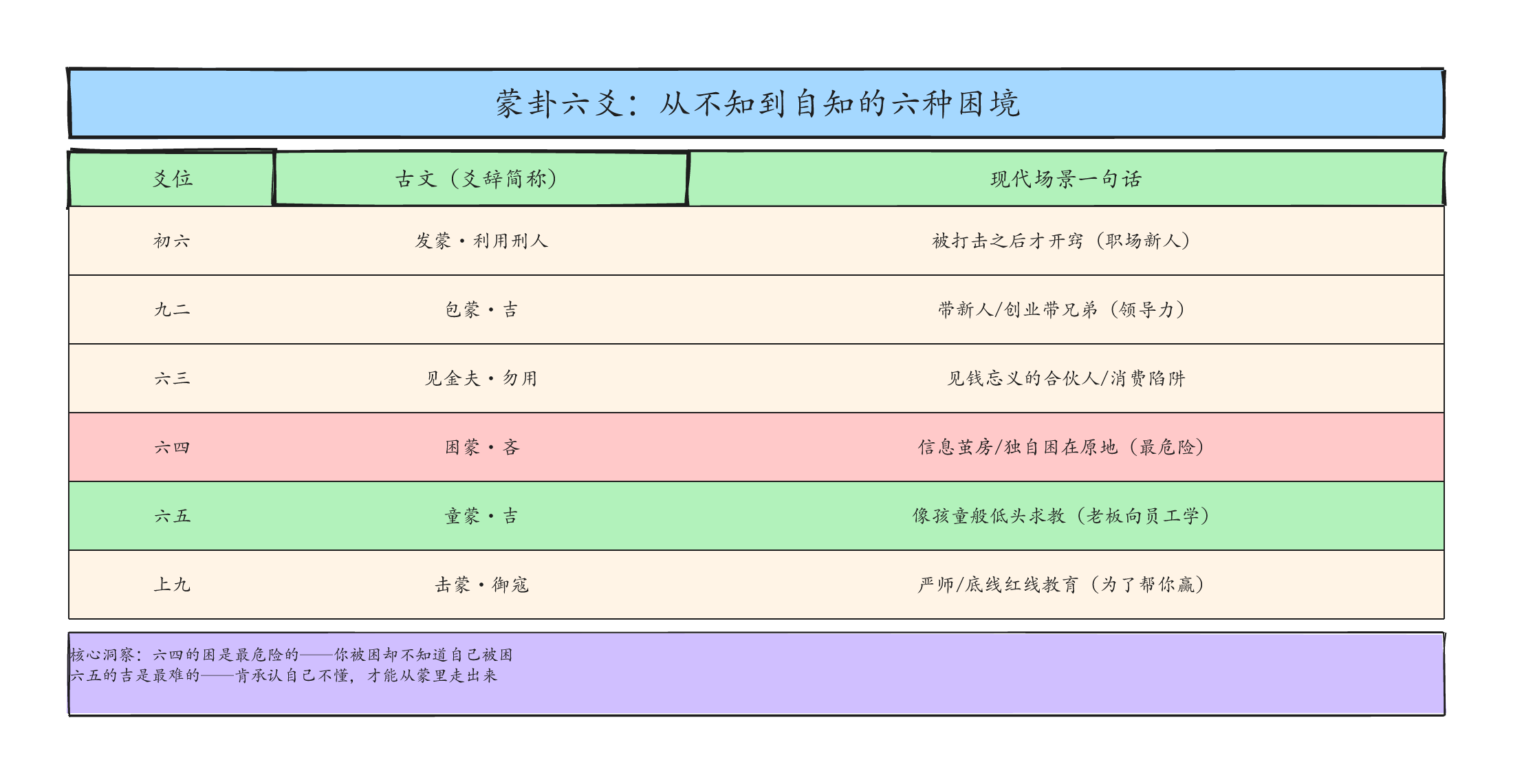
1. First Yin: Fa Meng Li Yong Xing Ren—Enlightenment Through a Sharp Blow
Fa meng, li yong xing ren, yong shuo zhi gu. Yi wang, lin.
At the beginning of enlightenment, establish rules and give a deterrent; but after the deterrent, you must "yong shuo zhi gu"—remove the shackles and let the person walk on their own, not rely on beating forever.
On the winter solstice of the 27th year of Meiji, Takashima Kanko divined the national situation for the following year and obtained the first yin of Meng. At that time, the Qing-Japan War had already begun. In his judgment, he wrote: The ignorant parliamentarians in Japan's Diet, who usually argued and couldn't see the big picture, would suddenly wake up only when the order to fight against Qing was issued and the sword was at their necks. This is "Fa Meng"—using a heavy blow to knock off ignorance.
This history occurred at the national level, but the same script plays out around you every day.
That colleague who says every year he's going to lose weight keeps milk tea on his desk and raises his glass at the year-end party saying, "I'll start tomorrow." Until last year's medical check-up showed moderate fatty liver—the doctor's words, "If you don't move, you'll need medication by 40," hit him hard. The next morning at six, he was running in the neighborhood. A single jolt of pain woke up a decade of procrastination.
The ears of the ignorant often open first through a jolt of pain.
But the Meng hexagram says calmly: "Yi wang, lin." If you think that striking is the entirety of education and that "establishing rules" means "long-term beating," you're wrong. "Yong shuo zhi gu"—after the shock, you must loosen the bonds and let the person walk on their own. For education to work, you must know when to stop.
The first step of enlightenment is not to teach, but to stop.
2. Second Yang: Bao Meng Ji—Being Able to Tolerate a Group of Ignorant People Is True Leadership
Bao meng ji. Na fu ji. Zi ke jia.
Tolerating ignorance is auspicious. Being able to tolerate the ignorance of women and children naturally makes the family prosper.
Japan's "Yi Sage" Takashima Kanko recorded a friend who came to ask about his official career and obtained the second yang of Meng. The second yang is the only "firm and central" line in this hexagram—a yang line in the middle of the lower trigram, connecting below to the first yin (the most ignorant) and above to the fifth yin (the gentle ruler), occupying a very special position. Takashima's core advice was only four words—leniency and strictness with measure.
He told this friend: When you take office, there will inevitably be a group of subordinates who are not on the same wavelength as you. If you start by screening with a strict ruler, those who remain will be pretenders, not doers. What the second yang teaches you is to first "bao" (embrace) the ignorant—not to despise or abandon them, but to give them a pace they can keep up with.
Later, this friend indeed governed with leniency and had a smooth career.
Now, let's move this to today.
Department managers training newcomers often fall into a trap: they dislike newcomers for being too ignorant, too slow, making too many bugs, and wish they could directly replace them with those who "already know." But think back to when you first started—weren't you also that "ignorant person" who gave your seniors headaches? Those who truly build a team are not those who always surround themselves with elites, but those under whom "people who were originally incompetent become competent after a year."
The same goes for the family. Whether a family can have "zi ke jia"—whether the children can take responsibility—often depends not on how strict the parents are, but on whether they are willing to "bao."
Those who can truly move people are not the smartest, but those who can best "embrace" ignorance.
3. Third Yin: Jian Jin Fu Bu You Gong—The Ignorant See Only the Word "Money"
Wu yong qu nü, jian jin fu, bu you gong. Wu you li.
Do not marry such a woman: when she sees a wealthy and powerful man, she loses herself. There is nothing to expect from such a person.
Takashima recorded a divination about a marriage. A parent came to ask whether a marriage for a daughter was feasible. Takashima performed divination and obtained the third yin line, with a very cold judgment: This woman sees profit and forgets herself; marrying her will lead to trouble. Advise against it.
The parent didn't believe it, and the marriage went ahead. Shortly after, as predicted.
The line text seems to talk about marriage, but the true meaning of the third yin in Meng is not about morality, but about cognition. The person who "sees a golden man" is not bad, but ignorant—he/she knows no other measure besides "money." So when someone richer appears, they immediately switch sides, not because they are heartless, but because their cognitive system has only this one variable.
Today, this "third-yin-style ignorance" is most common not in marriage.
It appears in that sister who always asks you to recommend a "million-annual-salary" partner; in that colleague who converts every item into "one Starbucks equals how many LVs"; in that partner who is lured by the words "high return" and invests all savings into a project whose business model is unclear; in that relative who leaves the family group chat for a "rebate big group."
The Meng hexagram does not scold them. It simply says—Wu you li. There is nothing to expect from deep cooperation with such people. Not because they are bad people, but because they haven't been enlightened yet.
The ignorant are most easily blinded by money because they see no other measure besides money.
Forward this to that friend who is always in the "I already understand" state—maybe he is stuck right on this line.
4. Fourth Yin: Kun Meng Zhi Lin—No One Around to Tell You "You Don't Understand"
Kun meng, lin.
Small Image: Kun meng zhi lin, du yuan shi ye.
Note the "shi" in "du yuan shi ye"—it refers to the yang lines, the wise teachers in the Meng hexagram (second yang and top yang). It means: The fourth yin line is sandwiched between four yin lines, with no yang line above or below to provide substantial help. It is far from "shi"—far from those who can truly enlighten it.
Takashima recorded a divination for a noble councilor. This councilor was self-righteous in court affairs, surrounded by peers who shared his views, with no one daring to point out his biases. Takashima obtained the fourth yin of Meng and judged: Like a blind person who cannot see the whole elephant, alone and far from reality. Subsequently, this councilor made consecutive mistakes in policy judgments, fulfilling this "lin" (regret).
Translating "du yuan shi ye" into today's life is one word—information cocoon.
When you open your phone, every piece of content caters to what you already believe; every friend around you says, "You're right"; the colleagues who could give you advice have either resigned or learned to stay silent; when you go home, your partner is too tired to argue, and your children have learned to only report good news.
You think you live in the center of the world.
The Meng hexagram says you live on a lonely island.
The "lin" of the fourth yin is not because this person is dumber than others, but because all feedback mechanisms around him have failed. It's not that he doesn't understand; it's that no one can tell him "you don't understand."
The most可怕 thing about being trapped in ignorance is not not understanding, but having no one around to tell you "you don't understand."
5. Fifth Yin: Tong Meng Ji—Those Willing to Admit They Are Ignorant Go the Farthest
Tong meng, ji.
Small Image: Tong meng zhi ji, shun yi xun ye.
In the entire Zhouyi, there are not many lines that end with a single "ji" (auspicious). The fifth yin is one of them.
Takashima recorded the story of his old friend Fukuhara Jitsukimi. Fukuhara was about to take office as the governor of Okinawa Prefecture and came to Takashima to ask about fortune. Divination yielded Meng transforming into Huan—the original hexagram Meng, the changing hexagram Huan.
Takashima's judgment was the longest in this hexagram. He said: Your nature is gentle, honest, and sincere, exactly matching the virtue of Tong Meng. But Tong Meng is not about ignorance; it's about being willing to admit you don't know. After you take office, the most important thing is not to rush to prove yourself—it's to set aside the governor's airs, select one or two officials who are well-versed in local conditions, and borrow their wisdom to enlighten your own ignorance. This is the correct path of Tong Meng Ji.
Fukuhara later governed Okinawa with leniency and was known for listening to the people, gradually dissipating the accumulated evils of the old administration—this was the fulfillment of the changing hexagram "Huan."
You see, in the entire logical chain of the sixty-fourth hexagram, the deepest wisdom lies not in the fourth yin's "trapped" or the first yin's "strike," but in this line of the fifth yin—willing to admit you are ignorant.
Apply this to today.
That middle-aged manager who refuses to learn new tools from younger colleagues after work—it's not that he can't learn; it's that he can't let go of the "I'm the boss" attitude. Those parents who stubbornly raise children the way they did ten years ago—it's not that they love their children less; it's that they can't admit "my methods are no longer effective." That elder who always argues with you, "I've eaten more salt than you've eaten rice"—it's not that he lacks experience; it's that he treats past experience as today's truth.
Tong Meng is not ignorance; Tong Meng is knowing that you don't know—and then being willing to lower your head and ask the one who knows.
Kun Meng is being trapped without realizing it; Tong Meng is self-awareness that leads to seeking help. One word difference, two realms in one hexagram.
Tong Meng is auspicious because he knows he is ignorant; Kun Meng is regretful because he doesn't know he is ignorant.
If you have a friend who always says "I understand everything" but is actually stuck in ignorance—it's not that he doesn't want to learn; it's that he hasn't realized he should seek.
6. Top Yang: Ji Meng—Sometimes Force Is Necessary, But Not for Venting
Ji meng. Bu li wei kou, li yu kou.
Severely "strike" to break ignorance; but do not act like a robber by actively attacking; use force defensively, like guarding a city.
On the same winter solstice, Takashima also divined another hexagram for the following year's Japan-Britain diplomacy, obtaining Meng transforming into Shi. At that time, Britain was putting continuous pressure on Japan. Takashima judged: "Bu li wei kou"—cannot actively confront head-on; "li yu kou"—gently refuse and keep a respectful distance. Later, Japan indeed did not resist hard and resolved a crisis.
When the Meng hexagram reaches the top yang, the tone shifts. The first five lines all talk about "how to gently enlighten," but at the top yang, it suddenly becomes "how to severely strike ignorance." This is not a contradiction; it's a balance.
Translating this line to today, the most relatable scenario is the moment when parents face their child's first test of boundaries.
A child reaches for a boiling kettle, runs through a red light, touches an electrical socket, or secretly puts a classmate's eraser into their own bag—almost every parent experiences these moments. One type of parent chooses to "reason," squatting down to ask, "Why did you do that?"; another type immediately slaps the child's hand away, with a cold voice that makes the child freeze.
The top yang of Meng speaks to the latter. But it immediately adds a key qualification—Bu li wei kou, li yu kou.
If that slap is because "I've had a tiring day and you're causing trouble again," that's "wei kou"—you're venting your own emotions, and the top yang says no. If that slap is because "the boiling kettle can really peel off a layer of skin, and a red light can really kill," that's "yu kou"—you're helping the child build a defense line that will protect them from disasters outside, and the top yang says yes.
The same applies when a manager faces a subordinate repeatedly making the same basic mistake. First warning, second reminder, third time—you must use force. But the purpose of using force is not to win, not to suppress the person to show your authority; it's to make them understand that "crossing this line is the company's red line," so that they won't make the same mistake elsewhere in the future.
There is only one criterion: Is this strike for your own satisfaction, or for their future ability to avoid greater disasters?
A truly strict teacher doesn't aim to win; they aim to help you win.
Conclusion
Looking back at these 6 stories—
First yin says, sometimes a single blow can knock off ignorance. Second yang says, teaching must be able to "embrace" ignorance. Third yin says, the ignorant are drawn to money; don't force it. Fourth yin says, those trapped in place are because there is no "reality" around them. Fifth yin says, those willing to admit they are ignorant are auspicious. Top yang says, sometimes severity is necessary, but not for venting.
The deepest layer of the Meng hexagram is this line—
Fei wo qiu tong meng, tong meng qiu wo.
It is not the adult who chases the child to learn; it is the child who comes to the adult to teach. It is not the teacher who chases the student to learn; it is the student who comes to the teacher to teach. It is not the sage who chases the ordinary person to awaken; it is the ordinary person who comes to the sage to awaken. It is not others who worry for you every day; it is you who must first admit you don't understand.
Seeking or not seeking determines whether enlightenment can occur. And whether you are willing to admit that you "don't know what you don't know"—that determines whether you can emerge from ignorance.
The Meng hexagram was the first hexagram that moved me when I studied the Yijing—because I myself was once that person who "didn't know what I didn't know."
Choosing the wrong direction at work, misjudging people in relationships, using the wrong force in educating children—what was the last time you realized that "you had been not knowing what you didn't know"? Share in the comments.
If you have a friend who is "stuck in ignorance but unwilling to seek help"—it's not that he doesn't want to learn; it's that he hasn't realized he should seek—forward this article to him.
Click "Watching."
On Thursday night, we'll continue with the second part of "The True Secret of the Five Elements"—the Five Elements are not five things like metal, wood, water, fire, and earth, but a "mode of movement." A common sense misunderstood by modern people for a thousand years.