
YiMatrix · Academy Journal
Are You Being "Generated" or "Controlled" in What You Do? The 5 Pairs of Generation and Control in Five Elements — See Where You're Stuck
You want to push forward but get stuck by "think it through"; you want stability but get disrupted by new opportunities; you want to cut losses but can't let go; you want peace but
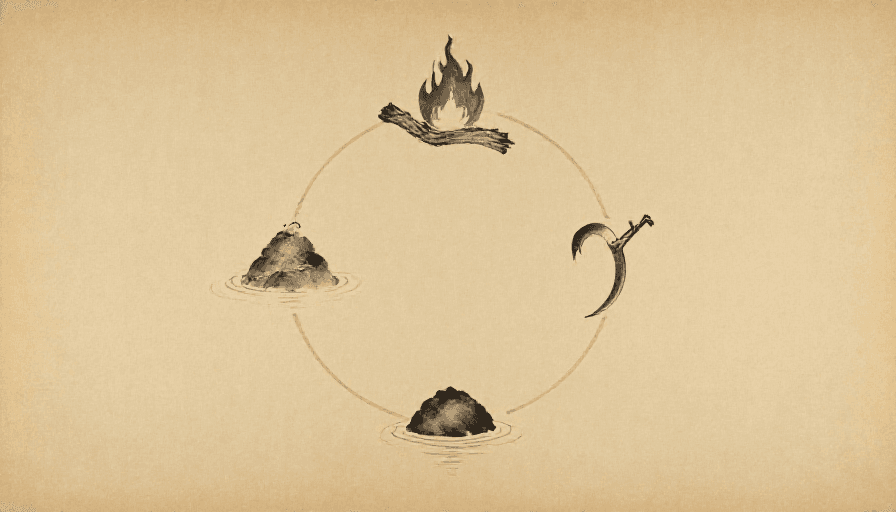
Have you ever experienced this moment—
You want to push forward, just said "I'll start tomorrow," and immediately 7 "risk points to evaluate first" pop into your mind.
You just stabilized your team structure, and your boss says, "Let's open a new business line."
You want some peace and quiet, but everyone is urging you to "deliver plans and results."
It's not that you lack motivation. You're being suppressed by another mode.
This isn't a personality issue. It's the control cycle of the Five Elements.
Control isn't conflict; it's about relationships.
In the previous article, we said the Five Elements aren't five things but five modes of operation. Today, we'll talk about how these five modes interact and counterbalance each other.
The "Hong Fan" Actually Never Mentioned Generation or Control
First, a counterintuitive fact.
The earliest Chinese text that recorded the "Five Elements" is the "Hong Fan" chapter of the "Book of Documents." When it defined the Five Elements, it used only 22 characters: Water soaks and descends; Fire blazes upward; Wood bends and straightens; Metal follows and changes; Earth is for sowing and reaping.
Not a single word about "generation" or "control."
So where did "generation and control" come from?
They were added layer by layer by later scholars—
At the end of the Warring States period, Zou Yan, a Yin-Yang scholar from the state of Qi, proposed the "Five Virtues Cycle." He didn't use the term "control" but "overcoming." "Yu was Earth, Xia was Wood, Yin was Metal, Zhou was Fire"—each dynasty rose by "overcoming" the previous dynasty's element, called "submitting to what one cannot overcome." The "Lüshi Chunqiu" quotes Zou Yan: "What replaces Fire will necessarily be Water." In other words, the dynasty that replaced Zhou (Fire virtue) would inevitably be Water virtue. This was the first politicization of the Five Elements.
In the Western Han, Dong Zhongshu, in his "Spring and Autumn Dew: Generation of the Five Elements," systematized "generation"—arranging the Five Elements in a cross with a center, flowing in a sequence of "father-son succession." Generation thus gained an ethical undertone.
In the Eastern Han, Ban Gu compiled the "Bai Hu Tong Yi: Five Elements," adding physical explanations for each pair of generation and control—Wood generates Fire by "drilling and rubbing," Water controls Fire by "the many overcoming the few." Generation and control now had a "why."
By the Sui dynasty, Xiao Ji, in his "Great Meaning of the Five Elements," gave the final definition of "control": "Control means restraint and correction." Control is not elimination but regulation and rectification.
Generation is not friendship; control is not hatred. It's about position.
Back to the standard order of 5 generation pairs and 5 control pairs—
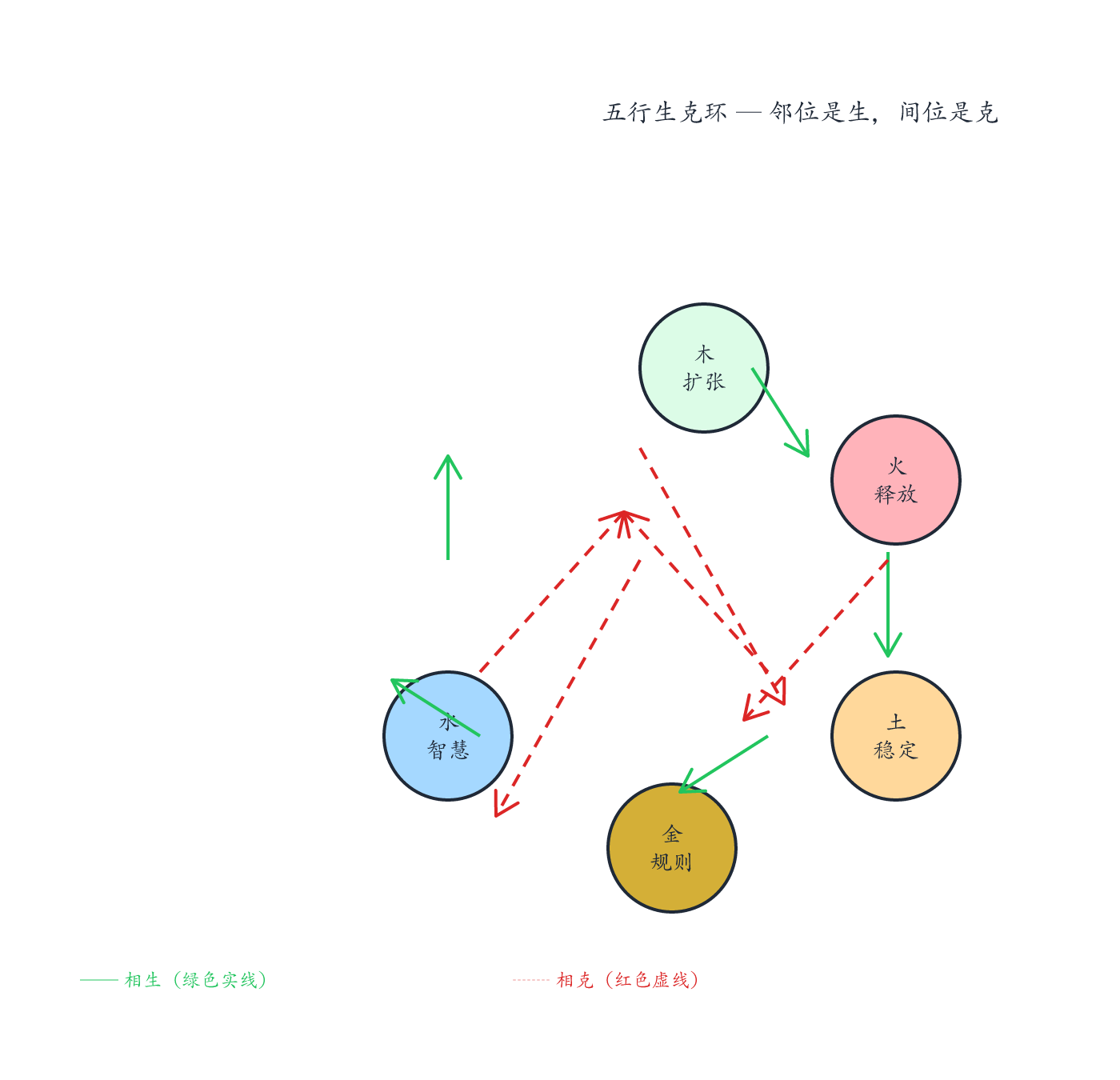
Generation: Wood generates Fire, Fire generates Earth, Earth generates Metal, Metal generates Water, Water generates Wood. One link after another. Control: Wood controls Earth, Earth controls Water, Water controls Fire, Fire controls Metal, Metal controls Wood. Restraint across one position.
90% of people misunderstand this, thinking generation is friendship and control is opposition. But it's actually about something else—position.
Adjacent Generates, One Apart Controls
Arrange these five modes in a circle: Wood → Fire → Earth → Metal → Water → back to Wood.
Dong Zhongshu said in "Spring and Autumn Dew": "The Five Elements are like five officials; adjacent ones generate each other, while those one apart overcome each other." In other words, adjacent means neighboring; one apart means skipping one. Neighbors generate; those separated by one control.
Adjacent pairs generate.
Wood is next to Fire. When Wood expands to its extreme, it begins to release, which is Wood generating Fire. When Fire burns out, it turns to ashes, which is Fire generating Earth. When Earth settles for a long time, it condenses into ore, which is Earth generating Metal. When Metal liquefies into moisture, it generates Water. Water nourishes plants, generating Wood.
Adjacent ones naturally pass on.
Pairs one apart control.
Skip the one in between, and the one across restrains. Metal (convergence) skips Water and restrains Wood (expansion)—when you want to charge, rules hold you back. Wood (expansion) skips Fire and restrains Earth (bearing)—when you want stability, new directions pull you apart. Earth (bearing) skips Metal and restrains Water (hiding)—when you want peace, responsibilities weigh you down. Water (hiding) skips Wood and restrains Fire (release)—when you want to burn, calmness douses you. Fire (release) skips Earth and restrains Metal (convergence)—when you want to cut, emotions stop you.
Xiao Ji added: "Control means restraint and correction." Control is not about eliminating anyone; it's about reaching in from the side to push back when one side becomes excessive.
Generation is going with the flow; control is being interrupted from the side.
5 Scenarios of Being Controlled: Which One Are You Stuck In?
Knowing the logic of position is useless. The key is which one is pressing on you now. Below are 5 scenarios. Find yours.
1. Wood Controlled by Metal — You want to charge, but get stuck by "think it through first"
Scene: Yesterday you promised yourself "I'll start tomorrow." Today you open the document, and 7 "risks to evaluate first" pop up, along with 3 "research for two more weeks," and you haven't typed a single word.
Mechanism: Metal (convergence, rules) reaches in from the side and holds down Wood (expansion, exploration).
How you're stuck: Procrastination, excessive review, always in the "preparation phase." The goals you set on social media every year never get started after three years.
How many days have you been "thinking" about something you should have started?
2. Fire Controlled by Water — You want to light up the room, but can't get hot
Scene: You're on stage, flipping through slides quickly, but everyone in the audience is looking down at their phones. You launched a product three months ago, and the post on your social media got only 4 likes.
Mechanism: Water (hiding, calmness) reaches in from the side and holds down Fire (release, expansion).
How you're stuck: Your expression lacks impact, your passion is doused, and what you create feels like cold leftovers. In a market downturn, everyone is shrinking, and the fire you want to light won't catch.
The thing you want to ignite—is it the market that's failing, or have you already lost the fire inside?
3. Earth Controlled by Wood — You want stability, but get pulled in all directions by new opportunities
Scene: You've just set up the team structure and streamlined HR processes. Your boss walks into the meeting and says, "Let's open a new business line."
Mechanism: Wood (expansion, exploration) reaches in from the side and holds down Earth (bearing, integration).
How you're stuck: Always building new systems, never finishing integration, the organization gets bloated, and what you've accumulated is all half-baked.
Is your "stability" real stability, or is it just that no one has made you stop?
4. Metal Controlled by Fire — You want to cut, but can't bear to let go
Scene: On Monday, you made a list of "projects to cut" with 12 items. By Friday's review meeting, you hadn't cut a single one—"observe for two more months" for this one, "can't lay off the team for emotional reasons" for that one, and "next year" for the rest.
Mechanism: Fire (release, emotion) reaches in from the side and holds down Metal (decision, simplification).
How you're stuck: Reviews become formalities, you always hesitate at the final cut, and rules are set but not enforced.
What's the thing you most need to cut but haven't?
5. Water Controlled by Earth — You want peace, but are crushed by a pile of "must-carry" burdens
Scene: On Monday, you told yourself, "This week I'll sleep early and read two books." By Friday at 1 a.m., you're still revising the 7th version of a proposal, with a presentation at 9 a.m.
Mechanism: Earth (bearing, responsibility) reaches in from the side and holds down Water (hiding, rest).
How you're stuck: Long-term burnout, no time to read, interrupted thinking, body failing before will.
Among the things you "must carry"—how many could you actually put down?
Being controlled doesn't mean someone is harming you; it means you're stuck in the wrong position.
Three Questions to Find Your Place
After reading the 5 scenarios above, you've probably identified one in your mind. Take it a step further and ask yourself three questions.
First — What mode are you primarily in right now?
Don't overthink. Pick the type of thing you've been doing most in the past month or two—charging (Wood)? burning (Fire)? stabilizing (Earth)? cutting (Metal)? hiding (Water)? Choose one.
After identifying your current mode, go deeper—
Second — Which mode is controlling you?
Reverse-engineer from the 5 control pairs above: If you're Wood, Metal controls you; if Fire, Water; if Earth, Wood; if Metal, Fire; if Water, Earth. The opposing force that always makes you "can't go on" is likely that one.
Once you know who's controlling you, the key is—
Third — Which mode do you need to switch to?
Two paths. One is to follow the direction of generation—Wood → Fire → Earth → Metal → Water → back to Wood. When it's time to burn, burn and then settle; when it's time to settle, settle and then simplify. The other is to stop first and wait for the controlling mode to pass—if the market downturn (Water) is suppressing your Fire, charging hard won't work. Switch to Earth (build product moats) first, and when the Water passes, the Fire will naturally rise.
A common scenario—In the past two years, many entrepreneurs have been stuck on "Fire controlled by Water": wanting to create a hit, but the consumer downturn has everyone pinned down. The more anxious they get, the less fire they have; the less fire, the more anxious. The way out isn't to burn more money on a second round but to return to Earth, solidify the product line that's been validated into a moat, and wait for the Water to pass (market recovery). Then the Fire will naturally ignite.
The five modes are neither good nor bad; the five controls are neither right nor wrong. The mistake is standing in the wrong position.
Final Thoughts
As I crossed the third threshold in learning the Yi, I realized I had overcome another—jumping out of the belief that "generation and control are superstition." The first threshold was realizing Yin and Yang aren't opposites; the second was realizing the Five Elements aren't five things; the third was realizing generation and control aren't about good or bad but about position.
Comment with one word—which mode is controlling you right now? Wood / Fire / Earth / Metal / Water. Just one word.
This is the second article in the Five Elements series. The third article will be published on Sunday at 22:30—we'll talk about practical application: how to use the five modes to plan your "switch roadmap" for the year, when to follow generation, when to avoid control, and when to use "mediation" to turn control into generation. Follow to not miss it.
For that friend who always complains, "So-and-so and I have incompatible Eight Characters"—forward this article to them. Let them know that what's stuck isn't their Eight Characters but that they happen to be standing in the "control position" of the Five Elements. It's the same kind of problem you're stuck in. Change positions, and the relationship will naturally smooth out.
Generation and control aren't about superstition. They're about what pushes you and what blocks you during the 16 hours you're awake every day.