
YiMatrix · Academy Journal
The Eight Trigrams Are Not Divination, but Binary — Leibniz Understood Fuxi's Diagram 24 Years Later
On April 1, 1703, Leibniz received Fuxi's Sixty Four Hexagrams Sequence Diagram and was astonished to find that the yin and yang symbols in the trigrams perfectly corresponded to t
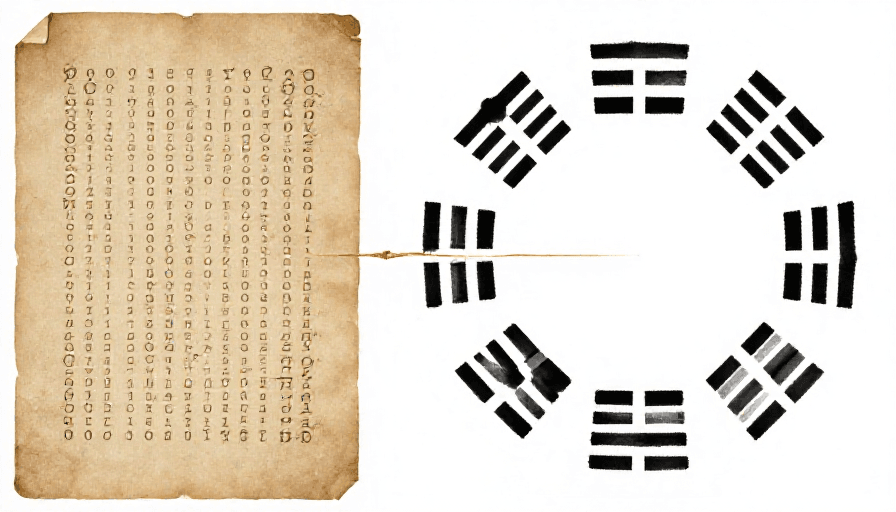
On April 1, 1703, in Hanover.
Leibniz opened a letter that had traveled from Beijing. The sender was the French missionary Joachim Bouvet. Inside the envelope lay a diagram — Fuxi's Sixty-Four Hexagrams Sequence Diagram.
He stared at the diagram for a few minutes, then did something he would spend the rest of his life explaining.
Next to the hexagram diagram, he wrote down 0s and 1s, line by line.
In a three-thousand-year-old Chinese diagram, he saw his own invention from 24 years earlier.
Many people start telling the story here — "Leibniz invented binary from the Eight Trigrams."
That's not true.
In March 1679, in Hanover. Leibniz wrote a manuscript at his desk in Latin, titled De Progressione Dyadica (On the Binary Progression). This is the earliest definition of binary in Western mathematics. That year, he had never seen any Chinese trigram diagram, and the manuscript contained no trace of Eastern philosophy.
A full 22 years later, on November 4, 1701, Bouvet sent the Fuxi diagram from Beijing. After another 17 months of transit, on April 1, 1703, Leibniz finally opened it.
That is, he invented binary first, and 24 years later saw the Fuxi diagram. He did not "learn binary from the Eight Trigrams"; he "used the binary he had already invented to understand the Eight Trigrams in retrospect."
And this is a hundred times more震撼 than "the Chinese taught Leibniz."
Two civilizations, six thousand kilometers apart, three thousand years apart, independently arrived at the same mathematical structure.
This is not a coincidence. This is the common underlying layer of human thought.
Let me pause here.
I know you might be starting to drift, thinking "What does this have to do with me?"
Let's change the approach. You don't need to calculate, check a calendar, or use an abacus. Just look at how you're doing things today —
The top layer is the side you show to the outside world. Dominant and leading, or gentle and yielding? Dominant is yang, yielding is yin.
The middle layer is the inner motivation you truly feel. Eager to charge forward, or passively waiting? Charging is yang, waiting is yin.
The bottom layer is your physical energy right now. Full of vitality, or drained to empty? Full is yang, drained is yin.
Three layers, each with only two options. You have already positioned yourself in one of 8 states.
All three yang, you are Qian today. All three yin, you are Kun today. Mixed layers, you are one of the other 6 trigrams.
This is not divination — it's encoding you into an 8-dimensional state space.
Below is the math that makes this clear.
The oldest source of Chinese philosophy, The Great Treatise (Xici, Part I, Chapter 11), contains 16 characters:
In the Changes, there is the Great Ultimate, which generates the two modes. The two modes generate the four images. The four images generate the eight trigrams.
In plain language: From a chaotic unity (Great Ultimate), it splits into 2 states (yin and yang). These 2 states each split into 4 (Greater Yang, Greater Yin, Lesser Yang, Lesser Yin). The 4, with one more line, become 8.
Notice the sequence: 1 → 2 → 4 → 8.
Each step multiplies by 2. Each step adds one more line. Yin line is 0, yang line is 1. One line gives two states, two lines give 2 × 2 = 4, three lines give 2 × 2 × 2 = 8.
The person who wrote these 16 characters didn't know how to write "binary" — but what he wrote was binary.
What do the 8 trigrams actually look like?
In Shuo Gua Zhuan (Commentary on the Trigrams), Chapter 3, there are 8 sentences, one per trigram:
Qian is Heaven. All three lines are solid — 111. It is heaven, strength, the pole of fullest yang.
Kun is Earth. All three lines are broken — 000. It is earth, docility, the soil that bears all things.
Zhen is Thunder. The bottom line is yang, the top two are yin. It is thunder, movement, energy bursting from below.
Xun is Wind. The bottom line is yin, the top two are yang. It is wind, penetration, the permeation that enters every crack.
Kan is Water. The middle line is yang, the top and bottom are yin. It is water, danger, the state of calm surface with a deep abyss below.
Li is Fire. The middle line is yin, the top and bottom are yang. It is fire, radiance, the brightness that depends on something else.
Gen is Mountain. The top line is yang, the bottom two are yin. It is mountain, stillness, the force of stable immobility.
Dui is Lake. The top line is yin, the bottom two are yang. It is lake, joy, the openness and reflection after vapor rises.
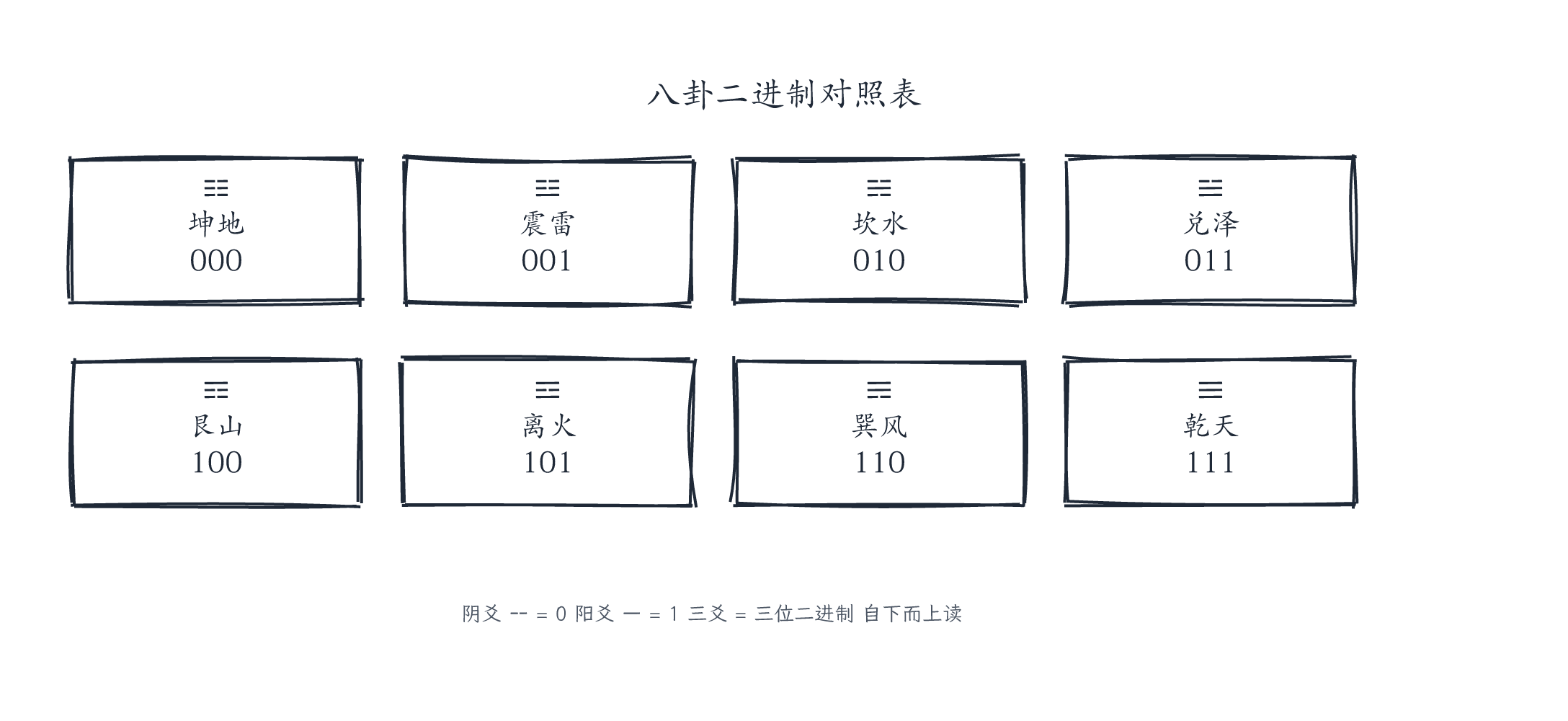
8 symbols, corresponding to 8 basic states. Heaven / Earth / Thunder / Wind / Water / Fire / Mountain / Lake — these are not 8 objects, but 8 fundamental attributes into which all things in the world can be categorized.
In Xici, Part II, Chapter 2, there is a sentence that says it most clearly:
To categorize the myriad things.
To classify and encode all things in the world.
Back to the moment Leibniz opened that letter.
What truly shocked him was not "the Chinese were earlier than me." He made it clear in his paper — he didn't care about chronological priority. What made him restless was something else:
A broken yin line can be read as 0. A solid yang line can be read as 1. Grouped in threes, the 64 hexagrams progress neatly from pure yin at the bottom to pure yang at the top, perfectly matching the symbolic system he had written in Latin in his Hanover study over twenty years earlier.
A 17th-century European mathematician and a legendary Chinese figure who drew the Eight Trigrams three thousand years ago, never met, never read a single word of each other, yet arrived at the exact same structure at the most abstract level.
This means binary is not an invention of any one nation. It is the same answer that the universe leaves for all sufficiently curious species.
We who write code today, and they who drew lines three thousand years ago, are essentially the same kind of creature.
The Eight Trigrams are not superstition. They are the earliest information encoding by ancient Chinese. Using the fewest symbols — two (yin and yang) — to express the most states — 8. Add one more layer, and it becomes 64.
Not fortune-telling. It's an algorithm.
I am Nanhuang, posting three times a week, using modern eyes to understand the system left by the ancients.
If you have friends who studied computer science but never seriously read the I Ching, forward this to them. After reading, they will realize that the if-else they write every day was drawn in a diagram three thousand years ago.
Next time, we will talk about what the 8 states of the Eight Trigrams correspond to in your life's 8 situations.
Are you in Qian or Kun right now? See you Thursday at 22:30.
Like and follow Bugua — we continue next Wednesday.