
YiMatrix · Academy Journal
Are You the Qian Hexagram or the Kun Hexagram? The Ancients Classified the World with 8 Symbols—3-Minute Self-Test
At 8 a.m., on the subway. You stand in the corner of the carriage, staring at your phone. There's a meeting today, and your boss wants you to make a decision. You know exactly whic
At 8 a.m., on the subway.
You stand in the corner of the carriage, staring at your phone. There's a meeting today, and your boss wants you to make a decision.
You know exactly which plan you want to push—but the colleague sitting across from you just posted the PPT of another plan in the group chat. In just a few sentences, your direction wavers.
You hesitate. Should you follow the boss's hint from yesterday, or put forward your own plan? Push or hold back? Speak up or listen first?
Three thousand years ago, the Chinese gave this moment a name.
They said you are now stuck between the Qian hexagram and the Kun hexagram.
It's not fortune-telling. It's about precisely placing "what state you are in at this moment" into a catalog.
Many people, upon hearing "Qian hexagram" or "Kun hexagram," immediately think of fortune-telling stalls: drawing lots, shaking coins, calculating love life.
No.
The Eight Trigrams were never 8 cards for divination from the start. They were the ancients' way of classifying the entire world using the fewest symbols.
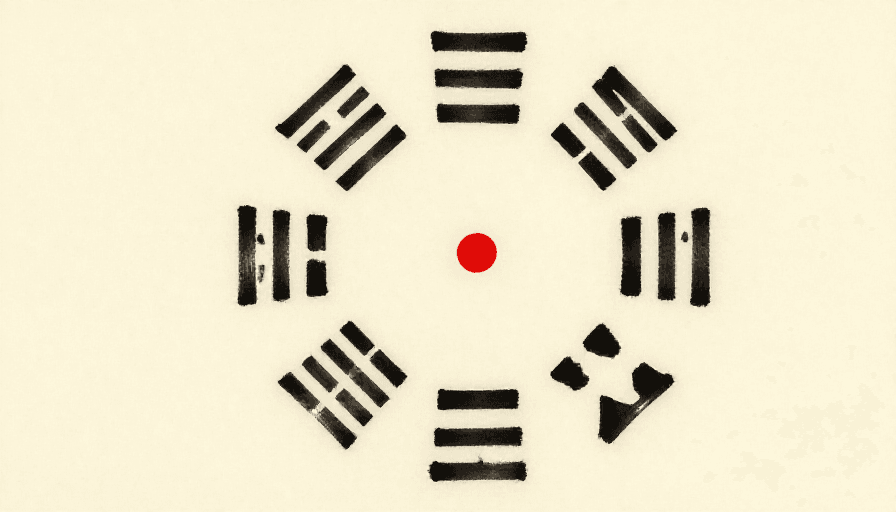
One yin line, one yang line, stacked three layers, yields exactly 8 different combinations. Each combination represents a basic attribute: strength, compliance, movement, penetration, danger, attachment, stillness, and joy. Any event or state in the world can find its place among these 8 attributes.
In Chapter 2 of the "Xici II" of the Zhouyi, there is a direct statement:
To classify the myriad things.
Meaning: to categorize and encode all things in the world, giving every "condition" a home.
This is something the Chinese did as early as the pre-Qin period—building a catalog for the universe. It follows the same path as today's library classification systems or biological taxonomy: using limited labels to cover infinite objects.
The difference is that the West did this with tens of millions of books, while the Chinese used only 8 symbols.
Not 8 divination cards. 8 state classifications.
8 Symbols, 8 States
In Chapter 7 of the "Shuogua" of the Zhouyi, only 8 words capture the core of these 8 states:
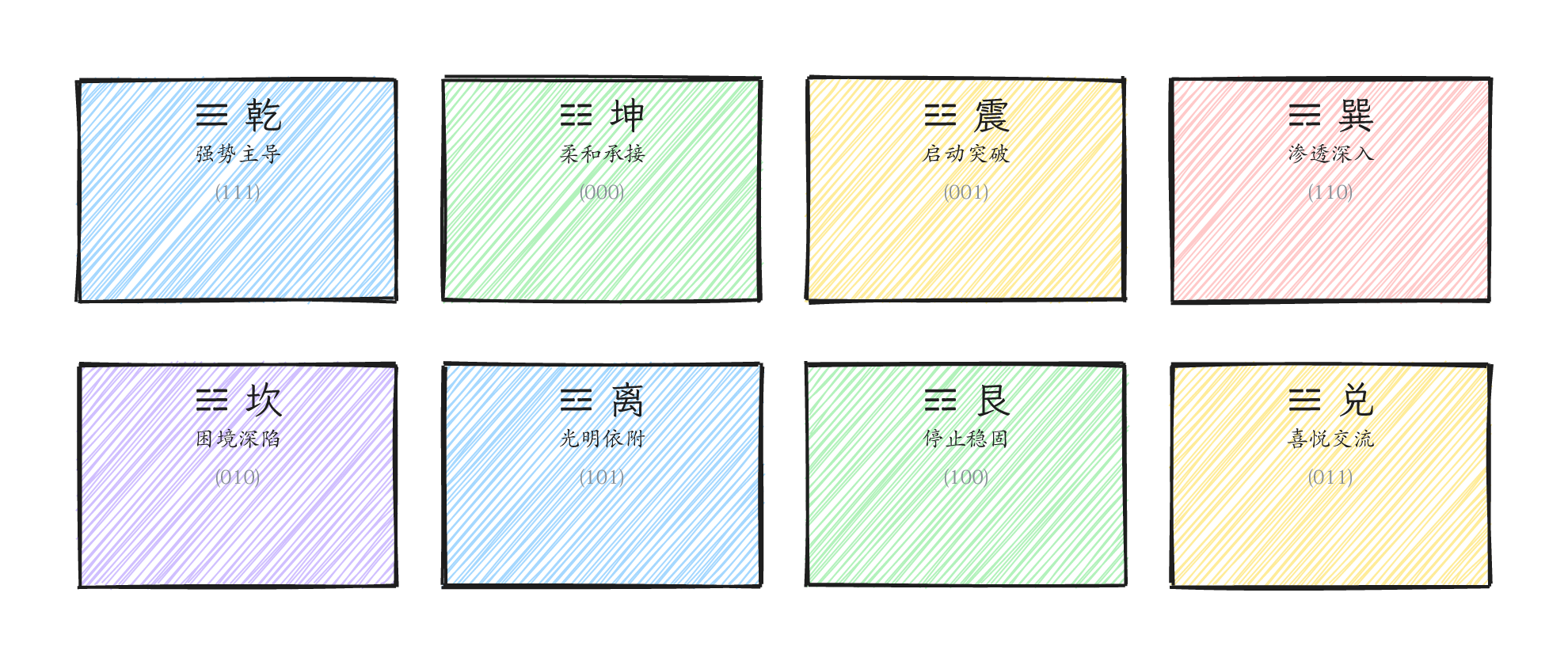
Qian, strength; Kun, compliance; Zhen, movement; Xun, penetration; Kan, danger; Li, attachment; Gen, stillness; Dui, joy.
One hexagram, one word. Strength, compliance, movement, penetration, danger, attachment, stillness, joy. Below is an expanded view of these 8 states—read along and see which one you resemble today.
Qian for Heaven — Strong and Dominant. Three yang lines, 111.
You drive the pace throughout, make decisions without hesitation, and have overflowing energy.
Someone in their first year of entrepreneurship. Someone who makes decisions immediately with a plan in hand. Someone who knew which project to take on as soon as they opened their eyes this morning.
Kun for Earth — Soft and Receptive. Three yin lines, 000.
You are not weak; you steadily absorb all pressure without resistance or confrontation, growing thicker the more you bear.
A senior colleague mentoring newcomers. The person at home who holds everyone's emotions. Someone who chooses to "listen to the boss first" today.
Zhen for Thunder — Initiation and Breakthrough. The bottom line is yang, the top two are yin, 001.
Pushed by something, something long suppressed suddenly erupts. Energy rises from below, unnoticed by others.
Someone who suddenly quits to pursue their own thing. Someone with a new idea and decides to try it. Someone ready to present their plan at today's meeting.
Xun for Wind — Penetration and Depth. The bottom line is yin, the top two are yang, 110.
Not confronting head-on, but penetrating everywhere. You work like wind—slow to enter, but every gap is traversed.
Someone who doesn't interrupt but is remembered every time they speak. A salesperson who lands a big client after three years. Someone planning to have a private chat with key people today.
Kan for Water — Danger and Entrapment. The middle line is yang, the top and bottom are yin, 010.
Calm on the surface, but with an abyss inside. You seem stable, but your mind is burdened, energy trapped and unable to escape.
Someone working overtime continuously with no results. Someone enduring a stuck relationship. Someone at the meeting today but preoccupied with other matters.
Li for Fire — Attachment and Radiance. The middle line is yin, the top and bottom are yang, 101.
Not a light source yourself, but able to shine by borrowing power. Attached to the right person, platform, or timing to reflect yourself.
Someone achieving results by following the right boss. Someone seen through a good platform. Someone ready to attribute their success to the leader's vision today.
Gen for Mountain — Stillness and Stability. The top line is yang, the bottom two are yin, 100.
Not giving up, but stopping when needed. Still like a mountain, standing firm. Knowing where to hold back.
Someone who decisively rejects a project. Someone who says "this is where it ends" in a relationship. Someone who decides "not to speak today, observe first."
Dui for Lake — Joy and Communication. The top line is yin, the bottom two are yang, 011.
Abundant energy, expressed openly, revealing what's inside. Not hiding or suppressing, like the reflection and openness after water vapor rises.
Someone who first lifts the mood at a gathering. A project manager who talks about team matters. Someone ready to proactively present their plan today.
By now, you've probably circled one or two hexagrams in your mind.
The ancients weren't telling your fortune. They were modeling you.
3 Minutes to See Which Hexagram You Are Today
Don't check the almanac or use an abacus. Just look at your state of doing things today—
The top layer is the side you show to the outside.
Are you strong and dominant or soft and compliant today? In the meeting, are you the one who pushes the plan through, or the one who receives others' plans? Strong is yang, compliant is yin.
The middle layer is the motivation you truly want inside.
Are you actively charging forward or passively waiting today? Is your inner self urging you to move forward, or are you waiting for someone, some news, or some timing? Charging is yang, waiting is yin.
The bottom layer is your physical energy at this moment.
Are you full of energy or drained to empty today? Are you full of vigor, or just holding on? Full is yang, drained is yin.
Three layers, each with only two options. Combined, you are positioned in one of the 8 states.
All three yang, you are Qian today. All three yin, you are Kun today. Mixed, you are one of the other six hexagrams—top yang, middle yin, bottom yang is Li; top yin, middle yang, bottom yin is Kan; top yang, bottom yin is Gen; bottom yang, top yin is Zhen... Refer to the earlier table of 8 hexagrams to find your position.
Please tell me in your mind which hexagram you are today.
After positioning, you don't need to do anything else, nor check for good or bad fortune. You've just framed your state today with a label that has existed for three thousand years.
This action is ten times more important than "fortune-telling." Fortune-telling seeks answers; classification seeks position.
Answers expire; positions do not.
Tomorrow, you'll switch to another hexagram and frame it again.
You are not fortune-telling. You are labeling your own state.
Why Can 8 Symbols Contain the Entire World?
By now, you might ask: Heaven, Earth, Thunder, Wind, Water, Fire, Mountain, Lake—how can the ancients fit everything in the world with just these 8 things?
The answer lies in the four words "taking images and comparing categories."
"Image" is not 8 objects. It's 8 attributes.
Heaven's attribute is strength—vigorous, active, advancing. Matters unrelated to the word "heaven" itself, as long as their attribute is "strength," belong to Qian. An entrepreneur pushing a project, an athlete sprinting at full speed, a boss making a decisive decision—all belong to Qian.
Water's attribute is danger—calm, downward, with an abyss. Matters unrelated to "water," as long as their attribute is "danger," belong to Kan. A stuck relationship, a trapped project, someone smiling while sinking inside—all belong to Kan.
"Comparison" is to match and classify all things according to these 8 attributes. Look at the core attribute of a matter and place it in the corresponding hexagram.
This is the earliest ontological modeling in human history.
In 1735, the Swede Linnaeus published a booklet called Systema Naturae. He drew a classification tree for living things on Earth, from the largest "kingdom" down to the smallest "species." This system was later expanded to include hundreds of thousands of known plants and animals.
Three thousand years ago, the Chinese used two elements—yin and yang—stacked in three layers to divide all things into 8 categories.
One uses multi-layered labels branching downward; the other uses 3-layer symbols covering upward. But the idea is exactly the same—
The programmer classifying files today and the Chinese classifying all things three thousand years ago are doing the same thing.
Using the fewest dimensions to cover the most reality.
Not superstition. It's modeling.
Three thousand years ago, the Chinese used 8 symbols to issue an ID card for all things in the world. When you can use one hexagram to clearly describe who you are at this moment, you have learned to observe yourself earlier than 99% of people.