
YiMatrix · Academy Journal
Not Enough with 8 Trigrams? The Ancients Used One Rule to Generate 64 Situations—Which Hexagram Are You Stuck In?
Three thousand years ago, the Chinese encoded this 'indescribable' feeling into 64 labels. Eight symbols, paired in twos, evolved into 64 situations. Not divination—modeling.
Sunday evening, you sit at your desk, staring at the screen.
A project has been pushed for thirty days. It seems to move every day—meetings, plan revisions, progress alignment—but deep down, you know it's not moving forward.
You can't quite say where it's stuck. It's not a lack of people, money, or plans. You try to explain it to a friend, but halfway through, you lose track yourself.
All that's left is one sentence: "Something just feels off."
Three thousand years ago, the Chinese encoded this "indescribable" feeling into 64 labels.
Each one has a name.
Many people think the Eight Trigrams are just those 8 things—Heaven, Earth, Thunder, Wind, Water, Fire, Mountain, Lake.
Not enough.
Eight trigrams are just 8 basic attributes. But what you face at this moment isn't as simple as "what I am"; it's more about "what I (inner) am encountering (outer)."
You are internally full and eager to push, but the external world keeps receiving you—that's one situation. You are internally waiting and listening, while the external world is fiercely pushing you—that's another situation.
8 inner × 8 outer = 64 "inner-outer combinations" to capture your situation at this moment.
In Chapter 11 of the Xici Shangzhuan (Commentary on the Appended Phrases, Part 1) of the Zhouyi (Book of Changes), there is a key sentence:
Yi has Tai Ji, which gives rise to Two Yi. Two Yi give rise to Four Xiang. Four Xiang give rise to Eight Trigrams.
This means: from a single chaos, two emerge; two give rise to four; four give rise to eight.
But behind these 16 characters, there is an unwritten rule—pairing in twos.
Take the eight already derived, and superimpose them in pairs. From 8 to 64.
8 is not the end. It's the beginning.
Deriving Hexagrams: How 8 Becomes 64
This process of evolving from 1 to 64 is called deriving hexagrams.
It's not starting from scratch or inventing new symbols. The ancients only had two things—Yin Yao (broken line, 0) and Yang Yao (solid line, 1)—and did one thing:
Add one Yao at each step.
1 → 2 (add one Yao) → 4 (add another) → 8 (add another) = three-Yao Eight Trigrams.
Continue with the same rule—on the basis of three-Yao trigrams, add three more Yao (total six Yao), and you get 2 × 2 × 2 × 2 × 2 × 2 = 64.
Alternatively: 8 three-Yao trigrams, paired in twos, 8 × 8 = 64.
Each of the 64 hexagrams is a six-Yao hexagram formed by stacking two three-Yao trigrams.
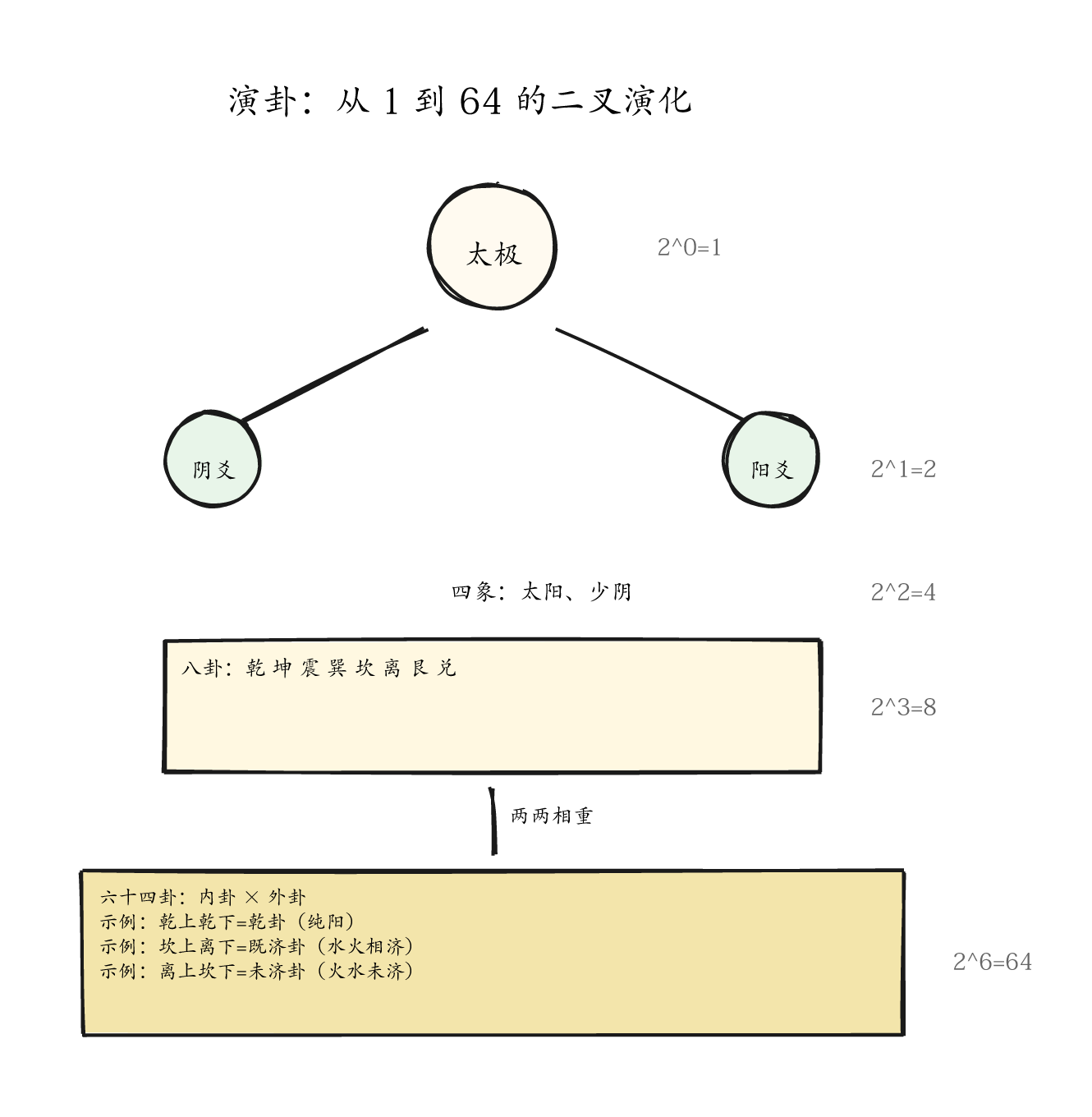
This is not a divination rule; it's the earliest recursive algorithm in ancient China. Three thousand years ago, they didn't write the word "algorithm," but what they wrote is exactly that.
At this point, you might ask a question—
64 hexagrams—just hearing the number is overwhelming. How did the ancients use them?
They actually provided two coordinate systems.
One is called Xiantian Bagua (Earlier Heaven Trigrams). Legend has it that Fu Xi drew them. Chapter 3 of the Shuogua Zhuan (Commentary on the Trigrams) summarizes them in eight characters:
Heaven and Earth fix positions; Mountain and Lake interpenetrate.
It describes the structural relationships among the 8 attributes—who opposes whom, who pairs with whom. Qian (Heaven) pairs with Kun (Earth), Kan (Water) with Li (Fire), Zhen (Thunder) with Xun (Wind), Gen (Mountain) with Dui (Lake)—four pairs of opposing forces build the world.
This system explains why the world can be constructed.
The other is called Houtian Bagua (Later Heaven Trigrams). Legend has it that King Wen of Zhou derived them, arranged according to the cycle of the four seasons—Zhen (East, spring growth), Li (South, summer brightness), Dui (West, autumn harvest), Kan (North, winter storage).
This system explains how the world moves.
A modern summary captures their division of labor:
Xiantian determines numbers; Houtian determines directions.
Neither is right or wrong; they have different roles. One focuses on structure, the other on flow. Almost all subsequent divination, Feng Shui, and Qimen use Houtian Bagua—because in reality, you don't need to know "why the universe is this way," but "where should I go now."
No matter which coordinate system you use, the question always comes back to that rule—how 8 evolves into 64.
Zhu Xi of the Song Dynasty, in his Zhouyi Benyi (Original Meaning of the Zhouyi), stated a rule for drawing hexagrams: First draw the inner trigram, then draw the outer trigram.
Translation:
- The lower three-Yao trigram = Inner Trigram = your internal state (subject, mindset, motivation)
- The upper three-Yao trigram = Outer Trigram = the external environment you face (object, pressure, resources)
Inner trigram + outer trigram stacked = a 64 hexagram.
These two positions cannot be swapped.
Take a classic pair for comparison—
Tai Hexagram (Hexagram 11): Outer trigram is Kun (Earth), inner trigram is Qian (Heaven).
Heaven's attribute is to push upward; Earth's attribute is to sink downward. One goes up, one goes down—they move toward each other—intersecting and connecting.
Meaning: Your inner energy is full and ready to push (Qian), and the external environment steadily receives you (Kun). You and the world are aligned in direction. This is a smooth, favorable situation.
Pi Hexagram (Hexagram 12): Outer trigram is Qian (Heaven), inner trigram is Kun (Earth).
Notice—the same two three-Yao trigrams, but their positions are swapped.
Heaven still flies upward; Earth still sinks downward. But this time, Heaven is above and Earth below—they go in opposite directions, not intersecting.
Meaning: Your inner state is receptive and waiting (Kun), but the external environment is pressing and pushing (Qian). The directions don't match. This is a blocked, obstructed situation.
Exactly the same two trigrams, but swapping positions reverses the meaning.
This is why 8 is not enough, and 64 is sufficient—
What you have in hand doesn't matter; what matters is whether the inner and outer align.
So why 64, not 50 or 100?
Because 3 Yao divides into 8 types, and 6 Yao exactly divides into 64 types. Not more, not less.
3 Yao is too few to cover life. 12 Yao is too many, making each type too specific to be meaningful.
6 Yao = two layers = inner and outer aspects = the design of "upper and lower trigrams facing each other" as the ancients described. This is not a coincidence; it's a design.
Three Steps to Locate Which Hexagram You Are In Right Now
Now that we've covered the theory, let's apply it in three steps.
No need to check the perpetual calendar or use an abacus—just look at your state over the past 30 days—
Step 1: What is your current "Inner Trigram"?
The inner trigram describes your internal state—what engine is running inside you.
If you've been pushing hard on something, making decisions without hesitation, and your energy is overflowing—your inner trigram is Qian (three Yang).
If you've been receiving, supporting, and holding things together, not resisting or confronting, but becoming thicker with each load—your inner trigram is Kun (three Yin).
If you've been trapped in a situation, calm on the surface but with a deep abyss inside, and things are stuck—your inner trigram is Kan (Pit).
If you've been holding back and suddenly want to move, a new idea emerges and you want to try it, energy surges from below—your inner trigram is Zhen (Movement).
There are four more—Xun (Penetration), Li (Attachment), Gen (Stopping), Dui (Openness). The previous article "Bagua #2" provided a complete comparison of the 8 states; if you don't match, go back and check.
What is your current inner trigram?
Step 2: What is your current "Outer Trigram"?
The outer trigram describes the environment you face—what is happening in the field where your matter resides.
If the external environment has been pushing and pressing hard on you, and the rhythm is not under your control—your outer trigram is Qian (External Pressure).
If the external environment steadily receives you, giving you space, resources are in place, and timing is waiting for you—your outer trigram is Kun (External Support).
If the external environment is full of obstacles, every step encounters a ditch, a pit, or unpredictable variables—your outer trigram is Kan (External Danger).
If the external environment is bright and clear, the path is visible, and key people and resources are on the surface—your outer trigram is Li (External Clarity).
For the remaining four, refer to "Bagua #2" accordingly.
What is your current outer trigram?
The inner trigram is the you that you know; the outer trigram is the world you see.
Step 3: Stack them = Which Hexagram?
Place the inner trigram from Step 1 below and the outer trigram from Step 2 above—you get a 64 hexagram.
No need to check the full table; just see whether the upper and lower trigrams are matching, conflicting, or misaligned.
- Inner Qian, Outer Kun = Tai: You want to push; the other side can receive. Smooth.
- Inner Kun, Outer Qian = Pi: You are already waiting; the other side is still pressing. Blocked.
- Inner Zhen, Outer Kan = Zhun: You just got motivation; the external is full of danger. Difficult start. This is the prototype of "all beginnings are hard" in Hexagram 3 of the Zhouyi.
- Inner Xun, Outer Kun = Sheng: You are slowly penetrating; the external is thick and receptive. Step by step upward.
- Inner Kan, Outer Li = Wei Ji: You are trapped in difficulty; the external is bright and visible—one step away from completion. This is the last hexagram of the Zhouyi, telling you that things are not over.
Five hexagrams, five most common situations. You likely fall into one of them at this moment.
Knowing which hexagram you are in is not to resign to fate, but to know where to go next.
If it's Tai, stabilize the rhythm and don't change tactics. If it's Pi, stop first and adjust internally; don't charge ahead. If it's Zhun, external obstacles are real; first take root. If it's Sheng, slow is fast; don't rush to accelerate. If it's Wei Ji, the last step is often not outside, but inside your own heart.
Connecting the Three Articles
This is the last article of the Bagua trilogy.
The first article discussed that Bagua is the earliest binary system in ancient China—encoding. The second article discussed that 8 symbols assigned 8 attributes to all things—taking images. The third article discusses that 8 paired in twos evolves into 64—combination.
Encoding + taking images + combination = the three-layer foundation of this system in the hands of the ancients.
In Chapter 2 of the Xici Xiazhuan (Commentary on the Appended Phrases, Part 2) of the Zhouyi, the passage about Fu Xi creating the trigrams says it most directly:
To categorize the conditions of all things.
To encode all "conditions"—states, situations, relationships—of all things in the world by category, so that each has its place.
8 basic categories, 64 combined categories. From Tai Ji to 64 hexagrams, this is the source code the ancients wrote for the world 3,000 years ago.
8 symbols, evolved into 64 situations.
It's not that the ancients had too many; it's that the world they saw was more structured than we imagine.
The next time you're stuck, first ask yourself—which hexagram of the 64 am I in?